
WesRFC and Food Justice Advocate Jocelyn Cerda Talks University Dining, Small-Scale Farms, and Hartford’s Growing Food Insecurity
Despite being the capital of Connecticut, Hartford is one of the state’s most striking examples of food apartheid, a system of segregation that restricts access to nutritious, affordable foods in low-income, Black, and Indigenous communities. According to Feeding America, a nationwide network of food pantries, as much as 24.6% of Hartford residents face barriers to food access.
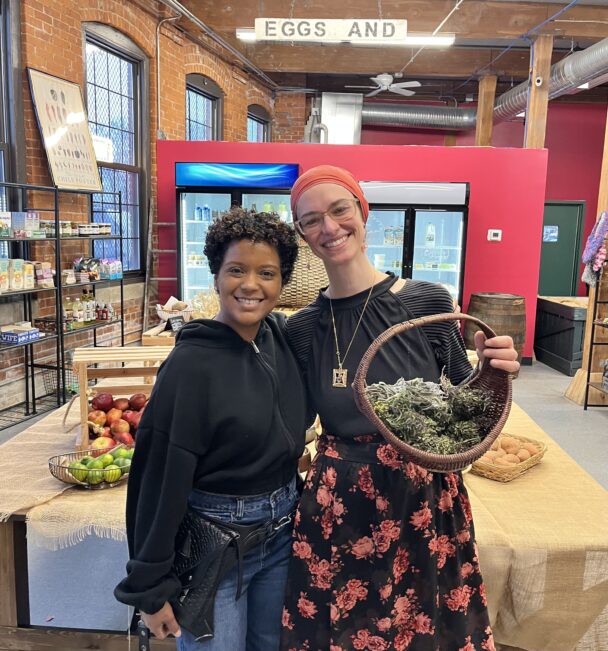
Jocelyn Cerda, a grocer and food justice advocate, is tackling the inequities embedded in Hartford’s food system and bridging the gap between the city’s residents and food producers.
Cerda visited the University on Friday, Feb. 21, to promote and discuss Mercado Popular, the grocery store she established to address the city’s increasing food insecurity in 2021. Cerda was invited to campus by the University’s prospective chapter of the Real Food Challenge (WesRFC), the Sustainability Office, the Resource Center, and Rooted Solidarity.
In the most recently passed biennium state budget, Connecticut legislators attributed $9 million to food pantries, spread across two years; this was a marked increase in funding for pantries from the past year. However, the state funding came just as the budget reconciliation bill slashed funds for food assistance programs like the Supplemental Nutrition Assistance Program last year, and the demand Hartford pantries faced reached pandemic levels.
Real Food Challenge is a national organization empowering college students to advocate for the creation of food systems that prioritize the needs of local, smaller farms, rather than large grocery chains. According to WesRFC, their mission will focus on uplifting regional farmers that supply University dining services and strengthening connections between those producers and the student body.
During her visit to the University, Cerda emphasized the significance of individual as well as institutional support in the fight for food justice, drawing connections between food inequity in Hartford and deeper systems across Connecticut.
“If we have people from other cities and towns around Hartford coming in and joining us in our fight, I think that people will finally listen to us,” Cerda said. “Hartford residents receive this stigma that we’re uneducated and don’t know what we want, so that also plays into how successful our advocacy is. There’s a huge bias, and I think [the University] can help me by helping us advocate for this grocery store. When other people from other towns and cities come into Hartford and make noise, we seem to have greater success.”
Housing insecurity compounds this issue. According to Cerda, when the cost of rent rises, residents are pushed into lower-income areas where grocery retailers are often unwilling to invest due to perceived financial risk. Because of this, Cerda has had difficulties advocating for the addition of a new grocery store to Hartford’s North End Gateway community, which has had severely restricted access to fresh produce.
“The North End Gateway has been super unsuccessful [in acquiring a grocery store] because it’s a low-income area,” Cerda said. “Right now, they’re building all these [luxury] apartments and raising the rent…and that’s going to raise the rent for everyone else, people who can’t afford [to pay] $2,000 a month. Maybe these high-income apartments can bring us a grocery store; however, how many people are going to get kicked out of their neighborhood because they can no longer afford it?”
Cerda’s passion for supporting communities like the one at the North End Gateway stems from her personal experience of the struggle to access nutrient-dense foods in downtown Hartford.
“I never saw fresh produce outside of bodegas growing up,” Cerda said in an interview with the Hartford Courant. She attributed medical conditions that emerged in her young adulthood to poor nutrition.
“I was diagnosed with Crohn’s disease and colitis [inflammation of the colon] following my unhealthy diet and lifestyle,” Cerda said. “At that point, I could not even eat lettuce or drink water. That’s how bad it was.”
The urgency of malnutrition in Hartford became especially clear to Cerda during the COVID-19 pandemic when nearby restaurants and stores shut down, rapidly increasing the number of families without reliable access to food.
“I will never forget this one story of a mom who had two small infants and COVID,” Cerda said. “It was her two small infants and her. She couldn’t leave the house to get food for her children. She didn’t have a car. She didn’t have a family. She only spoke Spanish, and I had to help her coordinate to get a box…from a food pantry. I followed up with her a few days later…. She never got a phone call [from the food pantry]. When she finally got [the box], the fruit was molded, and she couldn’t use a lot of it.”
Touched by these stories of food inequity, Cerda decided to expand the network of local, small-scale producers she had begun developing in 2016 after being diagnosed with Crohn’s disease and colitis. She created a farm stand, a roadside structure that allows farmers to sell directly to passing consumers. Cerda collected products from nearby, smaller, marginalized producers from her food network and sold them directly to Hartford consumers.
This initiative eventually evolved into Mercado Popular, a grocery store in Hartford that sources locally from primarily Black and Brown producers. By strengthening local food networks, the store supports regional farmers and expands access to fresh, healthy food.
During the tabling event, students stopped to hear about her story.
“I loved getting to know Jocelyn and also getting a better sense of the barriers low-income and people of color face in Hartford,” Deborah Campos ’27 said.
Campos asked Cerda about how the University could help to decrease the severity of food inequity faced by Hartford and Middletown residents. According to Cerda, when institutions, including students, faculty, and researchers, engage in these efforts, new perspectives are taken more seriously and can help generate solutions to build a more equitable food system.
“There is a higher percentage of people in Hartford alone who suffer from heart diseases than [those who do] not,” Cerda said. “This demonstrates the food apartheid that we experience. The food landscape in Hartford was designed for nefarious reasons. The food apartheid looks like an abundance of nutrient-dense, healthier foods in affluent communities, where in lower-income communities, you find an abundance of ultra-processed foods.”
Cerda shared her experience, business, and story with University students, who left the conversation with a deeper understanding of the importance of food systems work.
“Cerda’s talk was incredibly informative and is aligned with WesRFC’s mission to uplift local marginalized food producers and sourcers,” WesRFC member Brenda Carrion ’28 said. “We work to host events and create opportunities for students to get more involved with University dining food procurement decisions. Having more students would show the University that local production is a shared student value.”
Isabelle Harper ’27, another member of WesRFC, also affirmed the importance of new members for the group to achieve its goals.
“The University’s size and influence position the undergraduates to contribute meaningfully to building a more equitable local food system,” Harper said.
WesRFC is actively searching for students to join their cause and get the numbers necessary to do more for local producers and the broader Middletown community.
Rory Joslin can be reached at rjoslin@wesleyan.edu.
Hope Cognata contributed reporting to this article.



Leave a Reply