
Jonah Center for Earth & Arts Organize Residents & Students to Clean-Up Along Long Lane Trail
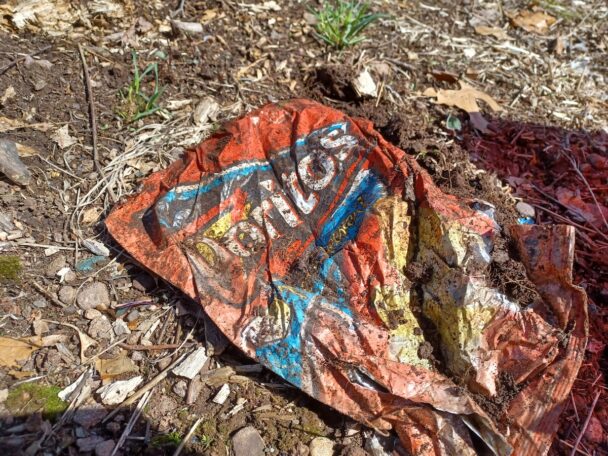
The earthworms emerge from the earth and begin diligently navigating through the soil after the malicious winter. Yet, there lie more hazards unbeknownst to them: broken glass, beer cans, and plastic bags.
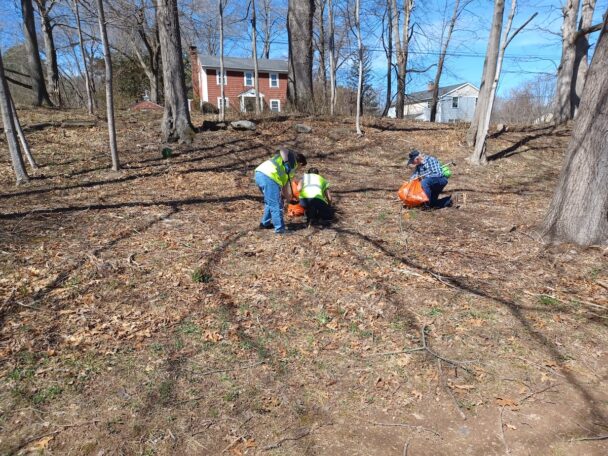
Last Saturday, April 4, a dozen Middletown residents and University students gathered along Long Lane’s multi-use trail, located between Long Hill and Wadsworth, for the Jonah Center for Earth and Art’s first litter clean-up event of 2026.
The clean-up was organized by the Jonah Center’s Litter Clean-Up Coordinator Jessica Bucholz, who primarily organizes community litter clean-ups in the Middletown and Portland areas. After noticing the accumulation of litter across Long Lane over the winter, the Jonah Center decided to continue its stewardship of the land and maintain a sustainable connection between humans and nature.
“Slowing down to clean up litter opens your eyes to how much trash there really is atop and embedded in the earth,” Bucholz wrote in an email to The Argus. “But once the litter is bagged up and hauled away, you can immediately feel the direct impact you’ve had on nature for the better. Many of our volunteers find the experience rewarding and come back to help time and time again, which is why I believe community litter cleanups are important in fostering a more sustainable relationship between people and nature.”
Peyton Wolfe ’29, who attended the event, remarked that cleaning up litter not only helps protect the local environment and contributes to sustainability efforts, but also encourages Middletown residents to use the trail and various outdoor spaces. Wolfe emphasized the importance of firsthand learning, such as litter cleanup, which allows volunteers like themselves to address environmental pollution and waste.
“Cleaning up litter reaffirmed the importance of reducing consumption, throwing trash away properly, and the prevalence of plastic and microplastics in our environment,” Wolfe wrote in an email to The Argus. “It reminded me that throwing trash away doesn’t mean it’s gone.”
The Jonah Center for Earth and Art is a nonprofit organization with a mission aimed at fostering a more sustainable relationship between humans, animals, and nature through collaboration, educated action, and art. This litter cleanup is one of the many initiatives they organize to contribute to their objectives.
John Hall, who founded the organization in 2004, highlighted the history and mission of the Jonah Center. According to Hall, their focus remains on reducing the harmful and adverse impacts of humans on the ecosystem at both the local and state levels while also acknowledging their operational capacity.
“The Jonah Center was founded out of concern that the ‘environmental’ community was failing to address the ‘ecological crisis’ facing the world,” Hall wrote in an email to The Argus.
Since its founding, the Jonah Center has engaged people in a wide range of initiatives to preserve the natural environment, which range from campaigns to reduce energy use to efforts to remove invasive aquatic plants from local waterways. The Jonah Center also promotes local artists, landscapers, and photographers involved with local wildlife by hosting performances and shows that uplift people artistically and emotionally.
“I recognized the need to apply a wider variety of cultural resources and strategies than purely technological and scientific ones, as important as those are,” Hall wrote. “We need to engage the human heart and emotions and foster a deeper connection to the natural world and what is happening to it.”
The Jonah Center works in partnership with many organizations in the Middletown community, including the Department of Energy and Environmental Protection Fisheries Division, the Middletown Clean Task Force, the Middletown Sustainability Commission, and the Urban Forestry Commission. Their partnership efforts also extend to the University, primarily through the Bailey College of the Environment. Visiting Professor of Environmental Studies Kathleen Miller incorporated the Jonah Center’s Midden Project as part of an invasive species challenge for her 2024 Winter Session course, “Strategies in Conservation and Environmental Action” (ENVS 244).
Needing governmental action and involvement to aid with their mission, the Jonah Center focuses on outreach to help mitigate environmental degradation. In 2020, the Jonah Center stopped the expansion of the Middletown Power Plant on River Road by paddling to remove invasive water chestnut plants (Trapa natans), which saved the “Floating Meadows,” a 1,000-acre freshwater tidal marshland between Middletown and Cromwell where the Coginchaug River flows into the Mattabesset River. Floating Meadows is home to birds, reptiles, amphibians, and fish, and acts like a giant filter system: Microbes on the roots of the aquatic plants clean the polluted water that flows down the Coginchaug and Mattabesset Rivers before emptying into the Connecticut River.
“The progress advocating and getting $3 million in state support for the 110-mile Central Connecticut Loop Trail is probably our most impactful project, but it is still in the planning and design phase,” Hall said.
Kristen Colombo, director of the Jonah Center, outlined the organization’s future plans, indicating that their long-term plan is to grow community relationships and environmental guardianship through their ongoing advocacy and actions. They also want to increase their working capacity. They will continue to use art and support artists who focus on nature, creating unique emotional connections with the environment. Colombo also noted that the Midden Project will be their primary focus for the next few years.
“We see this [and the Middletown boat launch] as a foundation that will anchor future Jonah Center community events and educational opportunities for years to come,” Colombo said. “Now is a critical time for organizations like ours to bring voice and action to care for our environment, humanity, and all living things. We are excited to continue the positive impact of the past twenty years in the Middletown area as the organization evolves.”
Grace Lee can be reached at glee01@wesleyan.edu.



Leave a Reply