
WesCeleb: Maggie Brown ’26 on Captaining a National Title, Loving Every Class, and Building Community
Maggie Brown ’26 will tell you she’s never taken a class she didn’t like. Add in captaining a national championship-winning ultimate frisbee team and conducting human rights advocacy fieldwork, and it’s easy to assume she had it all figured out from the start. However, finding the people and spaces where she belonged was a journey that took years. The Argus spoke with Brown about her work with the University Network for Human Rights (UNHR), her plans to travel to Lisbon, and more.
The Argus: Why do you think you were nominated for WesCeleb?
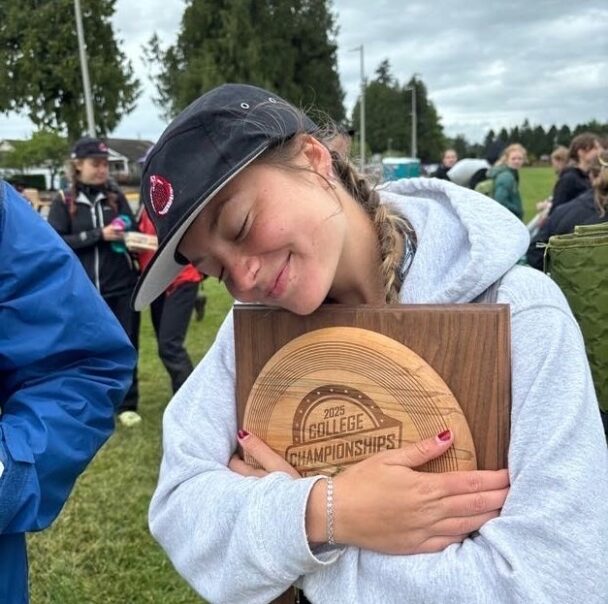
Maggie Brown: Funny question, it took me a second when I first got that text from you, I was like, “is this the wrong number?” I have friends who have done it before, but they’re the campus DJ or the star of the basketball team. It probably has to do with me being captain of Vicious Circles, a very successful women’s division ultimate frisbee team. I’m the one returning captain this year from when we won the national championship last year. It was pretty remarkable, and potentially unheard of in ultimate frisbee history at the University.
A: Let’s circle back to ultimate later. Can you tell me what drew you to your major and minors?
MB: I’m an American Studies major and African American Studies and Human Rights Advocacy double minor. I am someone who has had many passions about a lot of different things, and did not really have a strong sense of direction coming to Wesleyan. I also did not want to feel limited by distribution requirements or choosing a course of study before I knew that I could explore my options, so I basically just took classes that looked interesting.
I’m an avid Rate My Professor user, and my fun fact is that I’ve never taken a class that I didn’t like. I’ve never had a bad class, which I think is really impressive, and not the case for a lot of people. But I took the classes that I liked taking, and then took professors I liked, and they all ended up being in the American Studies Department. And I’m so glad I took that path. It’s been the most perfect interdisciplinary major. I can take super niche classes. I can take super formative, foundational, and general history classes. It’s just been really formative to the way I see the world, and it’s a really nice department to be learning in and from.
A: You have had a significant role in the UNHR. How did you get involved with that?
MB: This was something I was lucky enough to stumble upon here and something that I’ll have been working with and will continue to work in partnership with, hopefully for years past. It’s not defined by Wesleyan, but it has definitely defined my Wesleyan experience.
The UNHR is a non-governmental organization that came to the University to pilot a one-of-a-kind undergraduate human rights practical training program. The Human Rights Advocacy minor equips University students with a general sense of how international human rights mechanisms work. UNHR then facilitates a unique experience for students as part of the preparation to participate in a mission somewhere in the world. That experience includes traveling to directly engage with a population actively affected by human rights abuse, and then contributing to a material, often a report, for a regional or international human rights body.
I was fortunate enough to go to Jamaica my sophomore spring and collect testimony in rural towns around pollution from bauxite mining, which makes aluminum. There was extreme contamination of the water supply for local fishermen and the communities that depended on them at the hands of corrupt corporations. I worked alongside and learned from adults in the field, some of whom are my professors and some of whom were human rights lawyers native to Jamaica. I always tell people that participating in the practical work that UNHR does has given me the space to implement in practice all the theoretical and historical learning in my other classes.
Unfortunately, UNHR was kind of pushed off campus last year. There was a big uproar about it, and it was tough to see my favorite faculty leave campus. They used to have a house on campus that was really supportive, basically just a gathering space for students, specifically a lot of First Generation Low-Income students and others who felt they hadn’t really found their people at here at the University. It was a very authentic, wholesome community and a safe space for a lot of people.
That’s been a really tough loss, but the great thing is that the relationships that I’ve made with my former classmates, professors, and colleagues there have totally withstood the change, and I’m intending to travel to Lisbon for the Fall semester to help supervise and facilitate the UNHR programming that’s now operating out of Portugal. Essentially, the same path I took is now offered as an abroad program for undergrads from Wesleyan and beyond.
A: What have you taken away from your time with the UNHR?
MB: Overall, fighting to keep UNHR on our campus, not winning, but still being able to liaison between the university and a non-governmental organization has definitely been a good life skill. It has helped me see the value of existing in a space that invites students to actively challenge it, which is ironic because we were advocating for the survival of an advocacy program.
My time working in the field with UNHR really just gave me a sense of purpose that I hadn’t felt before. Coming to Wesleyan from a public high school, I dealt with a lot of feelings of imposter syndrome when I first came here and was surrounded by people who had 12 years of private school under their belt with specialized education. In the courses I took through UNHR, I learned the emotional skill set I have was of value. I think the human rights work that UNHR does is appealing to me because it’s so grounded in storytelling, listening, and amplifying voices that aren’t being listened to. It feels like a very authentic way to create structures that help people uplift themselves. That is very, very fulfilling to me, and I think it aligns with the University’s philosophy.
A: What are your future career goals?
MB: It’s interesting because, as an American Studies major, there are a lot of directions you could go. The Human Rights minor solidified my desire and passion for social justice work. While it taught me to be pretty critical of the legal sector, hyper-legalization, and over-bureaucratization of very real human matters, I’m feeling excited about pursuing a law degree because it’s helpful for getting things done in the field that I’m interested in. I’m not sure whether a law degree will take me internationally or if I’ll find myself working more domestically, but public interest law is probably what I’ll be doing.
The dream is to go to Lisbon, meet and learn from more amazing people, and then probably move back to the U.S.
A: Let’s switch to Vicious Circles, also known as Vish. What was it like to captain the team that won nationals?
MB: Vish is the non-men’s ultimate frisbee team on campus; we’ve been around since the 80s. Last year, we traveled to nationals in Seattle, Washington, my hometown, which was very sweet. My whole family was able to come, and we had a bunch of support from my local frisbee community.
I captain the team, and I captain all my best friends, which is really fun and also challenging at times. It’s tough to be hierarchically above your housemates, your friends, and your teammates in that way. Through that experience, I was able to develop a deeper appreciation for the community that Vish is and the way the team and the sport operates. It feels like an incredibly inclusive and equal environment. Every single person on the team contributes, whether or not they’re stepping on the field for every point. No one is just sitting on the bench, and even on the sideline, you’re actively contributing to the game, which is a really special part of the sport that made the nationals win that much sweeter.
It was just an incredibly special experience. Every year it’s a different team, which is crazy, and winning nationals was a really nice way to memorialize the group that we had last year, because we have a trophy to share among all of us. It’s in our living room. When we came home with our final championship victory, President Roth was excited on our behalf. There’s this hilarious story that at the senior week tent party, he ran into two of our captains who were wearing their medals. Someone was like, “Oh, these are the captains of Vicious Circles who just won,” and he got on his knees and bowed down. I felt support from people all across campus: friends, peers, even random faculty who I’ve taken like one class with.
A: What advice would you give to your first-year self?
MB: My Fall semester freshman year, as I alluded to with my imposter syndrome, I got here and had no idea how to balance the freedom, independence, and incredible social environment with the academic rigor, going to office hours, and asking professors for help. And so I kind of dug myself into an academic hole, but I got out of it by the end of the semester.
I would first tell myself: go to sleep, listen to your body. You have four years here, but in a bigger way, you deserve to be here and you are capable, and you should apply yourself as much as you can to every academic and other experience you’re fortunate enough to have here. I strongly feel that Wesleyan is a very special place, and I feel that I’ve taken something very meaningful away from every class, club, program, and event that I’ve participated in.
I would just remind myself that it’s gonna be okay. You belong here, and you’re gonna meet the best people in the world. The great part is that it exists beyond Wesleyan. As I’m graduating, I really do feel like the relationships I’ve made here will continue, hopefully for the rest of my life.
A: Can you describe your Wesleyan experience in four words?
MB: Fervor, foundational, family, flowstate.
This interview has been edited for length and clarity.
Maggie Smith can be reached at mssmith@wesleyan.edu.
Leave a Reply