
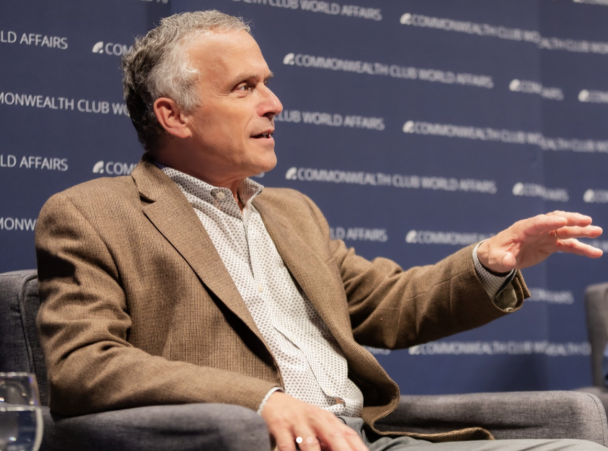
The 800-Pound Gorilla Speaks: Roth ’78 on Free Speech and the Future of Academia
University President Michael Roth ’78 does not fit perfectly into one ideological bucket.
He has sparred with Dartmouth College President Sian Beilock and Harvard Law School Professor Noah Feldman on the topic of institutional neutrality, which Roth has referred to as “cowardice.” He has defended college students from the now ubiquitous attacks stating that we are “fragile” or “coddled,” leading conservative media outlet The Washington Free Beacon to label him “South Park’s PC Principal.” Nine years ago, he appeared on “Tucker Carlson Tonight” and sparred with the then–Fox News host on immigration policy.
Among a sea of college presidents who have stayed silent, Roth’s presence stands out like a walrus among a pack of seals. Unable to hide and unwilling to concede.
Roth sits at a round wooden table in his spacious South College office. Sunshine peers through the large glass windows that overlook Wesleyan’s eccentric baseball field, Dresser Diamond at Andrus Field.
Roth sports a white button down shirt emblazoned with “Wesleyan University” above the pocket, a rather casual look for the man who has led the University for the past 19 years.
“I think the biggest threat to American higher education is the disruption from the federal government,” Roth said. “The most dramatic [are] the fines supposedly about antisemitism [and] the withdrawal of government support for scientific research and other kinds of research [in] a kind of ransom modality, or extortionist modality.”
Roth cites universities from Columbia to Harvard to the University of Virginia as examples of where the administration’s impact has already been felt. Most have already capitulated.
For the past year and a half, perhaps no college or university president has received more attention than Roth. As the Trump administration engages in unprecedented attacks on higher education, it is Roth who has become the face of a movement that aims to defend it. There is Michael Roth: from lampooning the Trump administration during an appearance on CBS’ “Face the Nation” to essays in The New York Times defending diversity, equity, and inclusion and arguing the president is weaponizing antisemitism on college campuses. Last year, Roth received the PEN/Benenson Courage Award for this work.
He certainly calls out the Trump administration, but in the same conversation says there is a lack of ideological diversity on college campuses.
Roth has long advocated for affirmative action for conservatives, particularly professors, on college campuses. In our conversation, he spoke about what he sees as the risks posed by ideological conformity on college campuses.
“In some ways it’s even worse because of student pressure to conform to certain political beliefs,” Roth said. “Faculty are afraid of students, and fellow students are afraid of students and that is another chilling effect.”
Numerous studies, including ones conducted by the Foundation for Individual Rights and Expression (FIRE), a prominent non-partisan free speech organization, document this phenomenon of self-censorship. Roth does not deny it.
Roth’s heterodoxy extends to his relationship with FIRE. FIRE has historically been a thorn in the side of university administrators and a frequent critic of free speech culture on college campuses. But they have positioned themselves as one of the staunchest defenders of academia during the second Trump administration. Roth has come around on them.
“I was very critical of FIRE for a long time,” Roth says with a short laugh. “Now [I] have become much more supportive. I sent them a little money at the beginning of 2025. Mostly I had a guilt of having been so critical, because I felt they were really fighting principled fights…. I do think in the last two years, especially, they’ve been doing some very important work.”
Roth also indicated that he agrees with FIRE more than the left-leaning American Association of University Professors (AAUP) on at least one issue: academic boycotts. The AAUP has endorsed academic boycotts in certain contexts.
“Boycotts of a country’s professors or culture makers are almost always counterproductive,” Roth said. “It’s almost always more about the expression of one’s own views than it is about hurting the right people in another place.”
He noted Wesleyan hosts an Israeli film festival and employs multiple Israeli professors.
Yet where Roth breaks with the traditional stances of free speech oriented organizations like FIRE is on the topic of institutional neutrality. More than 150 colleges and universities abide by institutional neutrality, which holds that administrators should generally refrain from speaking about social and political issues.
“The neutrality principle that was developed in 1967 in the Kalven Report was meant to keep the university out of trouble,” Roth said. “It’s dressed up as a way of trying to promote free speech by not having an institutional position to which people feel pressured to conform…. There’s no evidence that people felt pressured to conform and curtail their speech. That’s an empirical claim, [and] there’s no evidence for it at all.”
Roth argues that institutional neutrality is simply a way for colleges and universities to avoid trouble, particularly in the fallout of the Israeli-Palestinian conflict, which saw several university presidents ousted.
“If you want to have a principle saying, ‘We don’t want trouble,’ that’s not really a principle, it’s a tactic to stay out of trouble,” Roth said. “I think it’s embarrassing for people to say, ‘I’m afraid to speak,’ especially when they’re in highly paid positions at intellectual organizations.”
Roth is well aware of the risks that come with speaking out, especially since the University receives millions of dollars in federal grants.
“Of course I’m worried,” Roth told the Jewish Telegraphic Agency (JTA) last year when asked about the risks from speaking out against the Trump administration. He still chooses to speak.
The current administration is not the only thing on Roth’s mind, he’s talked about the risks facing small colleges across the country.
“I think small colleges, in general, are having a really hard time. They try to keep up with the Joneses…and offer certain things rich schools offer…. It’s really hard to do that.”
Small schools across the country confront closure or mergers, as financial and enrollment challenges persist: Hampshire College, California College of the Arts (which Roth led from 2000 to 2007), Cabrini University, and others.
“That’s sad for me, because some of these schools have storied histories,” Roth said.
There’s also the rise of artificial intelligence, but Roth brings a degree of optimism to the conversation, acknowledging it provides an opportunity to show what colleges stand for.
“Nobody should go to college to get information,” Roth said. “You can get information from your phone so much cheaper, [and] it’s probably more reliable…. Some years ago, a lot of smart people told me I should require coding at Wesleyan: ‘Everybody needs to code.’ Well, no one needs to code now, but people do need to make judgments about the information that comes to them…. You can’t automate that, and I think we should automate the things that are automatable, but that the human skills that we put a great weight on at Wesleyan will continue to develop in liberal education.”
Roth does not fall into any camp. He’s evolved from a FIRE critic to a donor, yet rejects their views on institutional neutrality. He calls for more conservative professors, but decries the Trump administration’s efforts to engineer that outcome. There is no university president quite like him. But perhaps this is refreshing in today’s polarized world.
As our conversation ends, Roth shakes my hand and walks me out of his office. I glance at the dozens of books that fill his office on topics ranging from philosophy to history. As I walk out of South College and onto College Row, the topics Roth speaks about—speech, principle, and pragmatism—all seem purposely unresolved rather than deliberately answered.
Blake Fox is a member of the class of 2026 and can be reached at bfox@wesleyan.edu.




Leave a Reply