
Reviewing Stoners on the Silver Screen as Conspiracists, Extremists, and Revolutionaries
This article contains spoilers for “Bugonia” (2025).
Numbness. Joy. Laughter. An increasing feeling of fear and panic that leaves you trapped in your body, confused by your endlessly terrifying surroundings. At least some of these feelings likely washed over those celebrating weed in its many forms yesterday.
Stoners have often been the comic relief of a certain kind of movie for decades, a loveable goofball like Spicoli (Sean Penn) in “Fast Times at Ridgemont High” or Pedro De Pacas (Richard Anthony “Cheech” Marin) and Anthony “Man” Stoner (Thomas Chong) in “Up in Smoke.” Their days are centered around tie-dye, music, and staving off the munchies. Some, such as Slater (Rory Cochrane) in “Dazed and Confused,” are afflicted by paranoia, but their theories feel quaint against the current landscape of QAnon, Pizzagate, and microchips.
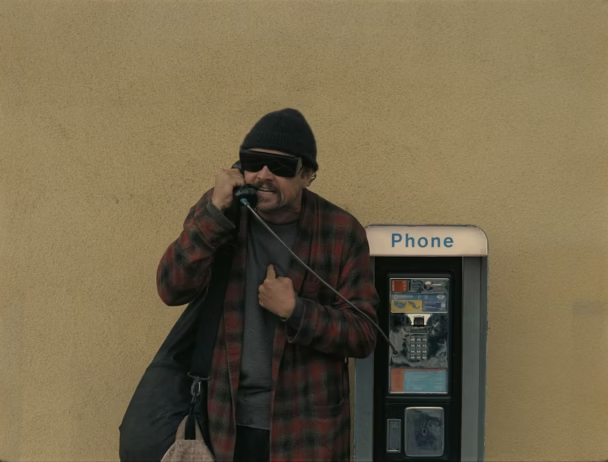
As such, it is only right that a new kind of stoner has taken to the silver screen. In Paul Thomas Anderson’s “One Battle After Another,” Bob (Leonardo DiCaprio) is a lapsed revolutionary who spends his days in hiding with his daughter Willa (Chase Infiniti), getting high, and watching “The Battle of Algiers.” They live without phones due to Bob’s fear that the cartoonishly fascist Colonel Lockjaw (a very un-Spicoli Sean Penn) will discover their secret life in a sanctuary city. Willa views her father’s eccentricities as a malady. She dismisses his concerns, leading a life devoid of his paranoia, including an illicit smartphone. But then they are found.
Bob is right to be paranoid, if that is even the right word for fearing a conspiracy that turns out to be very real. The government calls crisis actors to riot in the streets, journalists are abducted, and a ridiculous secret society meets underneath palatial Sacramento mansions. Bob stumbles through the film’s grand adventure, high and hungover, in search of his daughter.
But Bob is not the only lead of a politically conscious 2025 film plagued with paranoia. “Eddington,” Ari Aster’s contemporary Western set during the COVID-19 pandemic, is essentially a play-by-play of 2020’s many upheavals, from masking policies to Black Lives Matter, all filtered through a small-town New Mexico mayoral race. The sheriff Joe Cross (Joaquin Phoenix) and his wife Louise (Emma Stone) may not partake in the devil’s lettuce, but they certainly are paranoid. Their loneliness, angst, and confusion has been met by online personalities such as the charismatic preacher Vernon Jefferson Peak (Austin Butler), a cross between a televangelist and a new age spiritual leader.
Characters on both sides of the aisle are easily ensnared by forces pushing them to ideological extremes, turning their town into a volatile microcosm of America; and then the Antifa plane appears. A private jet flies away from the now-destroyed town, an ominous sight that then turns almost comical as the camera focuses on a piece of Antifa merch in the corner. The chaos really was orchestrated by outside forces, giving the characters’ mass hysteria a strange credibility.
Similarly, “Bugonia,” Yorgos Lanthimos’ twisted take on a South Korean classic, steeps viewers in an eerily familiar milieu of delusion. The film follows a lonely, conspiratorial man, Teddy (Jesse Plemons), on a quest to prove that aliens called Andromedans are destroying Earth. To prove this, he kidnaps girlboss CEO Michelle (Emma Stone) and puts her through a series of bizarre tests to prove that she is Andromedan royalty. Teddy seems crazed. He shaves her head, covers her body in lotion, and electrocutes her. And yet he is proven right.
Michelle is an alien with immense power who has caused deep personal harm to Teddy. His afflictions, his loneliness, a dead-end job in an Amazon warehouse, and grief are not random. They are an organized attack against not just him, but all of humanity. His violence and cruelty are not pointless; he is an intergalactic freedom fighter of sorts.
Bob, Joe, and Teddy are easy to stereotype. The flailing middle-aged man runs rampant in the cultural imagination, lashing out at the world they think has left them behind or dying a death of despair. The American Dream failed them, so addiction to drugs, screens, and delusions buoy the men through their days.
The subversion of conspiratorial thinking that these films engage in does not signal allyship with real-life conspiracists. It instead immerses the largely liberal audiences of these prestige-oriented projects in worldviews they’ve previously only heard mentioned on NPR. By portraying conspiracists as ultimately correct, viewers understand the world just as the men do. It is a scary, unfair place where there is always a winner, and it is never the underdog.
Only the revolutionaries of “One Battle After Another” offer hope. Willa will carry on her father’s fight, now knowledgeable of the vast, violent regime that surrounds her. As for the rest, they show that it is easy to succumb to paranoia, to pull in your knees, clutch your water bottle, and retreat from the confusion of the outside. Fear encircles you, making the mundane sinister. Unless it was sinister all along.
Abby Slap can be reached at aslap@wesleyan.edu.





Leave a Reply