
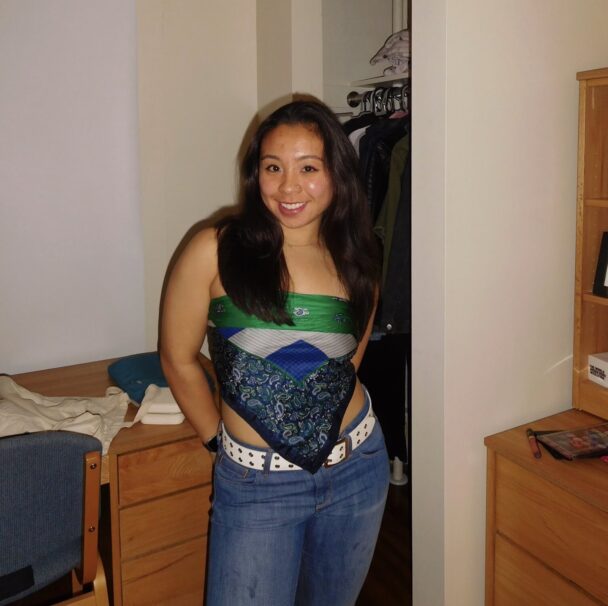
WesCeleb: Kayla Harrison ’26 on Reproductive Justice, Intersectionality in Science, and Ultimate Frisbee
Kayla Harrison ’26 always knew she was interested in reproductive health and education, but she didn’t know her interests would lead her to ultimate frisbee. From Science and Technology seminars and a cappella, to working as an Emergency Medical Technician (EMT) as well as sex educator for the Adolescent Sexual Health Awareness (ASHA) group. The Argus sat down with Harrison to reflect on her time at the University, her classes on pleasure and power, and the politics of science.
The Argus: Why do you think you were nominated for WesCeleb?
Kayla Harrison: I think that I’m involved with a lot of things on campus, kind of in diverse sectors. I’m involved with ultimate frisbee, and I am a big part of the Cardinal Sinners, and I’ve dabbled in a lot of performance spaces here, so maybe people know me from that. I guess maybe I was nominated for WesCeleb because I definitely say out-of-pocket things in my seminar classes.
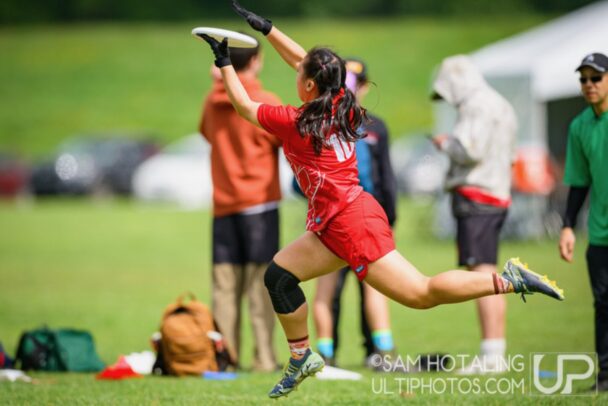
A: You’re involved in Vicious Circles [Vish], the 2026 Division III national champion frisbee team. How is that?
KH: It has really been one of the most formative experiences of my time here at Wesleyan. I think it’s such an amazing community and place to compete and improve as an athlete. On Vicious Circles, I’m the equity committee chair. In the fall, I’m responsible for running a meeting to establish norms of equity, both on racial and gender axes. I was also the strength and conditioning coordinator this year, which is really fun and a cool way to combine my passions of health care and ultimate, to try to design a strength and conditioning program that would help us improve as athletes. The main focus was injury prevention, because we had a bunch of really bad injuries last semester, and I wanted to make sure that we minimize the risk of that happening again.
A: What else are you involved with on campus?
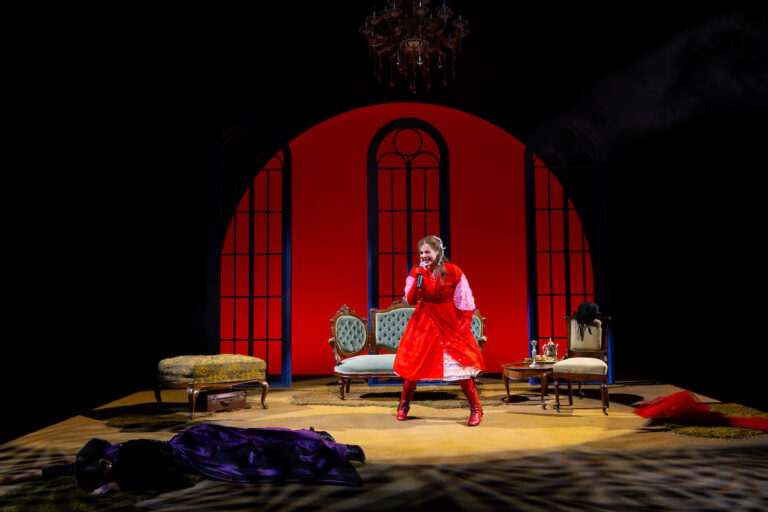
KH: I was the music director of the Cardinal Sinners for six semesters, but now I’m passing on the torch. I was in another A Capella group called Onomatopoeia, but I had to take a step back because I was just too busy. I did a couple of Spike Tape productions as an underclassman, but it came to a point where I had to choose between ultimate and theater, and I realized I really wanted to continue to do ultimate.
A: What are you involved with off campus?
KH: I do some teaching with ASHA, but I don’t do a ton of it currently. I guess the biggest thing I did off campus was working as an EMT. That was a really cool experience. Unfortunately, I had to stop because I get really car sick. I also play competitive ultimate outside of college, and I’ll be captaining a club team in Boston this summer.
A: Have you always enjoyed ultimate?
KH: Before college, I was definitely much more involved in music and theater, so I kind of pulled a reverse Troy Bolton. In high school, I went from theater kid to athlete. I played ultimate in high school, but mainly because in my high school, a lot of people only really play ultimate to get out of gym class. With Vish, everybody is there because they want to be there, either because they really love the sport or the social space.
A: What is Vish like socially?
KH: Frisbee is a gender inclusive sport, and a very gay sport, to put it colloquially. It’s a really cool environment for people to explore their queerness. I don’t think I was really exposed to a lot of queerness in athletics until college, until Vish, and that was really cool.
A: What’s your pre-frisbee game routine?
KH: I like listening to hype music. The biggest type of prep I do is in the gym, doing box jumps for frisbee. I do a lot of plyometrics. It helps with explosiveness, especially because I’m short.
A: What is your major?
KH: I’m a Molecular Biology and Biochemistry (MB&B) and Science and Technology in Society (STS) double major with a concentration in Feminist, Gender, and Sexuality studies (FGSS) and a minor in chemistry.
A: What inspired your path at Wesleyan?
KH: I realized that I had a really strong interest in reproductive justice and also reproductive health, and I wanted to be an OB-GYN. That stuck with me all through high school and now through college, and I definitely shaped all of my coursework around the idea of pursuing a career in women’s and non-cis men’s health. My FGSS classes have been helpful for that, because of the intersectional teaching about gender, race, sexuality, and socioeconomic status. To be a healthcare provider, you have to be aware of many different identities of patients to give them the care that they deserve. So much of healthcare is based around caring for cis-hetero white men, and that is what a lot of anatomical standards are based on. I hope learning about these things will make me a better doctor someday.
A: What interests you about reproductive health and sexual health awareness?
KH: When I was 15, I became kind of like a point person for my friends, where they would ask questions about birth control, periods, and sex. I became the educator for my friends in that way, and I think that’s also because at my school, we didn’t have any sex ed. That’s part of why I’m so grateful for ASHA, although I unfortunately haven’t been as involved with it the past couple of years. I wish I had that when I was in high school.
A: What’s your favorite class you’ve taken at Wesleyan?
KH: I don’t know if this is actually my favorite, but the one that I think really shifted my perspective on the world the most was an FGSS class that was taught by [Associate Professor of Feminist, Gender, and Sexuality Studies] Kerwin Kay, “Pleasure and Power.” It really taught me how much of the world is governed by power dynamics on the basis of social identity, and how sexuality is so much more of a governing force than we realize. Before that class, I had a very stereotypical cut-and-dry narrative about sexual assault as happening when somebody spiked your drink, or a man in the bushes that would come out and jump you, something like that and I think that was just a really important class.
A: What have you learned from FGSS and MB&B over the past four years?
KH: It made me realize how many layers there are to day-to-day interactions. What it all comes down to is that so much of my education is about intersectionality. You cannot experience one aspect of your identity in a vacuum if you are a woman of color. One of the best examples is the example of birth control. Birth control was a tool of liberation for white women, but it was a tool of population control for people of color. Even a seemingly objective technology like science is politicized. And how technologies are not just in a vacuum, the way that they are used and the way that they affect people is informed by the identity of those people.
A: Do you feel like the medical field lacks diversity in perspective?
KH: There’s definitely not enough research in female health care, in sports medicine, gynecology, and endocrinology. Black women are three times more likely to die in childbirth than white women. We want to think of science and medicine as objectives, but it has a racist history, especially in gynecology and obstetrics. Maternal and gynecological pain still persist to this day. People think that you can’t feel anything in your cervix, which is why IUDs, up until very recently, were always done with no numbing, and it’s barbaric. I want to make sure that I am aware of the history of these things as a provider to make sure my patients are comfortable and respected. Learning about the citric acid cycle, meiosis, and the objective stuff is important. But when you’re working with people, you need to learn more than just pure science.
A: What are your career goals?
KH: I want to go to medical school, to hopefully get my MD, but I’m going to take two gap years. I’m currently in the interview process with clinics for medical assistant roles. I loved my EMT work, and I think it really taught me a lot about how to interact with patients and navigate a healthcare setting. It was really cool getting to be on the front lines and directly treat patients out in the field. But that was just not sustainable because I get car sick.
A: Where do you find the balance between career and fun?
KH: I think that I gather energy from my friends, and find activities that energize me. The most I was ever able to find a balance between career and fun was when I was studying for the MCAT this summer. I mean, I was working part time nannying, then coaching youth ultimate. But I was studying between three and seven hours a day. That experience taught me that the brain breaks from playing club ultimate with my team were so necessary for me to then be able to be productive with all these really hard science courses. Google Calendar, that’s a good way to phrase it.
A: What advice would you give to your freshman self?
KH: Nap less during the day, sleep more at night. Do what makes you happy, don’t do things just because you think you’re supposed to do them. Obviously, you have to hit the benchmarks and requirements for a career, but I wish I had kind of taken a second to breathe more, because I was a very anxious freshman. I’m still an anxious senior. Take the time when you need to lock in, so then you can have time to make memories with your friends.
A: What are you looking forward to in your final semester?
KH: Trying to survive biochemistry and immunology.
This interview has been edited for length and clarity.
Claire Farina can be reached at cfarina@wesleyan.edu.

Leave a Reply