
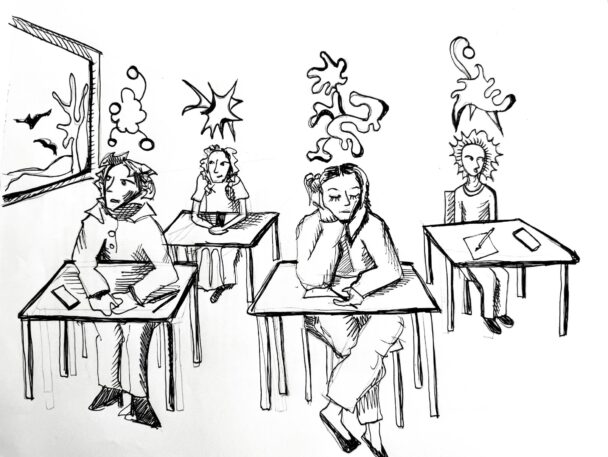
The Broke Mind Virus: ADHD, Modern Medication, & Your Spectacularly Idiosyncratic Mind
Somewhere between that Moodle post and the second espresso shot, your cognitive momentum gives out. You find yourself returning back to Instagram Reels instead of studying. It’s almost finals season and you’ve been telling yourself that you’re hopelessly overextended, scatter-brained, and all over the place. You know you’re smart enough to survive this; you’ve pulled it off before. But as you look around, your friends seem to be getting more done, more quickly and with less stress. And now, two hours into an Olin study session and two pages into a 200 page reading, you begin to question the nature of your own work habits. You begin to think, am I not built for this? Maybe my brain works differently than it’s supposed to.
Attention deficit hyperactivity disorder (ADHD) diagnoses among college students have skyrocketed at elite universities across the United States. What was once a childhood affliction characterized by an inability to sit still has joined the lexicon of the sleep-deprived, high-performing procrastinators attending American universities. The category of ADHD itself has become malleable, unclear, and at times even mendacious. Students interpret academic paralysis and absent mindedness as proof of a divergent brain. Understandably, they then look for answers and solutions. Clinicians have been adjusting their criteria while institutions have been expanding their accommodations. As more students use ADHD as an explanatory tool for “divergent thinking,” the more they attribute their inattentiveness, doom-scrolling, deadline-extending, and stimulation-seeking behavior as potential symptoms of a broader categorization. But this is not to say ADHD isn’t real.
The American ADHD narrative surged in the 1990s alongside the pharmaceutical rise of Ritalin. In 2024, ADHD diagnoses in United States children hit an all-time high of 11.4%. On college campuses, stimulant use has lost much of its stigma, often colloquially and satirically used as self-deprecation. Students report that Adderall, Ritalin, and Vyvanse help them feel “clearer,” “more functional,” and even “more themselves.” Studies sometimes find that medications improve aspects of behavior and motivation. However, a common misconception is that they offer any cognitive enhancement.
A recent study at the University of Pennsylvania by cognitive neuroscientists Martha Farah and Irena Ilieva had young adults take either Adderall or a placebo and then perform various cognitive examinations. The individuals who took the medication didn’t perform any better on tests than those who took the placebo—they only thought they did.
Despite decades of research, there is no definitive biological marker for ADHD, no blood test, consistent gene variant, nor a replicable brain-scan result. Diagnoses are reliant upon behavioral criteria. In popular culture, diverse and unrelated behaviors are believed to be associated with the condition. Do you interrupt conversations? Do you have difficulty focusing on one thing? Do you hyperfixate on only one thing? Are you forgetful, fidgety, late to obligations, prone to daydreaming, avoidant of necessary tasks, or have problems with LYING?! These traits are also symptoms of anxiety, depression, learning disorders, trauma responses, and burnout. Such traits are also quite common among those who breathe. How then should one interpret an attention disorder? To whom should one compare to? What on Earth does my attention have in common with the fidgety five-year-old with whom I share this classification with?
It is more or less the consensus that American higher education encourages and rewards a specific form and quantity of production. An ideal student is either someone who is able to embody it or someone who endures despite. Coffee, walks outside, ZYNs, cigarettes, naps, Diet Coke, Cognitive Behavioral Therapy (CBT), and amphetamines are some of the many corrective measures taken to approach the functioning of the ideal student. I am, however, not convinced my brain has anything in common with my fellow “attention-deficient” peers—aside from the supplements bridging the chasm between inattention and what is required to complete a bachelor’s degree.
Last year, New York Times Magazine contributing writer Paul Tough argued for a reconceptualization of attention disorders. Instead, he believes symptoms should be understood as existing along a continuum. Tough referenced a 2021 review by psychologist Luise Kazda which examined how receiving an ADHD diagnosis affects individuals. Kazda and her colleagues found that in 14 studies, diagnoses did make participants feel validated. It provided a sense of legitimacy, encouraged understanding from other people, and reduced feelings of guilt, blame, and frustration. However, 22 other studies suggested the contrary. Medicalizing ADHD was found to be disempowering. When difficulties were presented as symptoms of a disorder, it led to a reduction in personal responsibility which, in turn, encouraged passivity and a lack of progress. The Diagnostic and Statistical Manual of Mental Disorders—the reluctant Bible of psychiatry and psychology—is reliant upon subjective judgments and continuously shifting thresholds of what falls under the disorder. What counts as “inattentive enough” appears to be subject to much variation.
Tough wants ADHD to transcend dualistic classification where students either have it or they don’t. ADHD is real for many people, but it’s also deeply determined by context, shaped by levels of stress, competition, and expectations of how one thinks a student’s mind should behave. I’m in no way advocating for the abandonment of medications and diagnoses. I just think that meds have become the first and most privileged solution. This makes sense. Medications are fast-acting, measurable, and fit cleanly into preexisting systems regardless if you think you do.
Our university—while maybe to a lesser extent than peer institutions—valorizes output and punishes inconsistency. Such inconsistency inevitably becomes failure of the student, devolving often into failure of the spirit. ADHD both categorizes disorder and makes general the infinite particulars of one’s own suffering. There’s nothing wrong with understanding oneself through astrology and religion. The dangers emerge when “scientific” and “empirical” attention diagnoses become construed as introspective and a means of understanding one’s own mental tendencies.
So yes, school might be harder for you than others. You may be exhausted, unmotivated, or scattered. You may feel deeply that something is wrong. And you’re probably right. Blame it on the University. Blame it on gifted child syndrome. Blame it on capitalism. But much to my disappointment, ADHD does not seem to be the infallible all-encompassing explanation or justification that it has come to be accepted as. There is a specific mind that you may want, one you feel like you may need, but ADHD doesn’t come close to explaining the complexity of why you aren’t that.
So what to do? Everyone from TikTok “therapists” to clinical neuropsychologists say “adjust your environment.” Okay, fine. What does this mean? Research suggests that minds function in diverse cadences or “in-patterns”—pretty vague in my opinion. If medication and pathology provide refuge for you, awesome! Yet, if you feel anything like me, I offer three, perhaps obvious prescriptions: First, try anything and everything. Second, of the least harmful, use it in strict, regimented, moderation. Third, put your head down, keep going, and hope that whatever environmental change awaits you is better suited for your spectacularly idiosyncratic mind.
Kiran Bleakney-Eastman is a member of the class of 2027 and can be reached at kbleakneyeas@wesleyan.edu.





I really liked this article. I think the rapid increase in diagnoses is very alarming and your article is very relatable–people are always telling me I have ADHD and I think why would I want to think about my brain as something that has a disorder and is permanently broken–sounds disempowering. The science and classification system for ADHD is in a really weird place right now and probably overmedicalized which makes essays like yours important for navigating that. I read about anti/psychiatry (both!) very often. Here’s an article I liked with more suggestions if you or anyone else is looking: https://thediagnosis.substack.com/p/your-adhd-advice-gave-me-adhd. Hit me up for lunch sometime.