
Science and Technology Studies Department Celebrates 50th Anniversary With Conference
Then called the College of Science in Society, the College of Science and Technology Studies (STS) first came to the University in 1975 and aimed to foster interdisciplinary and applied study.
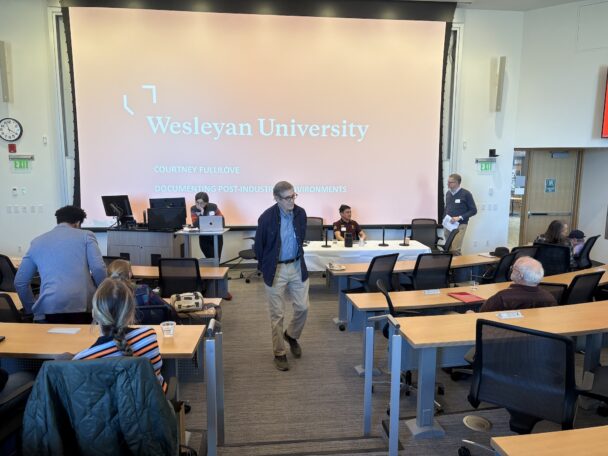
Half a century later, faculty, students, and alumni gathered for a conference celebrating the 50th anniversary of the program on Saturday, April 11. The all-day event in the Frank Center for Public Affairs (PAC) featured multiple alumni panels, talks by professors, and student presentations.
STS aims to blend the study of science, technology, and medicine with a humanistic perspective; majors are required to take courses from traditional science departments, such as physics, chemistry, or computer science, and specific STS classes focused on more multidisciplinary topics such as history, philosophy, and sociology.
The College of Science in Society changed its name to the Science in Society Program in the late eighties, before finally taking on its current name in 2024.
This conference was the fifth event commemorating the 50th anniversary of STS over the academic year, following a panel of STS faculty discussing directions of their research earlier this semester. Chair of the College of Science and Technology Studies Paul Erickson assisted in organizing the events.
“Last summer, we formed a committee of the faculty, including some people who’ve been in the program for not very long, and also senior people, and we reviewed our alumni list,” Erickson said. “We thought about what we wanted the events to be and what we wanted them to do. We wanted to get a fair representation of what our alumni have been doing. We also wanted to give a broad representation of what our faculty are up to.”
The event began at around 9 a.m. with a panel welcoming back four STS alumni: Livia Cox ’22, Leah DiBianco ’22, Rachel Grob ’88, and Sophia Sadinsky ’11. The group reflected on their current careers and how their paths have been affected by their experiences in the major and their time at the University.
“My interest always was in improving health and healthcare in this country, but I feel like the STS program made me understand that I could do that from a lot of different positionalities,” Grob said. “Every day, I do science, and I’m very aware of so many things that I learned here, how collaborative a project [science] is, and how this fantasy of objectivity can undermine the integrity of investigation that tries really hard to be empirical and to identify our own biases.”
The panel was well received by students, many of whom were appreciative of the insights from graduates on their careers in healthcare.
“It was interesting hearing the alumni speak,” Eli Ramirez ’29 wrote in an email to The Argus. “My professor, [Assistant Professor of Science and Technology Studies] Emily Vasquez, moderated the discussion and also gave a presentation about some of her research…. I was inspired by the drive that a lot of the students had with regard to STS.”
Following the first alumni panel, the attendees were invited to a faculty panel titled “Technoscience, Bodies & Selves.” The panel featured Professor of Science and Technology Studies and Director of the Center for the Humanities Anthony Hatch, Assistant Professor of Science and Technology Studies and Coordinator of the Animal Studies Minor Elan Abrell, Professor of Science and Technology Studies and Philosophy Joseph Rouse; and Vasquez.
Shortly after, the Black Box Labs Expo & STS Student Poster Session was hosted in Exley Science Center. Attendees were welcomed by current STS students, who had the opportunity to share their research and interests.
“I really enjoyed the poster sessions…showcasing the kinds of collaborative work between professors and students,” Associate Professor of Science and Technologies Studies Ying Jia Tan said.
After Black Box Labs Expo & STS Student Poster Session, four more STS alumni, Earl Geyer ’13, Sarah Osterhoudt ’97, Danya Sherman ’06, and Andrew Stewart ’88, discussed their experience in the major and its effect on their careers in a panel entitled “An STS Education and Life After Wesleyan.”
Sherman, who worked for AmeriCorps and the organization behind the development of New York City’s High Line before getting a master’s degree in urban planning and becoming a community development consultant, said she was happy to return to the University.
“I loved my time at Wesleyan, so any opportunity I can to come back to campus, I take,” Sherman said. “I have two young kiddos, and I want to start their love of Wesleyan early. But also, I really did find what was then the Science and Society Program, now Science and Technology Studies, really impactful on my career and life, and was excited to see how it had evolved and what other people were up to.”
Erickson enjoyed catching up with STS alumni and seeing how their time in the program shaped their work.
“I learned a huge amount about what our alumni took from the program, what inspires them in the work that they’re doing, how their postgraduate work has connected with their education at Wesleyan,” Erickson said. “I think that, for me, the biggest eye-opener was actually getting to hear their stories, really for the first time.”
After the second alumni panel, Professor of Science and Technology Studies Courtney Fullilove, Erickson, and Tan presented on research topics related to the environment. Leading off, Fullilove talked about Manresa Island in Norwalk, Conn., the site of a former coal-fired power plant, its environment and history, and how she has incorporated classes into the site. Next, Erickson discussed the relationship between economics and the natural sciences, particularly as they grew closer in the 20th century. Finally, Tan spoke about the Taiwanese plastics industry, corporate environmentalism, and local recycling programs.
Tan reflected on the whole conference, noting that it highlighted the multifaceted nature of STS.
“Professor Rouse raised a really important question about how STS can be a model for the transformation of the University in this kind of new age with multiple [environmental] crises,” Tan said. “In a way, I think the conference offers these kinds of multiple approaches that STS can actually bring about.”
Akari Ikeda can be reached at aikeda@wesleyan.edu.
Spencer Landers can be reached at sklanders@wesleyan.edu.

Leave a Reply