
Make America Skilled Again? In a New Campaign, the Department of Labor Makes It Clear They’re Aiming at White America
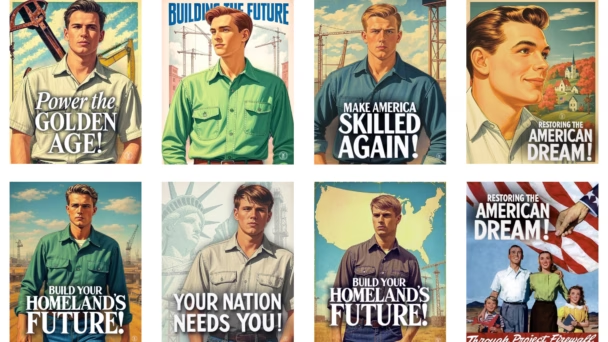
Over the past few months, the U.S. Department of Labor launched an advertisement campaigns encouraging U.S. citizens to apply to the new federal initiative ApprenticeshipUSA, directing them to apprenticeship.gov.
Making America Skilled Again
“Apprenticeship.gov is the one-stop source to connect career seekers, employers, and education partners with apprenticeship resources,” the Department’s website reads. “Discover apprenticeships across industries, how programs are started by employers, and how to become an apprentice.”
ApprenticeshipUSA comes in the wake of the Labor Department attempting a shuttering of Job Corps, a federally-funded program providing 16–24-year-olds with vocational training, housing, and healthcare benefits. The program used to service disconnected and disadvantaged youth across the nation, and ApprenticeshipUSA can be seen as essentially replacing it.
The posts feature art casting almost all white, muscular men standing in front of various infrastructure calling back to a 1940s-50s aesthetic. It seems that the campaign is meant to rouse domestic interest in blue collar work, which often begin with apprenticeships. Quotes like “Build America’s Future,” “Americans First,” and “Your Nation Needs You” appear in the background of these posts, evoking Cold War–era propaganda posters from the Soviet Union. But what’s the ultimate goal here? And what can help explain the appearance of these posters right now?
Pop Culture’s Turn to White Supremacy
Even before President Donald Trump was elected, right-wing pop culture had been trickling into the mainstream. However, with the inauguration of the new administration, it seems that the floodgates have opened, and conservatism has concretely established itself within the sphere of pop culture. A prominent example of this include trad-wives Ballerina Farm and Nara Smith, who promote a traditional approach to motherhood by placing an emphasis on homemaking instead of a career as well as constantly posting videos cooking for their ever-growing bands of children.
In line with trad-wife content is the “Make America Healthy Again” or “MAHA” movement, which is often connected to Robert F. Kennedy Jr., the U.S. Secretary of Health and Human Services under the Trump administration. In pop culture terms, this “movement” is associated with drinking raw milk, eating bone marrow, raw beef, eggs, and whatever else is deemed as “natural” and “unprocessed.” Whatever that means.
Sydney Sweeney also seems to have connected with conservatives recently, with many individuals on the right wing defending her over a recent controversial American Eagle advertisement. Some critics argued that the ad promoted eugenics because of the tagline that states “Sydney Sweeney has great jeans,” playing on the words “genes” and blue “jeans” in reference to a line about her blue eye color.
There’s also the rise in what Vox calls “faith-adjacent” pop music, a response to the Brat and The Rise and Fall of a Midwest Princess albums that dominated pop culture last summer. Examples of this new sub-genre of pop music include Benson Boone’s “Beautiful Things,” and Alex Warren’s “Ordinary,” both of which can be interpreted as and sort of sound like Christian worship music.
As the left is quick to proclaim that “woke is back” amidst Democratic victories in New Jersey, Virginia, and (most notably) New York City, one has to question whether or not these elections are enough to propel us back into what so many seem to want, namely the culture of wokeness that seemed to exist in the late 2010s and early 2020s and permeated everything, from music to commercials to television shows and everything in between. Is woke really back, or are we still in the midst of what seems to be a conservative pop culture renaissance?
Who Isn’t in the Ad?
Much of the art we see, especially in terms of art that appears in popular culture, is a reflection of our current cultural state. Vice-versa, our current cultural state is a reflection onto art. Whether or not you subscribe to the idea that all art is political, there is at least a large portion of art that is, whether it is made for politics or in reaction to them. This ad campaign is just the latest in the long line of political art—if you can even call it that in this case. Building off of the earlier description, the ad campaign also features recent posts with the titles “Restoring the American Dream,” which also unsurprisingly features a white man, and “A Dream Worth Fighting For,” featuring a white nuclear family sitting in a non-descript church pew with an American flag in the background.
So what does it mean for this ad campaign to only feature white individuals in reference to encouraging blue collar work in the United States? It seems that the president and his administration are trying to send a very pointed message here, especially as they continue to cut DEI efforts on the federal level as well as attempt to influence universities to do the same.
The lack of non-white and non-male workers says something important about who the U.S. government wants to represent in the blue collar workforce. In fact, the message seems to be encouraging just white men to apply to this initiative, meaning that they want the workforce that will “Restore the American Dream” to look white and masculine. Furthermore, looking at the image of the family, it seems that they want this workforce to contribute to this dream, the one “worth fighting for,” which is to say the dream of the white, heteronormative, nuclear family.
It should go without saying that this is problematic. Not only is the United States built on the backbones of immigrants, who currently make up 19% of the workforce, according to the U.S. Bureau of Labor Statistics, white men make up one-third of the workforce, and white women make up about one-quarter. Furthermore, women as a whole make up close to 47% of the workforce, close to half. So, by encouraging only one specific kind of person, a white man, to apply to these apprenticeships, the U.S. government is actively discouraging the majority of the workforce population to apply to such programs. This means that their aim seems to be to turn the blue collar workforce into one populated mainly by white men, in order to bring back some “American Dream” of a white, economically-successful, church-going, traditional nuclear family.
After years of hearing how diversity has been the strength of the American workforce, it’s jarring to see how quickly that has all been forgotten in favor of a white, nationalistic image they are clearly attempting to craft of the American labor force. The Washington Post writes that this is trademark propaganda, since it “activates strong emotions, simplifies information and ideas, attacks opponents, and appeals to people’s deepest hopes, fears and dreams.” The fear here is that the white American workforce is being threatened by non-white, non-U.S. born individuals, and when the white American workforce is being threatened, that means that the white American family is being threatened.
Also what is intriguing to note is that the U.S. Secretary of Labor is Lori Chavez-DeRemer, who is both Latina and a woman. Clearly, this ad campaign is not relatable to someone like her, and it’s interesting that she is part of an effort to recruit a population that excludes the two main demographics she is a part of.
Lastly, the campaign itself is rumored to be AI-created art. It clearly features elements of a Norman Rockwell-esque aesthetic, which is interesting considering that he famously left The Saturday Evening Post in 1963 due to the fact that they would not allow him to depict Black individuals in non-subservient positions to white people. Moreover, in 1964, his first piece for Look magazine became one of his most famous works, titled “The Problem We All Live With,” which features Ruby Bridges being escorted by U.S. marshals on her way to be the first Black child to attend the previously all-white William Frantz Elementary school in the South. So, to utilize Norman Rockwell’s art as inspiration for this campaign is ironic considering these facts.
Moreover, the usage of AI art is just plain gross, considering that AI art generators use artists’ work without consent in order to train the algorithms, meaning that when the art ends up being generated for further use, it is a hodgepodge of art that has been copied from various sources, none of which have explicitly allowed for the usage of their art in this way.
But don’t fret! After some scrolling, out of countless posts of this type that have been released, a grand total of one featured a Black man and a white woman alongside the standard white man that always appears in these posts. Clearly, they’ve ticked off their diversity checkbox.
Julia Podgorski is a member of the class of 2028 and can be reached at jpodgorski@wesleyan.edu.


Leave a Reply