
Defiant Drag: Auntie Heroine Terrifies and Inspires in Noisy Visuals Drag Show
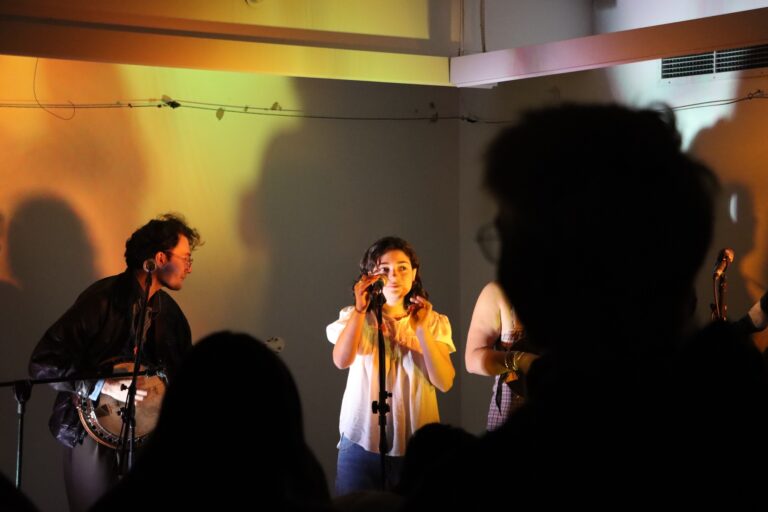
On Saturday, Oct. 11 at 8:30 p.m., University arts collective Noisy Visuals hosted a drag show in the ’92 Theater. Auntie Heroine, the show’s host, is a drag queen who specializes in comedy, horror, gore, and spectacular looks. They were made famous on Season 6 of “The Boulet Brothers’ Dragula” (“Dragula”), a reality drag competition show that focuses on alternative drag judged by four pillars: Drag, Filth, Horror, and Glamour. Auntie Heroine had just finished touring for the release of the season before they came to perform at the University.
The Queen Street Divas (of Wigtown), a new drag group on campus spawned through Noisy Visuals, gave dazzling and unnerving performances of their own during Auntie Heroine’s costume changes. The group was founded last year and is now run by Mae Cohen ’27 and Harmony Hoogs ’27.
In an interview, Cohen said the reason for the show was that she loves drag and wants to increase its presence on campus. Auntie Heroine was asked to perform because of their magnetic performance on “Dragula.”
“They’d never just put on their own show before,” Cohen said. “They’d only ever been in shows with other people. So they were really honored by the opportunity to have a kind of a one-woman show produced by a bunch of college students.”
The show demonstrated the production and technical skills Auntie Heroine had developed on tour, and they were nothing short of breathtaking. Either by fear, awe, shock, veneration, or an odd mix of them all, every member of the audience was caught between screams and gasps throughout the two-hour show.
“I was, first of all, very gagged,” Auntie Heroine said. “I was so honored that Noisy Visuals reached out to me and wanted to support me [after seeing] who I was as a person, and what I showed on ‘Dragula’ and on social media…they saw themselves in me. That really just meant a lot. Being there was just such an incredible experience.”
Auntie Heroine said that they also started doing drag in college, and they found it to be a full-circle moment to be able to mentor the Noisy Visuals crew in creating a drag production.
Auntie Heroine started their performance with a pop-y lip-sync in a neon, spidered, sequin gown and their signature shock of tall hair, doing some crowd work and cheeky comedy that was made even more amusing by the delightful surprise of their Midwestern accent, though they appeared more likely to hail from Transylvania or some campy, glamorized underworld than rural Illinois. Then, they performed some Disney songs transformed by extremely racy lyrics, to the raucous laughter of the audience. This distortion is paralleled in their name, which makes reference to their being an antihero, particularly an antiheroine, because women-presenting people are so easily vilified. It’s also because, as they told the audience, the Disney villains are always more sexy. They then rattled the crowd by reading them a horror story by candlelight.
Auntie Heroine shared that this idea came from being read to by their high school principal, which they described as an impactful part of their upbringing.
“There’s something so captivating and special about having a story told to you,” Auntie said. “We had that as children, right? It really inspired me, because I know I have that theatricality about me and my voice and who I am as a person. I really would love to be a professional storyteller one day.”
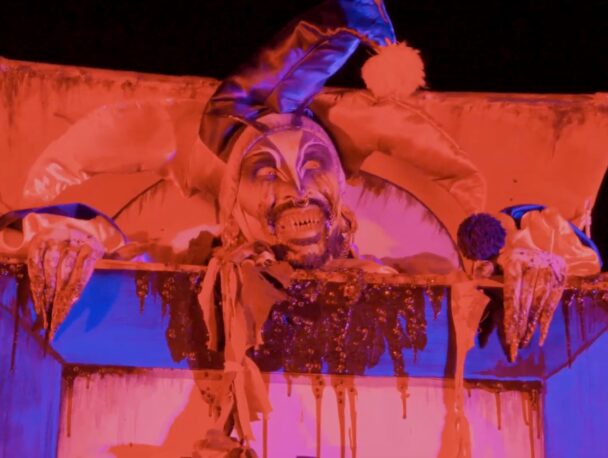
To me, Auntie Heroine is a storyteller in more ways than one. In fact, I think that the deep horror evoked by their drag carries as much meaning and opens the mind just as much as the story they read out. The last three numbers performed by Auntie Heroine each started from a character: a baby-eating bunny; a manic, murderous jack-in-the-box; and the last survivor of a health epidemic, surrounded by dead bodies (portrayed by friends of Noisy Visuals) that rose up to finally consume them. What was so compelling about each performance was not just how profoundly they portrayed characters through performance and costume, but also how each unique character implied a terrifying story that forced the audience to reach into the darkest recesses of their minds and use their imagination, something that only the best storytelling can achieve.
Drag is unique in that it is one of the few art forms still popular today, especially among young people, that relies on physical presence and the active participation of the imagination. It is the audience’s energy and willingness to buy into the drag fantasy that yields the reward. Because drag artists perform as individuals, presenting their own personal imaginative spectacle, unmediated by writers, directors, or costume designers, they boldly present confidence in their creative self. Auntie Heroine described the many layered ways in which the individual creativity that drag allows can free and inspire people to find their own individuality. Auntie Heroine locates the basis of such inspiration in the creativity we possessed as children and the importance of holding onto that childlike imagination and individuality.
“[Drag] gives you permission to play, just like when we were kids and we could go into our treasure chest full of costumes and wigs and masks and wands or whatever the hell we had, and we could create our own identities and beings and just have fun,” Auntie Heroine said. “And I think drag gives us that permission as adults, because for some reason, we’ve taken that permission away. So it gives us a chance to be able to play with being on stage, play with interacting with people, play with our own identity.”
They added that drag not only provides an outlet for imagination but also allows us to speak truth to identity.
“I think drag is a means of activism: just, like, [being] queer,” they said. “Joy is protest. Drag is activism. It is a protest against the people who would not even look at the political climate right now. It gives us a chance to speak our truths.”
Auntie Heroine explained how the direct connection between the artist and the art heightens the individuality of drag as an artform and inspires the audience to identify with the uniqueness of each drag performer.
“I think it’s fine to have a human be a role model,” they said. “So often our role models are the characters that we grow up with, whether it’s Disney or, for me, ‘The Lord of the Rings.’ I think that drag is almost a better spokesperson, a better activist than any regular human, because we are larger than life. We are encompassing so much more. We are real life superheroes or antiheroes.”
At the end of their performance, Auntie Heroine brought out all the members from Noisy Visuals who helped with the show. They then stepped forward and gave a speech on the dangers that the LGBTQ community is facing because of the current U.S. government’s anti-gay and anti-trans messaging. They stressed the importance of everyday queer visibility.
“What is going on right now? It is the active and targeted division of people,” they said. “It is an oligarchy working, using fascism to create tyranny. And what an oligarchy wants more than anything is to create chaos, so that things become so overwhelming for people that they can’t focus on one topic.”
Auntie emphasized that the LGBTQ community, especially the transgender community, is especially vulnerable in the current political climate.
Out of drag, Auntie Heroine is a non-binary person. They experience the dangers of their differences every day. But they said they do not give up hope for their community, reiterating their message of visibility.
“First and foremost, and this is to all LGBTQIA+ people, is that we have to stay visible,” they said. “They want us to be scared. They want us to disappear. But ultimately, they are a minority, and we are the majority, not as LGBT people per se, but as people that support us: good, decent people.”
As part of Auntie Heroine’s emphasis on the impact of childhood and what it can bring us in adulthood, they also spoke about how important education is in creating unity and understanding. That’s why they found it such an exciting opportunity to showcase their personal art in their own show at a university.
The show’s incredible execution, detail, and spirit left me with a constant and profound sense of wonderment and will to create, even if just in imagination. Thankfully, Auntie left our interview with a message for the college students who endeavor to continue the trail of their imagination and artistic individuality.
“Remember that any performance, especially drag, is about the love of it,” Auntie Heroine said. “It’s not about the money. And if you’re doing it for the money, stop doing it and reevaluate your life. Continue to do things for the love of them. I think we know as artists—at least we should know and you should be prepared—that artists will always be working side jobs or whatever they need to do to survive, but we all know that the real work is what we do with our passions. Just do anything possible to continue doing your art.”
Charlotte Seal can be reached at cseal@wesleyan.edu.
Leave a Reply