
WesCeleb: Saydie Grossman ’26 on A Cappella, Theater, and Finding Her Place
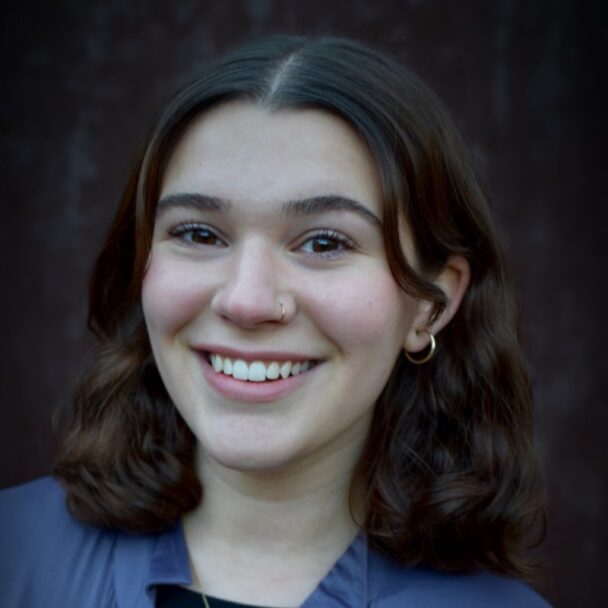
Saydie Grossman ’26 has done everything. In this week’s WesCeleb, she looks back on her experience at the University: shifting from STEM ambitions to a double major in theater and philosophy, joining a cappella and theater groups on campus, and discovering her voice on stage and in academics. The Argus sat down with Grossman to discuss what she’s most proud of, the challenges she’s overcome, and her advice for finding authenticity and connection at the University.
The Argus: Why do you think you were nominated to be a WesCeleb?
Saydie Grossman: I have been privileged enough to be in so many spaces on this campus and to get to know so many people throughout these three years. I navigated essentially between three or four prospective majors and ended up getting very close with the people in my current majors. I work in admissions, and I’m in a cappella and student theater. These are just big circles of people. I feel like I know most people’s names in all of those spaces.
A: What are you majoring in, and what drew you to these majors?
SG: I’m a double major in theater and philosophy. I came into college as a prospective molecular biology and biochemistry major. I did tons of science research and sciency, mathy things in high school, and that was what I wanted to pursue in the beginning, but I very quickly realized that was not my venue anymore. So I ended up branching away from biology into public health. I took this amazing public health course with [Visiting Assistant Professor of Molecular Biology and Biochemistry] Henry Meriki. That really made me just so much more aware of the non-physical sides of science, bioethics, and public health. And from there, I was really interested in ethics, so I took an introduction to ethics course. I realized that was what I wanted to do, and I got really involved in environmental ethics. I took a bunch of environmental classes, and then I further branched into the philosophy world into philosophy of art and aesthetics, and that’s what I’m doing my senior thesis in.
A: Can you tell me more about your thesis?
SG: I’m writing a thesis on the philosophy of performance, which kind of nicely meshes my two majors together. I’m interested in authenticity and [the] display of authenticity, and how different audience relationships can put authenticity into question. Behind the fourth wall, in front of the fourth wall, [and] this new term that I’ve been thinking about, called sitting on the fourth wall, which is like a self-aware performance, and how the authenticity of a performance can be put into question. It’s very theoretical, but it’s also grounded in this practical exploration I’m doing this semester through the theater department. I’m in this production that’s currently called “Marta Becket, Save Us All.” It’s an experimental devised piece, which basically means everybody in the ensemble is creating the show together, and staging and writing and coming up with it together. And a lot of the questions of the show are: What makes an authentic performance? What is an audience? And what is your ideal audience?
A: You’re pretty involved with a cappella on campus. Can you tell me a little bit about your involvement with that?
SG: I’m in two a cappella groups, [Notably Sharp and Triple Major]. I’ve been involved in both of them since my freshman year, and they’re very different. Notably Sharp, we call ourselves the best-dressed a cappella group. I think overall, our tone is just warm, homey-sounding music. It’s the kind of music you want to be singing around a fire with your friends. I feel so close to this group of people. They’re like my go-to friend group and family on this campus.
And then I’m also involved in Triple Major, which is the competition a cappella group. We prepare for [the International Championship of Collegiate A Cappella] every winter, and that’s super, super fun. It’s a little more intense, but it’s a lot of fun. I think the group has gone through a lot of changes in the past few years, so my involvement has been a lot of [trying to] bring the group together in some ways. I’ve really enjoyed being part of both spaces. I feel like they occupy completely different spaces in my mind.
A: You’re also heavily involved in Spike Tape; I’m curious to hear what that experience has been like.
SG: I’ve been involved in Spike Tape on and off since my freshman year. Last year, I had the chance to be in two productions on campus. My connection to theater has largely been through musicals in high school. [Last year,] in the fall, I was in a production of “Falsettos” directed by Quincy Segal [’26]. It’s one of my favorite shows of all time, and it’s a tight ensemble of seven people. There are only five in the first act, and then [two more] in the second act. It was such a small cast, but I think it was over 40 people working on the show, be it the musicians, the production team, stage management, crew, costumes, all of that. And it became such a wonderful little “tight-knit family,” which is a reference to the show.
And then in the spring, I was in a giant production of “A Chorus Line,” [which,] unlike “Falsettos,” was a cast of, I can’t even remember, 25, maybe 21 people. It was a completely different style: tons of dancing, just an absolute chaos of dancing and singing, and these giant dance numbers. Overall, my time in Spike Tape has just been so much fun. It’s fun to see how Wesleyan students will really pour themselves into time-intensive things that don’t pay and don’t have credit associated with them, but are so fulfilling.
A: Why did you decide to become a tour guide?
SG: Oh, wow. That was a while ago. I became a tour guide in my second semester at Wesleyan. I think, in part—other than being somewhat adopted by some sophomores who were already tour guides and wanted me to become one—I was really struck by the overall vibe of WesFest when I came. When I met the Wesleyan students [there] and saw how warm and excited they were to talk about their time at Wesleyan, it really just made me excited to go here. I also work at the desk at the Office of Admission now, and it’s a really fun experience. It’s so lovely to meet so many prospective students and get to know their experiences. I’ve had so many students on this campus say, “You’re the reason I came to Wesleyan.” I mean, what a privilege to be able to give somebody that kind of perspective and that excitement to come to the school.
A: What’s your favorite tour guide fact to share?
SG: I always talk about how we have the best-attended football games of any liberal arts school in the country, and that’s because anybody who walks across or is in the building surrounding Andrus Field during the time of a football game is considered a spectator. And by that metric, I’ve attended every single football game.
A: What are some things you like to do outside of academics in your free time?
SG: Oh, that’s assuming I have free time. That’s a really good question. I mean, the cliché: I really love spending time with my friends on campus. I feel like I have spent a ton of time with friends in the practice rooms, especially the last few years. I’ve loved sitting by the piano and singing with my friends. I love just taking walks around campus. My boyfriend and I do that often. I love the falafel truck. Did you know that the [family that owns Mamoun’s] Falafel Truck had a miniature horse? My boyfriend and I were here over one summer, and we watched the family walk by the Connecticut River with a little mini horse on a leash.
A: Do you have any advice you would give your freshman self?
SG: I think that being socially independent is the greatest skill you can learn. In high school, you were socially successful if you had a friend group, and at Wesleyan, it can feel a little cliquey sometimes. I think if you let yourself be free from that, which is a process that I could only explain to my freshman self now, and just realize that only you are responsible for your own self, then you’re a better friend. Because when you’re in a friend group of people that just forms for the sake of having a group, it’s so much harder to form connections.
A: What are you looking forward to this year?
SG: I feel like I’m on the precipice of being burnt out, but I’m not there yet. This next semester of intense thesis work and more intense academic work will be a little bit of a push, especially as the weather gets colder and I’m spending more time in the library and at my house. Once I get to spring, I feel like the adrenaline of it being the Spring semester will carry me through to the end. I think if somebody told me I had another year after that, I’d be like, absolutely not.
I feel really excited about the show that I’m going to be part of this semester. I’m really looking forward to seeing how it shapes up. I think this whole show is so much about process and not product, but I’m excited to see what the product ends up being. And it’s expanded my view of what theater looks like and how my own story can be present in what I put on stage.
I’m excited for sweater weather; [I’m] just loving the fact that it’s slightly cooler out already. I also love the homecoming weekend vibe. I love my a cappella group. [Notably] Sharp does a winter and a spring retreat where we go and spend three or four nights in a house together, and it’s just the most loving, wonderful time. We cook and we sing and we go on hikes. It’s just so lovely.
A: What is something you’re proud of?
SG: I feel very, very proud of “Falsettos,” [and] of my personal growth through that. I feel so proud of how the team came together. It was just a wonderful time and a really enriching theatrical experience for me to have in college. I can imagine this show this semester already being and becoming one of the things I’m most proud of. I’m really enjoying being a part of it. It’s a very introspective process, and I just feel like, already, so much of myself has been brought into the space.
I didn’t even mention this, but I’m working with a nonprofit organization this semester called the National Education Equity Lab. It’s coordinated through Professor [of Philosophy] Tushar Irani, who works in the Philosophy Department and the College of Letters. He was a professor of mine, and he asked me if I wanted to be part of this program, which is basically an organization that brings college courses virtually to Title I high schools around the U.S. I’m helping not only as a teaching fellow in that course, but I’m helping to lead the cohort of teaching fellows this semester, which has been really fun.
More broadly, I just feel very proud of my academic journey. I have this really wonderful professor, [Assistant Professor of Philosophy] Nicholas Whittaker, who is my thesis advisor, and they’ve also been my professor for three courses. They teach in the philosophy department and have just emphasized to me the value of my own thoughts and to recognize myself as a valuable thinker and student. In philosophy, the data points we use are just thoughts that people have, so acknowledging myself as having valuable data points is a big thing to grapple with, because alongside Aristotle and Robin Wall Kimmerer and freaking Paul Taylor, I am right here, and I’m like, “Hey, guys, you know, I do have things to say.” I think it’s very true of my time here, and it feels like something I’m proud of, that I can be a standalone, socially independent free thinker.
This interview has been edited for length and clarity.
Lyah Muktavaram can be reached at lmuktavaram@wesleyan.edu.
Nathan Yamamoto can be reached at nyamamoto@wesleyan.edu.

Leave a Reply