
Beyond The Blue Lights: Meet the Carnies
It’s 5:15 on a Wednesday afternoon, and the carnival in the parking lot at Middletown’s Palmer Field is quiet. The rides are switched off, their lights out and their cabs empty. Atop the Ring of Fire, a vertical wheel inside which hapless riders are flung in terrifying circles, a few pennants flutter in the wind.
The carnival’s employees mill about beside the central food concession, a low-ceilinged trailer covered with signs advertising Italian sausage and cheese steaks. Shivering in the early April chill underneath layers of hooded sweatshirts, they chew tobacco and smoke cigarettes as they wait for Arlene Coleman, the boss’s wife, to start handing out cups of coffee.
All at once, one of the fair’s three diesel generators roars to life, spewing an ugly cloud of black smoke. “That generator’s cold, boy,” says an old carnie by way of explanation. He peers at the dark cloud spilling across the closed park, hiding the Ferris wheel from view. “Hope that’s the reason.”
As the smoke subsides, Mary Oates emerges from the lot where the employees have parked their RV’s. Greeted by shouts of “Good afternoon, ma’am!” she unlocks the carnival office, which is situated in a trailer just behind the food concession.
Standing at the top of a low set of stairs, Oates passes around a sign-in sheet. A dozen employees wait their turns. Oates jokes with Rebel, a towering 200-pound bald man in a black and red leather jacket who has been with the carnival for 25 years, while Mike, the bumper car operator, fills out a safety checklist. Coleman Brothers usually employs about 20 people for the entire season, plus a few more in each town. It’s still early April, however, and a lot of the regulars haven’t shown up yet.
A cheery middle-aged woman with blonde hair and a loud laugh, Oates is a third-generation carnival manager. Coleman Brothers, now owned by her brother Tim, was founded by her grandfather, Richard Coleman, in 1916. Since she was born, Oates has spent nearly every spring and summer on the road. Beginning with the event in Middletown, where Coleman Brothers has its winter quarters, the carnival visits 22 fairgrounds between the end of March and Labor Day.
From year to year, much of the journey stays the same. They’ve been working some of the same county fairs for 60 years. “I’ve known the postmaster in Boonville, New York, since I was a kid,” Oates says.
Oates’ husband Anthony is also a carnie. He is the owner of Oates Concessions, the company that provides the carnival games at most of the Coleman Brothers shows. Their two sons, now grown, used to travel with them. It was through her sons that Oates learned of some of the hazards of the road.
“Farm girls,” she says. “In those little upstate New York towns, there isn’t much to do.” Each year when the carnival arrived, they would be waiting for her sons as soon as they got off the bus. “I’d ask [the girls] how old they were,” Oates remembers, “And they’d say, ’20,’ and I’d say, ‘My son’s 16! Stay away from him!’”
Life cycle events don’t wait for the winter. Over by the popcorn stand, Jessica Rossitto, a freshman majoring in criminal justice at Middlesex Community College, says that her mother went into labor while she was working the North Stonington Fair. Rossitto’s grandfather was the founder of Brownstone Amusements, a slightly smaller carnival company based in Portland. Since her grandfather died in 1992, their grandmother has been running Brownstone by herself. Now she’s looking to sell. “It’s hard for one person,” says Rossitto. “A lot of stress.”
Rossitto is at the fair with her brother Freddie. Both are working for Coleman while Brownstone is in transition. Freddie seems to be in his element at the fairgrounds. Dressed in a white hooded Coleman Brothers sweatshirt and a well worn pair of work pants, he says that he’s the only person who will climb to the top of the fifty-five foot tall Ring of Fire to put up the pennants. Wearing a harness, he starts out climbing the inside of the three-foot wide track. Then, about halfway up, he swings around to the outside.
“You can’t see, so you’ve got to sort of feel your way around with your foot,” he says.
Over at the machine-gun game, Jeff Kane is taking a few shots while he waits for customers. A carpenter from Florida, Kane answered an ad offering a chance to “Travel New England.” They called him back while he was watching “America’s Most Wanted” with his wife. “I said, I want to go on vacation,” he says. “It’s a good way to do it. You’re not going to die, people are going to look after you, you’re going to eat, and you’re going to meet a lot of people.”
By now, a few guests have filed onto the midway. The Ring of Fire is making a tremendous amount of noise. Over by the bumper cars, Mark says that he’s only had one person take the ride. Who that person bumped with is unclear.
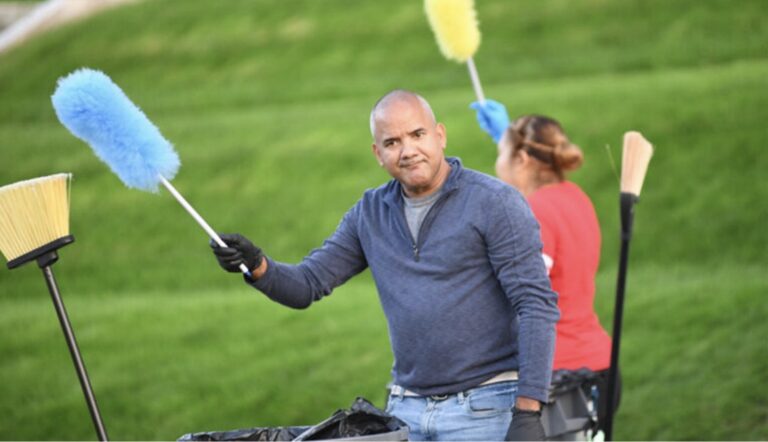
Standing under Ali Baba, a ride shaped like a tremendous hammer, the operator, John Morse, shows off the control panel. When asked if it’s a good ride, he answers, “I’m not really into riding carnival rides. I see them all the time.”

Are you sure the family’s last name is Oates..not Oakes?
I have been working for Coleman for three years, setting up and breaking down rides. It is so much fun and I learn how to do stuff with my hands and keep out of trouble. Sometimes I feel like the carnival is my home. I look forward to building the new rides this summer.
I wonder whether John Doolan still works for Coleman. He went on the road with them in 1955.
Back in 1972 I did abut half a season with John White who had some concessions that traveled with Coleman Bros. Fond memories.
i have been working with food concession on colemans for around 10 years.i work for al pecces and i really enjoy doing the work at the fair . It gets in your blood and year after year you show up and work another year.I had got out for around 10 years but i have been with lots of carnivals.I started out with buck page years ago in the early 1970s.I was 13 and help mazzarolas pizza. THEN I went to games and as i got older i run the rides .One year i got real bad pheonoma and i just keep working and i was choching up blood and a ambulance guy made me go to the hospital and i stayed in for over a month and then i took a bus and went to south carolina to go back.Its a lot of hard work when you open at 10 am and close a midnight.but its so much fun and i enjoy the work and meeting new people.
I just closed up my 2010 season. We play 4 spots a year and then we come home to phoenix. My boss is the coolest boss you could ever have. Yes, the hours are long but if you aren’t into anything bad then you save your moneyand live nicely during the winter. I wouldn’t even think about getting a sucker job now. This is what I’ve been looking for all my life.
can someone please tell me what their season schedule is like i got that they start in middletown, but then?