Tag: Main

  • Environmental Advocacy Coalition Hosts Workshop on Gas Pipeline Opposition 

    Environmental Advocacy Coalition Hosts Workshop on Gas Pipeline Opposition 

    c/o Spencer Landers

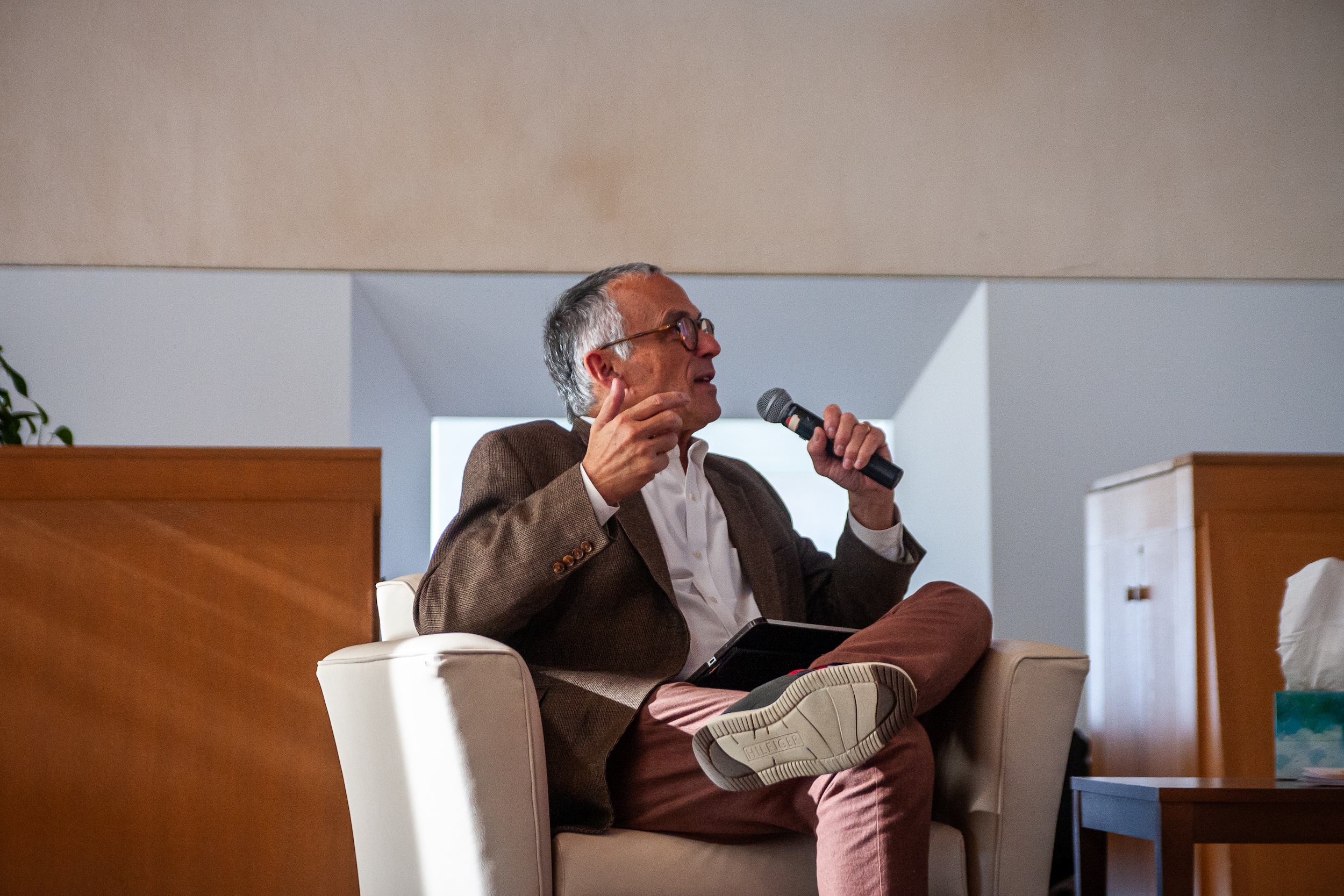
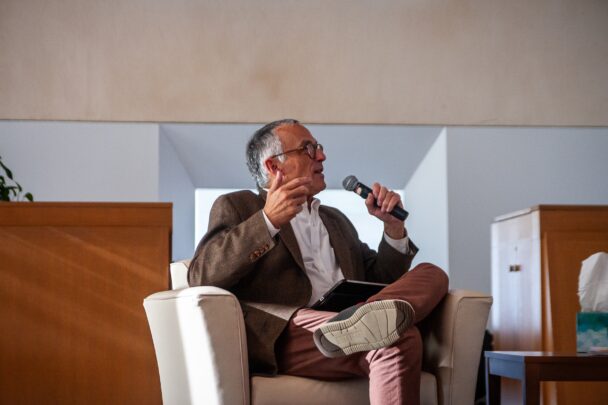
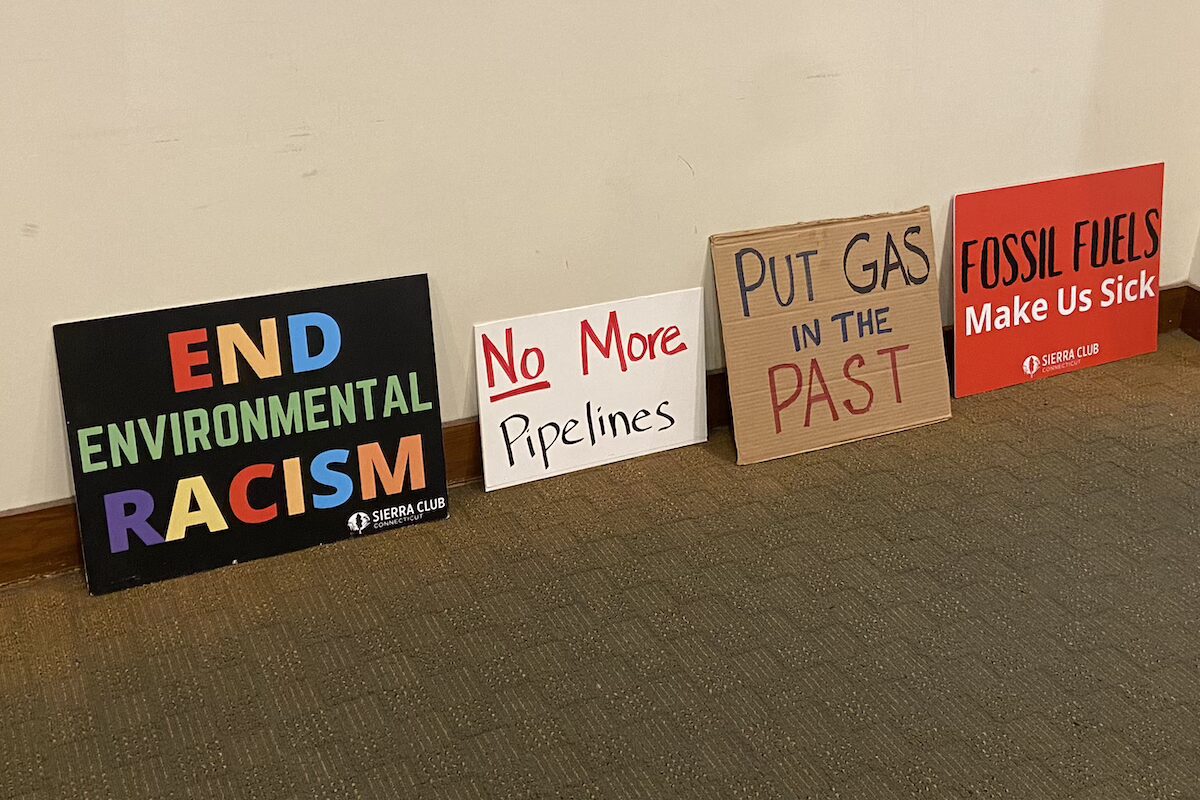
    Dozens of student activists attended a workshop in Exley Science Center on Saturday, Dec. 6, focused on methods to fight gas pipeline expansion in Connecticut and the broader northeast. The event was hosted by No Pipeline Expansion (NOPE) Northeast, a multi-state coalition comprising over a hundred community organizations opposed to gas pipeline expansion projects in the northeast United States. 

    Formerly known as Stop Project Maple Coalition, NOPE was initially established to counter Project Maple, a methane gas pipeline expansion across Connecticut, New York, Rhode Island, and Massachusetts proposed by multinational oil transportation and energy company Enbridge. Since then, NOPE has broadened its scope to further oppose pipeline projects in the broader northeast, such as the New York Northeast Supply Enhancement Pipeline. 

    Although Connecticut does not produce its own gas, relying largely on imported gas from other states, three main interstate gas pipelines pass through the state as of April 2025: the Algonquin Gas Transmission, Iroquois Gas Transmission System, and Tennessee Gas Pipeline.

    The first half of the workshop focused on NOPE’s opposition to multiple pipeline concepts that have piqued the interest of both President Donald Trump and Connecticut Governor Ned Lamont, which NOPE views as a potentially ruinous alliance. The Trump administration hopes to repeal numerous environmental protections and rebuild cancelled pipelines along the East Coast; the governor has expressed interest in some of the plans. At the event, speakers elaborated on the potential risks posed by these collaborations, including economic and public health concerns, environmental damage, and energy dependence on out-of-state fossil fuels instead of local energy solutions. The speakers argued that clean, locally-sourced energy leads to lower energy prices, broad economic growth, energy security, and healthier, cleaner communities.  

    “I think we’re in a really critical moment for a number of reasons,” Sarah Dynowski, State Director of Sierra Club Connecticut, said. “The pressure from the federal government, the Trump administration specifically, to build pipelines that we don’t actually really need is really a challenge. And it’s becoming more and more of a challenge, because the narrative that somehow we need more gas has been taking hold, and we know we don’t.”

    The workshop further discussed different ways in which students could get involved in protests against environmental deregulations and pipeline projects. Participants were given index cards to write down actions that activists could take to best fight pipeline projects. After that, participants split into groups to brainstorm targets and tactics. 

    Sierra Club Connecticut, a member organization in the NOPE coalition, is the state chapter of a leading national environmental nonprofit. They were the primary organizer of the event, and chose the University as the event’s venue due to several different reasons.

    “[We had the event at Wesleyan] largely because it’s in the middle of the state, and also between New York and Massachusetts…we’re trying to bring people in from around the region,” Sena Wazer, the Volunteer and Outreach Coordinator for Sierra Club Connecticut and the main event organizer, said. “I also really love having it on college campuses, because I think it helps bring in students, and I worked with Sunrise Movement Wesleyan to bring in students from Wesleyan.”

    Sunrise Wesleyan is the University’s hub of the youth-led national Sunrise Movement, which has worked on political engagement against climate change via local advocacy. In 2019, the energy provider Eversource began construction of the Southeast Resiliency Project, installing approximately ten miles of gas pipeline between Middletown and Montville.

    “There is a gas expansion project happening in Middletown,” Dynowski said. “Eversource is expanding pipelines for redundancy’s sake. It’s going through Middletown and then under the Connecticut River.”

    Wazer and Dynowski both noted that they had visited the University before. 

    “I have come here several times to some environmental studies classes, just to talk about the history of the environmental movement and the kind of issues we’re facing now, and it’s great,” Dynowski said. “There’s a lot of terrific ideas.”

    Several University students, many of whom were members of environmental advocacy organizations, reflected on the importance of events like the workshop. 

    “We should all care about how this energy is furthering the climate crisis, causing asthma and health issues,” Sunrise Movement Wesleyan Coordinator Sasha Lovell ’28 said. “We need to start learning about the expansions that are coming close to Wesleyan so that we can oppose them, because these are things that are really unhealthy, unpopular, and backed by these big government interests. I think that’s something that everyone should be concerned about.”

    Students also called for the University to follow its own environmental commitments. 

    “At Wesleyan, our policy that’s been passed on is the sustainability strategic plan [SSP], and this is our way of trying to get to carbon neutral,” Sunrise Movement Wesleyan coordinator Aviva Branoff ’26 said. “Our goal is to be carbon neutral by 2035, and this is not at all the trajectory that we’re on. Wesleyan students should be educated and ready to support the SSP, know what it is, know how to fight for it, and hold the school accountable for something they already signed and agreed to follow.” 

    According to the University’s SSP annual report for FY 2025, the University has reduced its carbon footprint by 32% from its 2008 baseline, largely attributed to converting majority of campus heating pipes to energy-efficient hot-water pipes, improving student transportation, and reduced faculty air travel.

    President Michael Roth ’78 reaffirmed the University’s goal to go carbon neutral by 2035, stating that there are more phases to be completed for energy-saving infrastructure projects on campus, which will further help in achieving eventual carbon neutrality.

    “It’s expensive, it takes a while,” Roth said, adding that energy-efficiency has become a priority whenever a major construction or maintenance project takes place, referencing the new science center scheduled to open in Fall 2026. “It’s done all in the summer, but it’s really been very effective in reducing our dependence on fossil fuels. So we’ll continue to do that.”

    Dynowski invited interested University students to join the fight for climate action.

    “We welcome folks to be involved, because there are lots of activities that can be done from one’s dorm room,” Dynowski said. “Students can also join a rally or event, or just brainstorm some fun ideas we might do, like a march, a bike ride, or a flash mob. We want to have a diversity of voices at the table so that we do good work.”

    Spencer Landers can be reached at sklanders@wesleyan.edu.

    Brendan Kelso can be reached at bkelso@wesleyan.edu.
  • Letter From the Editors: At 45 Broad Street, Someone Like You Cares a Whole Awful Lot

    Dear Reader,

    A friend, a fellow at NPR, recently recounted a morning when six journalists had to look over a sentence they’d written before it could air. That number made us smile. You can’t publish a word in The Argus without seven people reading it first.

    Increasingly, it feels like we’ve become focused on product over process, conclusion over confusion, result over reckoning. Our world’s investments in AI might promise a reduction in mundane work (robotronic inbox clearance! Defenestrate your spam!), but what follows, we fear, is a loss of the voluntary, collaborative, and human decisions behind every good system. 

    Should we accept this premise? At The Argus, we’ve remained as committed to process as to product. Twice-weekly, our production nights regularly run nine hours: New writers work in-person with senior editors; the Copy Department debates the validity of a comma; the layout editor grabs hold of the aux, and a midnight dance party might occur, depending on the editor’s music tastes. The process can also be slow and frustrating and tedious, but it is in those moments of depth that the importance of this work, the pace itself, shines through. In a work culture that prizes efficiency, how often do you get to linger with a sentence for an hour? To write and rewrite a headline until it fits? To care for one word against another?

    Journalism has always been about this “business of caring,” as sports writer Roger Angell wrote. This organization, run almost entirely by unpaid 20-year-old volunteers (62 of them, next semester!), still cares a whole awful lot. 

    This semester, The Argus has had to navigate the increasingly repressive Trump administration with care. International student members of The Argus, who work as invaluable editors, managers, and contributors, have turned down assignments and asked for their bylines to be removed from written works for fear of government retaliation. Students, both international and domestic, have voiced legitimate concerns about writing pieces critical of the Trump administration, and former Argus contributors have requested that past political opinions be removed from the newspaper’s online archive. On Oct. 15, The Argus joined 54 other college newspapers in signing an amicus brief supporting the Stanford Daily’s lawsuit against the Trump administration; you can read our rationale for the decision here

    In the midst of a national crackdown on newspapers, both student and professionally run, our staff published 21 editions of The Argus. Our News team delivered rigorous coverage and investigations of campus protest, University policy, and the impacts of the Trump administration on Wesleyan. Our Features section wrote diverse profiles of campus partnerships, WesCelebs, Greek life, and trolley systems. Our Arts & Culture writers covered innovative student theater, literary magazines, and hard-working ballet dancers. The Sports section interviewed award-winning athletes, wrote about Hollywood endings and last-second heroics, and covered record-breaking seasons. Our Opinion team edited passionate repudiations of the University’s drinking game ban, detailed essays on the United States’ political state, and brought back the sex column

    That’s to say nothing of our Ampersand, Comics, and Puzzles sections, who populated our print editions with cross-words and cartoons, and our devoted Copy and Layout teams. And not all of the progress happened within the newsroom—nearly a dozen masthead members helped launch a weekly newsletter, install over a dozen newsstands on campus, revamp our social media, and work to make our website more attractive and functional.

    All of The Argus’ sections, from the finance team to the archivists, brought on first-time contributors this semester, totalling 35 new contributors (21 of whom became staff writers, with three or more contributions). They helped us publish 266 articles this fall. Of the roughly 315,000 words we published, we know of only two that were misspelled.

    In a time where fear and apathy feel, paradoxically, equally pernicious, we turned to faculty for a wiser, broader perspective through our Letters on Pragmatic Hope. Their writing reminds us that our societies have felt scared and worried before, but that we can, and must, continue to make changes—internally and externally. Even today, Professors told us, students are increasingly turning towards meaningful beauty. (Wesleyan’s music department, Dean of Arts and Humanities Roger Grant notes, has more enrollments than almost any other department on campus.)  

    It’s a pessimistic time to be a 20-something-year-old. It’s a pessimistic time to be any years old. But it has been a gift to spend time with so many people who still believe so deeply in community, storytelling, accountability, and the pursuit of beauty and truth.

    Right now, our words live somewhere in transit: between copy editor and layout designer, WordPress and InDesign. They live in process, where a whole bunch of people have spent their Monday nights writing and rewriting, collectively converging upon something never quite finished.

    We are quite sad our semesters as editors are drawing to a close. You can doubt us (see nine hour productions), but it’s been deeply inspiring to understand this paper from article inception to print publication. We are, however, incredibly excited to welcome next semester’s Editors-in-Chief, Janhavi Munde ’27 and Peyton De Winter ’27, who currently serve as The Argus’ Managing Editor and Production Manager. They will be joined by incoming Managing Editor Raiza Goel ’28, one of our current news editors. We have absolute confidence in their leadership, and we’re so excited to see the direction in which they take this paper.

    While we write, these words live on a screen. To celebrate our final edition, in the morning, we will wake up at 7 a.m. and drive to the printing press and stand among the machines that toil and twist and turn these bits of binary into the ink in your hands. 

    That’s amazing, isn’t it? That people still get to do this? As long as there are people to interview and paper in this world, we know that the dozens of Wesleyan students who make this paper run will continue to make the biweekly, downhill walk to our 45 Broad St. office. 

    With gratitude,

    Thomas Lyons & Miles Pinsof-Berlowitz

    Editors-in-Chief

  • College Football Has Sold Out and Forgotten How To Be Itself

    College Football Has Sold Out and Forgotten How To Be Itself

    c/o James Black / Getty Images

    The NFL is designed to crown a champion. It has equal schedules, capped salaries, fair drafts, and structured parity. It’s a machine built to decide who’s best. College football is the opposite. It’s inherently unfair. Some teams get six home games, others three. Some conferences play eight games, while others play nine. Texas may schedule Ohio State out of conference while Georgia plays Marshall. With 133 programs, the sport is structurally incapable of determining the best the way the NFL can.

    And for so long, that was fine. That unfairness created space for dozens of narratives to matter simultaneously. You didn’t need to be in contention for a national championship to have a meaningful season. You could beat your rival, win your conference, or earn a bowl berth for the first time in a decade. The impossibility of fair comparison meant more things could matter.

    In the past decade, college football has been trying to become the NFL: NIL, the transfer portal, conference realignment. But the aspect that’s flown most under the radar in hollowing out the sport is the obsession with crowning a national champion.

    History of the National Champion

    The championship obsession didn’t start recently, and the sport has never been able to agree on how to crown a champion. For most of the 20th century, the national title was decided by polls. There was the Associated Press and the Coaches Poll. It was a wildly imperfect system. Voters saw only a handful of games due to no DVR and TV restrictions, and coaches rarely watched anyone but their opponents. Unsurprisingly, the polls disagreed 11 times between 1950 and 1997. Coaches lobbied and the media debated, but those conversations didn’t define the season, and they didn’t interfere with everything else. Rivalries, conference championships, and bowl games all mattered on their own terms.

    The BCS (1998–2014) paired #1 and #2 using polls and computers, preserving bowl tradition while creating a title game. But flaws still persisted. In 2003, USC was top-two in both polls but didn’t make the Championship Game because the computers didn’t value their metrics. The system also faced antitrust challenges.

    In 2014, the College Football Playoff debuted as the solution. A 13-person committee selected the top four teams for a single-elimination bracket, rotating through the New Year’s Six bowls. The playoff was undoubtedly the fairest way yet to determine a championship. However, bowl games lost prestige, with star players sitting out even New Year’s Six bowls if their team missed the Playoff.

    The 12-team playoff is in its second year. It was sold as increasing parity and creating marquee matchups. Parity hasn’t and won’t improve, as it’s virtually impossible for a Group of Five team to win multiple games. And sure, there are more marquee matchups. But they came at a disproportionate cost. The old systems, imperfect as they were, left room for conference championships, bowl games, and regular-season matchups to matter alongside the national title race. The expanded playoff obliterated that balance. Now there’s one narrative: who’s in and who’s out. Games still decide conference championships and rivalries, but when they don’t shift playoff seeding, they lose prominence. 

    The current 12-team CFP format created the possibility of this problem. The expansion to 4 teams, then to 12, wasn’t just about fairness; it was also about money. And that’s where ESPN’s economic incentives made the problem inevitable.

    ESPN

    ESPN is the sole media rights holder to the College Football Playoff. They paid billions for exclusive access, and they’ve built an entire media apparatus to justify that investment. They broadcast (or sublicense) all the playoff games and host countless shows debating and previewing the playoffs. They also own the SEC Network and ACC Network, giving them direct financial interest in those conferences’ success. 

    During the regular season, ESPN shares broadcast rights with Fox, NBC, CBS, etc. But the playoff is theirs alone. Every playoff game, every playoff selection show, every minute of playoff coverage generates revenue ESPN doesn’t have to split. So, from a pure profit standpoint, devaluing the regular season for the benefit of the playoffs makes sense. Why hype a Conference Championship game Fox is broadcasting when you can debate playoff positioning instead?

    I was watching ESPN on Wednesday when I realized how far this had gone. ESPN analysts were discussing how Indiana vs. Ohio State was virtually pointless. The argument is that both teams will stay at #1 and #2 in the rankings regardless and receive byes. 

    #1 versus #2. Both are undefeated. The winning QB likely takes the Heisman. One of college football’s bluest bloods against a program having its best season in 70 years. It’s as “Game of the Century” as “Game of the Century” gets, and ESPN is talking about how it’s pointless…while not even sending College GameDay there. 

    ESPN has built weekly shows dedicated to the bracket. They turned their commentators into selection committee surrogates, constantly ranking teams instead of talking about the X’s and O’s or weird, wild stories that used to drive college football. It doesn’t feel like coverage of college football anymore; it feels like coverage of a selection process. And because ESPN controls so much of college football media, their framing becomes the only framing.

    All this matters because fans adapt to what they’re told is important. When ESPN frames every game through playoff implications, when they spend all week hyping bracket scenarios instead of rivalry games, that reshapes fan psychology over time. You can’t sustain organic passion for something the entire media apparatus is telling you doesn’t matter in the big picture. Eventually, fans internalize it.

    Consequences

    Fan passion alone can’t sustain traditions. Traditions need institutional support: games that actually happen, not rivalries eliminated by realignment. They need players and coaches who treat them as important, not programs declining bowl games entirely. Conference realignment has already proved this by killing regionality because schools chased TV deals. 

    And now the playoff is coming for what’s left. The four-team playoff hurt bowl games. The 12-team playoff has all but killed them and is slowly doing the same to conference championships. This week, BYU dropped in the rankings because they lost their conference championship game. In fact, since the CFP was invented, the Alabama this season is the only team to lose in the conference championship and not drop. So if a championship can hurt your playoff seeding more than help it, why play one? The discussions are already there, and it’s not hard to imagine power conferences eliminating them within a few years. 

    As an Oklahoma fan, I remember the 2020 season. We lost our first two Big 12 games, and playoff hopes vanished before October. But that year was unforgettable: a four-overtime Red River shootout, crushing Oklahoma State in Bedlam, revenge against Brock Purdy and Iowa State in the Big 12 Championship, and then dismantling Florida in the Cotton Bowl. Not one second had anything to do with the playoff, and it was still my favorite season. 

    On Sunday, Notre Dame declined its bowl berth after missing the playoff. If a program whose entire brand is built on tradition and independence won’t play a bowl game, what does that signal to the rest of the country? Well, Iowa State and Kansas State are also declining bowl berths. 

    The pursuit of ‘the best’ was never the point of college football. It was a sport defined by the plural, not the singular, dozens of narratives mattering simultaneously. The minute everything had to feed into one definitive answer, the rest stopped mattering. The regionality, the chaos, the possibility that a 9–3 season could be triumphant, all were sacrificed for a single championship narrative.

    College football is becoming a closed system of 20–30 programs playing for one trophy while everyone else exists as content filler. And there’s no evidence that anyone with power is going to choose the sport’s long-term health over short-term profit.

    Sam Weitzman-Kurker can be reached at sweitzmankur@wesleyan.edu

  • Introducing SafeWords, Wesleyan’s Sex Column: Going Down, Getting It Up, and Covering the Bases

    Dear Argus Readers,

    We are pleased to announce the inauguration of a brand new sex column in The Argus, SafeWords. This column is dedicated to answering your most pressing questions about intimacy: Whether you can’t seem to “get it up” or don’t know how to “go down,” we’ve got you covered on all bases, so that you can get to third base. Let’s lay the foundation so you can…you get the idea.

    Let us introduce ourselves: We are Birdy and Bea. As writers for the school newspaper, we know all about sexual intercourse. That’s why we’re bringing our expertise to you, dear reader. Though our gendered names might suggest a heteronormative relationship, we are not actually gendered beings, but disembodied space particles wandering through the aether. Bet you didn’t see that coming.

    This first issue, we’ll be sharing anecdotes—call them hook up stories—about the most disappointing feeling when things get steamy: “Well, I’m really into you, but I can’t feel anything down there!”

    Why does this happen to so many of us? 

    One reason for a “dry spell” is that you are on Selective Serotonin Reuptake Inhibitors—street name, SSRIs. By a conservative estimate, this is about 100% of Wesleyan students. A lackluster libido is a common side effect of SSRIs. At the moment, there is inconclusive evidence that SSRIs have any effect on sexual dysfunction. Daniel Bergner points out in The New York Times Magazine that seemingly very little research has been done into this question. But, he says, the medical community is beginning to move towards an acceptance of PSSD, or post-SSRI sexual dysfunction. 

    Birdy

    Who cares what the medical community thinks. An answer many of us, including yours truly, have taken as truth is that SSRIs do inhibit sexual performance. The higher the dose, the greater the effect: I, Birdy, have seen the unsettling effect of forgetting to take your pills. Suddenly I start feeling like a pooch on the loose. I’m also on a relatively high dosage of Zoloft, and I’ve been taking it since the 3rd grade, so when I come off it, the effect is extreme.

    One time, I was having complications. The other person simply said, “It’s okay, we can have fun. Nobody has to come.” That, I think, is the attitude we should all adopt. Diplomatic. If I wasn’t into you, I wouldn’t be in bed with you.

    I do think it’s unfortunate that we must choose between mental and sexual wellbeing. I hope more work is done into this, because is our generation not the most notoriously horny of them all? I mean, we interact with adult content, softcore and hardcore, on our personal devices all the time. We read smut. We scroll past NSFW posts on social media. Pornography is widely accessible in a way never before in history. You can watch millions of videos of the nasty stuff on your phone at any second. Some say we are the most sexually free generation, and yet we have been all but neutered.

    Bea

    Welcome to Wesleyan, where every second person you meet is on SSRIs. (I’m kidding, obviously. I’m making that joke because I’m on Zoloft. Get that treatment if you need it, no shame!) SSRIs affect everybody in different ways. You’ll never meet someone who has had the exact same experience as you, especially with regard to sex. For example, I recently had a conversation with a friend about our latest sexual experiences. While my SSRIs have made it nearly impossible for me to orgasm, she has had no issues with being able to do so (which is SO unfair). 

    Not too long ago, my ex-partner and I had a conversation where he said that I don’t seem to enjoy penetration too much. After some time thinking about this, I realized that I can still feel aroused, but it doesn’t really translate well downstairs. You know what they say about the “motion of the ocean,” but there’s no ocean to begin with, which makes it pretty difficult if he’s looking to “invest the family jewels.” Apparently, this can be a side effect of SSRIs, but I had never heard of this, and I have read the side effect list at least a dozen times. (Every time I get my medication refilled, they give me a new one, just in case I forget) That’s the thing: There’s a list, but it isn’t truly comprehensive. I had heard that it can make it harder to orgasm and that it reduces libido, but there’s a whole host of other things SSRIs can cause that no one bothers to mention. 

    With that being said, we humbly offer our advice:

    1. Talk to your partner

    Maybe the most important piece of advice we can give: TALK TO YOUR PARTNER. Whether this is long-term, short, or extremely short, if they’re a decent person, they should be able to understand the situation. If you’re just not feeling it, don’t push yourself to do something. It won’t be fun for you if you have to pretend you’re aroused or act like you enjoy something when you don’t. 

    2. Don’t skip multiple doses in hope of an orgasm

    While Birdy might have a different opinion on this, I, Bea, will say that when I tried to skip multiple doses in hopes of an eventual orgasm (desperate, I know), it just made me feel depressed and anxious (ironic, right? I hope you can sense my sarcasm through the print/screen, wherever you’re reading this), and that clearly doesn’t help with feeling aroused either. Skipping multiple doses also obviously isn’t super great health-wise, as it can lead to this sneaky little problem known as Antidepressant Discontinuation Syndrome, which, according to the Cleveland Clinic, can have a variety of effects such as insomnia, nausea, dizziness, headaches, flu-like symptoms, mood changes, brain zaps, etc., etc…the list goes on and on. But you get the point—it’s not a worthwhile thing to do. Put yourself first, bae (kissy face emoji). 

    3. Make lube your best friend

    For my girls, SSRIs can make you extremely dry down there, so to ease discomfort (and also to prevent injury—i.e. tears in the vaginal wall), it’s important to take precautionary measures. 

    4. Build the tension

    SSRIs can make you feel really numb downstairs, especially for girls. For guys, it can be much harder to pitch that tent—if you catch my drift. As your humble writers (and friends) we recommend: FOREPLAY FOREPLAY FOREPLAY. Keep things flirty; whisper sweet nothings to your partner. Find different points of touch in order to create a feeling of arousal. Utilize those erogenous zones to your advantage! Stroke your partner’s back, inner thighs, abdomen. Tickle them. Maybe try a toy or two, to keep things interesting? So many options to explore!

    Our final note: Sometimes it just plain sucks. We consider it important to first and foremost acknowledge this. Feeling frustration is perfectly normal, and it can help you begin to accept that at least for now, this is going to be your reality. There are times where it can feel like the buildup lasts forever or that there is a come down without any sort of release. But you can still have a good time and feel connected to your partner. And, while it isn’t the same, it can also be incredibly rewarding to have the ability to make your partner come even if you’re not able to. Pleasure comes in different forms (get it? comes?) and you can still have lots of fun. An orgasm shouldn’t be the goalpost, especially if there are chemicals in your body that are actively making it difficult to reach that state. And remember that the medication is there for a reason. While it can make the sexual experience frustrating, it’s still adding an important benefit to your life.

    Until next time, 

    Birdy and Bea

    P.S. Want to send a response? Have a burning question? A funny hook-up story? Further advice? Submit them in our anonymous form below for a chance to be featured in a future article! We know you want to 😉

  • Inside Wesleyan’s Rare Book Collection, From 17th Century Shakespeare to Feminist Artist Books

    Inside Wesleyan’s Rare Book Collection, From 17th Century Shakespeare to Feminist Artist Books

    c/o Leah Ziskin

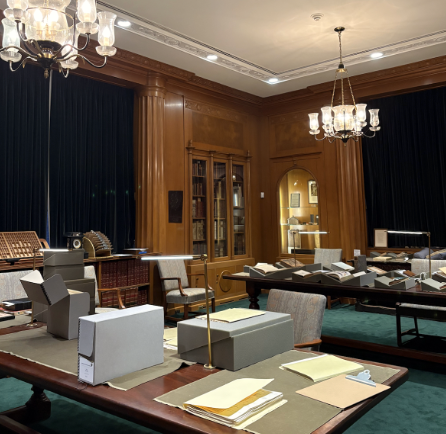
    Tucked in a corner on the first floor of Olin Library lives the rare book collection, an ever-growing collection of 45,000 literary works that is a research resource for students looking to interact with physical history. The fascinating assortment of texts in the collection ranges from artists’ books that combine literary and artistic mediums, to 19th-century missionary Bibles in languages from around the world, to copies of Shakespeare’s original works. Head of Special Collections Tess Goodman recently took The Argus on a tour of the space and discussed the function and importance of the rare book collection. 

    The Argus: What is the rare book collection?

    Tess Goodman: The rare books that we have in Special Collections at Wesleyan are pretty diverse. We have pretty solid coverage in terms of American and British literature and history. We have a lot of missionary Bibles that were collected when Wesleyan students in the 19th century were very interested in Christian missionary work. We now have a large collection of artist books that are very invested in both experimentation with the physical form of the book and printing techniques, but also in social justice and in ideas like feminism, anti-racism, or environmentalism. The book explores these concepts as a way to do advocacy.

    A: How does rare books fit into the larger Special Collections & Archives department?

    TG: The Special Collections & Archives department is kind of split between the rare books and the archives—the university papers—but we work very much in tandem. Often, I work with [Dietrich Family Associate University Librarian for Unique Collections and University Archivist] Amanda Nelson to try and develop a class that will teach students how to deal with both archival documents and rare books together. The advantage of a collection like this is that books are the most common historical artifact that survives from the past, aside from things like coins. They have a really intense depth with so much content.
Helping students learn how to understand them is really a way to open up a portal to the past.

    A: Where and [from whom] do you primarily get your books?

    TG: Some of them have been donations, but the bulk of the collecting that I do at this point is from a number of different rare book dealers. There are some whom I have developed relationships with. I have known them for a while because I worked in the trade at different rare book institutions before coming to Wesleyan. I also go to book fairs. Most recently, I went to the Boston Book Fair, which is held every November. The advantage of going to an event like that is that you can wander around and find things serendipitously. So, for example, I walked into a dealer’s booth, who is based in New Haven, and found an 18th-century copper printing plate for a very reasonable price. This was something that I had been looking for for a while, and I bought it from this person whom we had never had a relationship with before, but it was very exciting to find exactly what we needed on the spur of the moment.

    A: How and why do students currently use the rare books resources? 

    TG: One way is through class visits. These are more structured visits where I work with the professor to try and figure out the teaching goal for the session. Usually, [they are] looking at examples of texts that students are reading in a literature class or sources that students might use to do historical research.

    The other way that students can visit is when working on individual research projects. Sometimes this can be for a class that has put together an assignment that relies on Special Collections, or [it can be] on their own initiative. 
We’ve had students doing class papers or thesis projects on all kinds of material in the collections. A student who graduated a few years ago wrote a thesis about the [“Landino,”] which is one of the first attempts to print an illustrated edition of Dante’s “Divine Comedy.”We have a copy of the 1685 Fourth Folio edition of Shakespeare’s plays, where two of the plays have been extensively annotated, and one student did research on these annotations and found out that [they were] written by somebody who was creating their own new publication by pirating the plots of two of Shakespeare’s plays and smashing them together.

    A: Why should students continue to visit the rare book collection?

    TG: We are currently operating in a world where facts are disputed and evidence-based truths are harder to recognize. In this environment, it’s extremely important that we all learn to distinguish fact from fiction through processes of verification, research, and the analysis of hard evidence. Special Collections holds the historical record: hard evidence about the past that is available nowhere else. Students here build a lot of different skills, from navigating a rare books library, to analyzing 500-year-old illustrations, to reading 19th-century handwriting. This is all an effort to help students learn to conduct original research. 

    A: Do you have a favorite book or collection of books here?

    TG: My favorite book always changes. Recently, the book that I’ve been most enthusiastic about is a Dutch emblem book from the 17th century. An emblem book is a genre that’s basically dead now, but it was this literary and visual genre of book that had a cryptic phrase, motto, or proverb accompanied by an equally cryptic illustration and some sort of scholarly gloss or interpretation. There is one that I really love that was printed in the Netherlands around the 1680s that has a lot of very beautiful illustrations and a lot of bizarre mottos. There’s an image of a cheese that’s been gnawed by maggots, and the caption says something like “too sharp makes shabby.” So the cheese has been aged to be too sharp, and it’s gone bad. It’s this weird image of how 17th-century brains worked. This particular book also has really interesting, vivid pictures of daily life in the 17th century. The book has this bizarre conflation of daily life information and philosophical information with strange imagery. 

    A: Do you see any challenges facing the rare book collection now or in the future?

    TG: There are all kinds of challenges facing the collection. Trying to help people understand why this stuff matters is something that is always going to be important for us. I think at Wesleyan, we have a very healthy community interest in Special Collections. A lot of the faculty are really good about bringing their classes here, and I think many students are enthusiastic. But making sure that people understand that we are here, that we are accessible is always an uphill battle because the door is always locked for security reasons. But we want people to be able to come in and ask questions. I also think that as people get more and more in the weeds of things like AI and digital databases, there may be a growing conviction that everything’s available online, which isn’t true. Continuing to make ourselves obviously relevant is one of the biggest challenges that we face. 

    A: Is there anything that you are currently looking to add to the collection?

    TG: We have been really trying to add Native American and South American books to the collection. We just added a little book that was printed on birch bark but is not actually written by a Native American person. It is challenging because a lot of resources from the 19th century were written by white settlers and not by Native Americans. Much of the physical documentation that exists comes from one perspective, so trying to figure out how to build a complete picture means that we are kind of looking for a needle in a haystack. A lot of the interesting texts didn’t necessarily survive, but we’re doing our best. 

    Leah Ziskin can be reached at lziskin@wesleyan.edu.

  • “Walk Like an Egyptian,” and Talk Like a Hall of Famer: Why The Bangles Deserve National Rock & Roll Award

    c/o The Independent

    When I was in fifth grade, I got my music teacher fired.

    Don’t feel bad for her. She deserved it. She should never have been working with little kids. Anyway, I rebelled for the first time in my life and managed to create enough of a stink that she was let go. (The details: unnecessary. The result: Read on and find out.)

    I was elated. No more freakin’ nursery rhymes. Within a couple weeks, we had a new music teacher: a mom who immediately won me over when she played The Beatles in the first class. Finally, some real music. In March, during Women’s History Month, she took on the task of teaching us about female musicians. She played songs by Beyoncé and the Spice Girls. Nothing I hadn’t already heard. And then she played us a song by The Bangles. 

    My entire life up until that point had been spent obsessing over boy bands: not One Direction, but actual bands like The Beatles, The Who, The Kinks, The Clash, and The Byrds. But they always seemed somewhat untouchable, like I could never do what they were doing. They were my heroes, but there wasn’t anything about them that made me feel like I was capable of doing the same thing. The Bangles were my first introduction to an all-female band, and they gave me the feeling that I could do that, too. I could make music. 

    I went home after that music class and spent hours on YouTube watching all their music videos and grainy concert footage. I was mesmerized by their musicianship, their stage presence, and above all, their harmonies. It was like watching angels sing rock and roll. They were effortlessly cool, and I immediately decided I was going to be in a band. I was going to tour the world and write music and record and be as cool as these four women. One small problem: I didn’t play an instrument. But this isn’t about me, despite the fact that I just spent the first part of this piece talking only about myself. Don’t worry, I have a point. 

    Every year, the Rock & Roll Hall of Fame (Rock Hall) has their induction ceremony, and every year, The Bangles are snubbed. They were once again left out this November. Here are the requirements to be inducted: An artist’s first commercial release has to be at least 25 years prior to the year of induction; they have to demonstrate some level of musical excellence (what does that even mean?); and they need to have had a profound impact or influence on music in one way or another, which means, let’s face it, they have to sell a lot of records.

    Let’s see how The Bangles measure up:

    The Bangles were the first all-female band to have five Top 5 Hits on the Billboard Hot 100. They stormed MTV with their iconic music videos for songs like “Walk Like an Egyptian” and “Manic Monday.” They won the BRIT Award for International Group in 1987. They have released four studio albums and a compilation album, with their 1986 release Different Light achieving multiple platinum status. They have toured the world and have millions of fans. They’ve even been hailed as “The Female Fab Four.” What more do you need to know? 

    But much more importantly, The Bangles were part of something bigger: They opened the gates for more female musicians to step into the light. And it was, ahem, a different light, a light that didn’t ask women to shrink themselves or wait for permission or settle for being the “girl in the band.” The Bangles were the band. They wrote, they arranged, they played, they harmonized, they carried their own gear (at least in the beginning), and they did it all in an era when female musicians were still treated as accessories, supporting characters at best. They proved that an all-female group could dominate charts, captivate audiences, and redefine pop-rock on their own terms.

    “We had a dream. An awesome dream,” lead guitarist Vicki Peterson said in the VH1 “Behind the Music” segment done on the band.

    They dared to dream about being famous musicians at a time when that wasn’t what girls were supposed to be dreaming about. Being a female singer was one thing, but girls playing rock and roll instruments? There were almost no previous all-girl bands to look to for inspiration. There was Fanny (if you don’t know who Fanny is, I’m begging you go listen to their live stuff because it will blow your mind), and there were singer-songwriters like Joni Mitchell and Jackie DeShannon, but very few female bands had ever had any commercial success. The Go-Go’s were finding it, but they stemmed from the punk scene in LA. The Bangles were a part of the Paisley Underground, a movement in LA in the early to mid ’80s that was composed of bands who wore their ’60s influences literally on their sleeves. This meant saccharine harmonies, jangly guitars, catchy riffs, and refreshing energy along with the bell bottoms and ruffled sleeves. 

    As four women, they had to work extra hard to get their music heard. They would carry their demos in plastic bags to local record stores and personally bring their singles to DJs. They faced constant adversity due to their gender; meanwhile, they were better than the majority of the male bands out there. They knew how to rock out, and they knew how to sing together at a level that most bands spend their entire lives trying to reach with a natural, unforced chemistry that was as charming as it was potent. They were sincere, they were fierce, and they were absolutely fabulous. Watching them felt like watching four goddesses. 

    Goddesses. Not Gods. That’s what made me go, “Oh, wait. I could do this.” I saw myself in them, and that gave me the courage to pick up the guitar and then later the drums. The first song I tried to write was a rip-off of “If She Knew What She Wants.” I may or may not have cried writing it, because I so desperately wanted to be Vicki Peterson right off the bat, but if there’s anything The Bangles have taught me, it’s that hard work pays off. 

    So here we are again, another year gone by, another Rock Hall ballot without The Bangles. And maybe on paper that’s just an omission. But for me, and for countless other women who picked up instruments because those four women showed us we could, it feels like a misunderstanding of what influence actually looks like.

    Influence isn’t just measured in sales or chart positions or how many executives in a boardroom approve of the degree of your impact. Influence is measured in bedrooms and garages and first guitar lessons. It’s measured in the number of girls who looked at a stage or a music video or a grainy YouTube clip and felt a door opening. It lives in the fact that decades later, people like me are still talking about them with passionate devotion. When someone shows you a dream you didn’t know you were allowed to have, you don’t forget it.

    So yes, the Rock & Roll Hall of Fame should induct The Bangles. They’ve definitely earned it. But more importantly, they deserve to be recognized for breaking down barriers in pop music. We live in a world that still—still!—acts shocked when women pick up guitars and play them well. But now we girls have women to look to for guidance, women who inspire us to turn it up to eleven. 

    I’ve been lucky enough to meet two out of the four Bangles: one on Zoom with an old music teacher and one in person. Safe to say I was tongue-tied, but meeting them was a reminder that they’re also humans. You know the saying, “Never meet your heroes?” Screw that: Vicki Peterson was one of the most genuine and humble people I’ve ever met. She encouraged me to keep playing, keep writing (I’m planning on sending her this, so hi, Vicki!), and to just keep going. She made me feel like I could do anything. And that’s way more important than any induction. 

    Honestly, the Rock & Roll Hall of Fame needs The Bangles more than they need the Hall. 

    Edie Anderson can be reached at emanderson@wesleyan.edu.

  • Movie Review: “Wicked: For Good” Offers a Powerful Yet Disquieting Conclusion to Chu’s Musical Parable

    Movie Review: “Wicked: For Good” Offers a Powerful Yet Disquieting Conclusion to Chu’s Musical Parable

    c/o Deadline

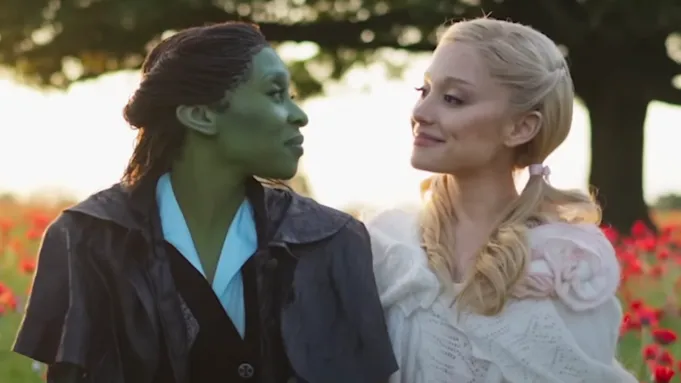
    “Wicked: For Good” is set in an Oz inundated by propaganda and inequity—the mien of wickedness, as it is glaringly apparent, has become a driving force.

    This film deserves a degree of pessimism and apprehension. It is, after all, a second act. “Wicked: For Good” is not a cheery, whimsical successor to the Ozian spectacle that is “Wicked.” Rather, it ushers in disquietude from the initial shot (forced animal labor on the Yellow Brick Road) to the moments following the titular song where Dorothy (Bethany Weaver) claims an unwittingly tragic victory.

    Emerging from the shadows of the climactic first act closing number “Defying Gravity,” act two thrusts audiences into the grim villainization of Elphaba (Cynthia Erivo). The distortion of Elphaba’s inherent kindness and goodwill, amplified by juxtaposition with Glinda’s paradisal life, is one of most thought-provoking aspects of the film, upsetting the status quo of this revisionist narrative.

    The musical “Wicked” is a loose theatrical adaptation of Gregory Maguire’s 1995 novel “Wicked: The Life and Times of the Wicked Witch of the West.” However, the musical diverges from the book’s contents most notably in the ending. While the musical wraps the story in a neat bow, at the heart of both the novel and the musical is a spirit of defiance, dignity, and a critique of tyranny and herd mentality. Despite its fantasy and whimsy, “Wicked” tells the story of abiding strife, a quality starkly persistent in act two.

    How easy is it to contort the illusion of goodness in the favor of those who are truly wicked? This question, particularly sensitive given our current socio-political climate, festers in the subtext of “For Good.” Formerly known as Galinda (Ariana Grande), Glinda “knows the wicked’s lives are lonely” all too well, but succumbs to the glory of eminence and adulation, in part due to the legend of the Wizard (Jeff Goldblum), who is evidently no legend, or Wizard, at all. The Wizard’s iniquitous behavior is unjustifiable in all domains, but his guise of superiority catalyses the musical. He is wonderful, and wonder goes a long way.

    Elevated to near mythical status, the Wizard’s bells and whistles maintain his image at the cost of the disenfranchised. But Elphaba knows (as the audience does) that the schtick is a part of the ruse. In “Wonderful,” a number performed by the Wizard, we see Elphaba entranced, but she is not so easily beguiled. As per the Wizard, “it’s all in what label is able to persist,” and unfortunately for Elphaba, what sticks to her is the image of wickedness.

    While Erivo soared in “Wicked,” Grande ascends in “For Good,” even if she requires the assistance of a “pink, shiny bubble” to do so. With greater emphasis on Glinda’s character arc, “For Good” offers more than a glimpse into the “wicked workings of you-know-who.” A reflective ballad and a heartrending emotional arc place emphasis on Glinda’s redemption, a notable choice given the tonal shift in act two. While the second act inspires despair, it centers around the bubbly mascot of privilege and hope: Oz. Perhaps this juxtaposition is meant to further accentuate the true nature of each witch, keeping with the theme of disclosure.

    While Oz seeks Elphaba’s persecution on account of her activism and valor, Glinda basks in the adoration of the public. Despite significant character development, she remains unworthy of the praise she so effortlessly receives by the end of the film. Nevertheless, it’s Glinda’s complexity that allows her to shine so brightly in a world where most blend into the crowd. Glinda may be an emulation of what goodness is supposed to look like, but she is not an imitation. She is an individual first and foremost, despite her flawed judgement, making her a perfect match for Elphaba, whose “outward manifestorials” are not her physical appearance but her unique resolution.

    In keeping with the stage musical, the second act is less extravagant than the first, prioritizing emotion over eye-candy. Director Jon M. Chu, accordingly, indulges less in the spectacle that lies front and center, as in “Wicked,” instead leaning into the subtleties of strife and sorrow that drive “For Good.” Gone is “Dancing Through Life.” The party is over and the storms are no longer at bay. The only glimmer of the joys once shared at Shiz University are offered in a brief flashback in which Elphaba, Glinda, Fiyero (Jonathan Bailey), Nessarose (Marissa Bode), and Boq (Ethan Slater) saunter through the grass, a harsh contrast to the dismal landscape of the present.

    “For Good” includes new musical material, whereas the brimming first act does not. “Wicked,” which premiered in 2003, has eleven songs in act one and eight in act two. “Wicked” remained true to the original score, but “Wicked: For Good” features two new songs written by composer Stephen Schwartz. For all the discourse regarding the two new songs, it is difficult to dispute that “No Place Like Home” and “The Girl in the Bubble” are, indeed, not plot-based. While these additions are designed to round out the film’s occasionally sparse narrative, they are not compensation for underdeveloped character arcs and insufficient storytelling. These are gorgeous compositions. While gripes about the fluidity of the narrative in the second act are reasonable, such grievances do not pertain to the beauty of the film’s score as a whole. 

    Justifiable criticisms, however, arise from the musical adaptation’s original stray from the book. It isn’t that the score or performances in act two are lackluster in comparison to the first act, but that the story itself wanes. While many were holding space for “Wicked,” the scope of “Wicked: For Good” seems, to those uninterested, too bare in comparison to its predecessor, which crams as much Oz as possible onto the screen. In addition, more screen time for other characters central to the story, such as Fiyero and Boq, would have bolstered both the narrative and emotional arcs of the second film, especially given their notably enthralling performances.

    All this is to say, perhaps a single overarching film adaption would have resolved issues with pacing, even if its running time pushed four hours. Conversely, perhaps the inclusion of more material from the novel would have satisfied the expectations of those who are not particularly enthused by impromptu song and dance. Nonetheless, for a theater lover, both “Wicked” films are sights to behold. With impeccable vocal performances, jaw-dropping choreography, stunning costumes, breathtaking sets, and commendable direction, “Wicked” and “For Good” are remarkable cinematic experiences.

    On the face of it, “Wicked” may simply be a fantastical story of witches, but under the skin lies a story of perseverance and of bravery, as well as friendship and the unyielding love that can unite supposed diametrically opposed foes. That love will leave anyone changed for good.

    Kendra Williams can be reached at kwilliams@wesleyan.edu.

  • From the Argives: “How Many Times a Day Do You Inhale?” and Other Absurd Argus Ads

    Spend enough time in the Argives and the advertisements start to raise eyebrows. Cigars! Unregulated medical claims! Bowling alleys! Decades of issues (mostly) published on this day over the years reveal promotions that drift well beyond the practical, reaching back to the earliest Argus.

    The first-ever edition of The Argus, published on Sept. 24, 1868, printed two full pages of local advertisements, including six men’s clothiers and tailors, three ice cream parlors, and five cigar shops, all located on Main Street.

    Like American drug stores today, these merchants sold a wider variety of goods than their stores’ names might suggest. Burr Bros. grocery hawked “kerosene oil of the best quality,” and an ad for W. R. Arnold’s “new and commodious” restaurant boasted its ice-cream rooms, state-of-the-art “Arctic” soda fountain, and wide selection of cigars.

    The Argus’ long love affair with smoke shops and cigar sellers started strong in this inaugural edition. Goetze, one cigar shop, even advertised “University brand segars,” possibly a custom line for Wesleyan students, as no documents suggest the manufacture or sale of a cigar brand named University in Connecticut in 1896. 

    Chewing tobacco and snuff rounded out the list of tobacco products offered by The Argus’ earliest patrons. One apothecary on Main Street endorsed “Bliss’ Catarrh Snuff,” saying, “[Bliss’ Snuff] has often been tried! It will relieve the worst cases! Some bad cases have been cured!”

    Companies making speculative health claims on unregulated products flourished prior to the creation of the Food and Drug Administration (FDA). Often, the back pages of The Argus resembled a collage of medical scams. 

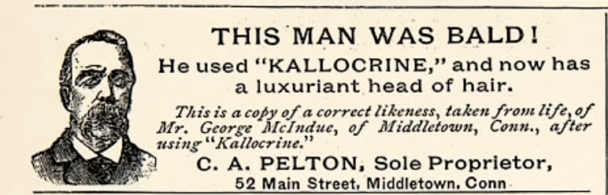
    “This man was bald!” read one Argus ad published today, Dec. 5, 135 years ago. The ad included a sketch of a well-groomed man’s portrait. “He used ‘Kallocrine,’ and now has a luxuriant head of hair,” The Argus explained. “This is a copy of a correct likeness, taken from life, of Mr. George McIndue, of Middletown, Conn., after using ‘Kallocrine.’”

    Another ad from Dec. 5, 1890, struck a similar note, this time from a local druggist, promising a “liberal discount” and advertising a “new thousand dollar soda fountain” serving hot chocolate, bouillon, coffee, and even clam broth.

    After the establishment of the FDA in 1906, new businesses filled the many gaps left by The Argus’ former patent-medicine patrons. Conveniently for anyone reading in retrospect, the new postings in the paper’s Dec. 5, 1910 issue, 104 years ago today, better hint at campus life and local commerce of the day.

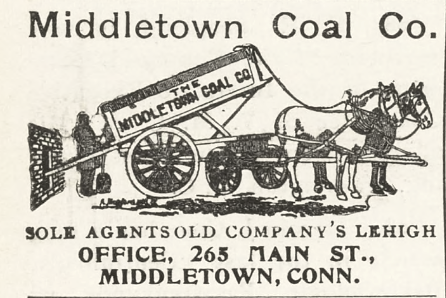
    One ad came from Middletown Coal Co., a Main Street dealer advertising that it carried Old Company’s Lehigh coal, a widely sold household heating coal shipped in from Pennsylvania. For student boarding houses still heated by coal, this would have been a routine stop. A few columns over, readers would have found a promotion for Tuttle’s Orchestra, a local music outfit headquartered at 100 Grand St. and managed by C. B. Tuttle, the sort of ensemble possibly hired for campus dances and fraternity events.

    Another ad in the Dec. 5, 1932 issue pointed to the local student coffee spot in a world before Perk on Main. The Coffee Bar, right next to Fisk Hall at 220 College Street, offered students a second drink “on the house” and pushed fudge cake and toasted chicken sandwiches as the ideal pairing.

    Still, tobacco remained a steady presence in Argus advertising well into the 1930s. In the same issue, a promotion for Edgeworth pipe tobacco explained that “a pipe is the most popular smoke,” and suggested that “while you ‘cram’ for that exam… just light up a pipeful of Edgeworth Smoking Tobacco.” The ad called it “the favorite college smoke.”

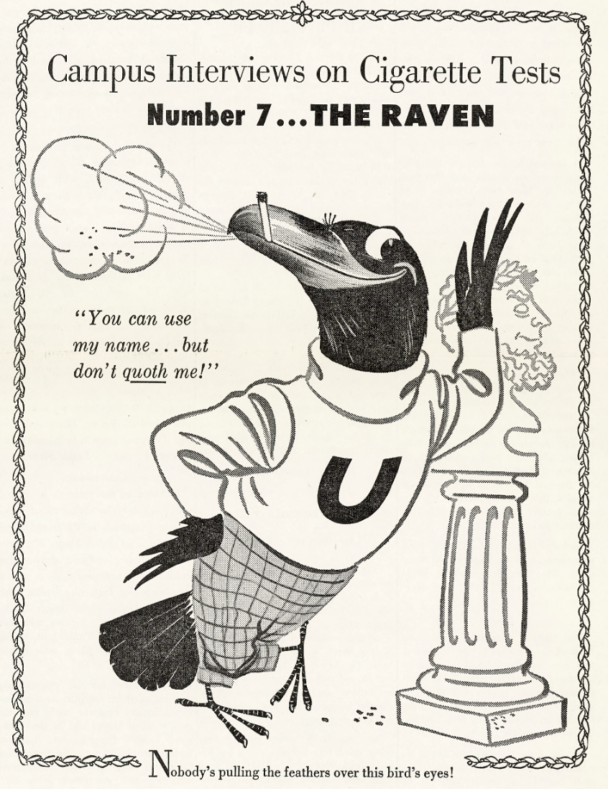
    By 1950, The Argus was running cigarette campaigns with a real sense of structure. In the Dec. 5 issue, a Camel ad appeared under the headline “Campus Interviews on Cigarette Tests,” presenting a cartoon raven who announced, “You can use my name… but don’t quoth me!” The copy insisted that “one fast puff or a quick sniff” couldn’t tell a smoker much, and proposed an experiment to remedy the issue: “the 30-Day Camel Mildness Test,” in which students were invited to smoke Camels “pack after pack, day after day.” At the end of the month, the ad said, one’s “T-Zone (T for Throat, T for Taste)” would settle the matter. 

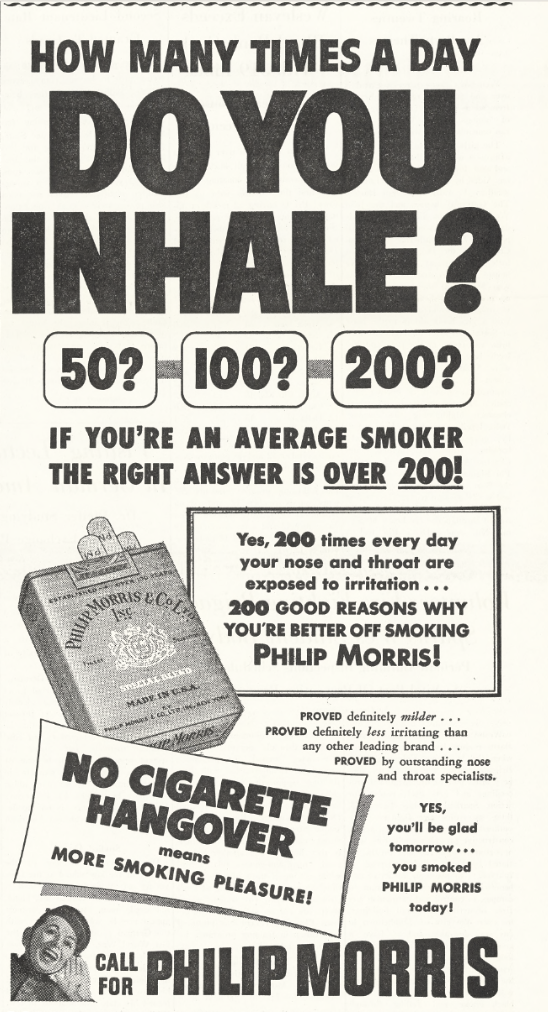
    The issue on Nov. 20, 1951 was another case of the cigarette ads swarming The Argus in this time. In this edition, The Argus published an advertisement that asked the question “How many times a day do you inhale?” The company, Philip Morris, was promoting their cigarettes, which were supposed to prevent “cigarette hangover” and provide “more smoking pleasure.” They claim to have created cigarettes that prevent throat irritation, citing that they make their cigarettes with the help of nose and throat specialists. While these “specialists” may seem convincing, the advertisement gives no indication to specifically how throat and nose irritation is reduced through their special formula.

    Moreover, Philip Morris use extreme language to make three points about the effectiveness of their cigarettes, saying, “PROVED definitely milder… PROVED definitely less irritating than say any other leading brand… PROVED by outstanding nose and throat specialists.”

    However, while this advertisement might not be very scientific, it definitely knows its target audience. Smoking culture still prevails at Wesleyan, as it does at many other universities. Whether it’s students taking a cigarette break on the steps of Olin or their balconies, this advertisement remains applicable even over 70 years after publication. 

    The advertisement ends with a final appeal to students to change their cigarette brand to Philip Morris. 

    “YES, you’ll be glad tomorrow…you smoked PHILIP MORRIS today.”

    But The Argus didn’t limit itself to peddling nicotine products. On March 3, 1992, The Argus published an issue that contained an advertisement for meditation workshops. However, the absurdity of this advertisement was not actually within its content; it was what the workshop actually entailed. The Argus published an article on Oct. 24, 2025, titled “From the Argives: Campus Workshops Serve as Cult Pipeline,” which discussed the cult—disguised as said meditation workshops—that ensued on campus. In its original ad, The Argus merely promised that attendees would “develop creativity,” “increase personal power,” “experience stillness of mind,” and “control thoughts & emotions.” 

    In tiny little block letters at the bottom of the advertisement was the company behind the cult and advertisement, The Hartford Meditation Society. The “society” was a front for the schemes that the cult leader, Frederick Lenz, was plotting on Wesleyan’s campus.

    What wasn’t in the advertisement is that these workshops would function as a doorway to initiation into the cult, where every aspect of a cult member’s life would be controlled. Moreover, while the advertisement said that admission to the meditation workshop was free, some cult members would have to pay monthly dues of $2,500, which made Lenz around 5 million dollars per year. Who would’ve thought that an innocent meditation workshop could lead to something so sinister?

    On Apr. 21, 1970, the Argus published an issue advertising Pelton’s Drug Store, which decided to go with the super catchy slogan, “Always glad to cash Wesmen’s checks—[we’re] especially glad to cash Weswomen’s.”

    These Weswomen were not available to comment on this enticement. But the drug store’s creepy advertising approach feels especially jarring considering that 1970 was the year that Wesleyan became a coed university. 

    Yet Pelton’s even offered free delivery! So, if female students didn’t feel like going to the store, Pelton’s Drug Store would come to you!

    Pelton’s Drug Store is one of an array of bygone businesses in the Argus ads timecapsule. On Dec. 5, 1980, 45 years ago today, The Argus printed one such ad from Middletown Lanes, the city’s former bowling alley. Middletown Lanes on Washington Street then had 36 lanes, an electronic game room, billiards, a snack bar, and a cocktail bar. 

    Several businesses that patronized The Argus in 1980 have stuck around, however, including Jerry’s Pizza, which was also promoted in this Dec. 5 issue. Their ad reminded students that Jerry’s would deliver “to your room—[every] night except Saturday,” taking calls from 9 p.m. to midnight: the kind of availability that keeps a place around.

    Most of the businesses in these pages have come and gone with the decades, though a few have managed a longer run. Smith & Bishel Hardware is among them. Founded in 1898 and now the oldest family-run business in Middletown, it first appeared in Argus advertising on May 31, 1899, calling itself the “new hardware store” in town. The shop has remained on Main Street ever since, enduring changes in location and generations, and leaving one of the earliest local footprints in the paper.

    Hope Cognata can be reached at hcognata@wesleyan.edu.

    Lara Anlar can be reached at lanlar@wesleyan.edu

    “From the Argives” is a column that explores The Argus’ archives (Argives) and any interesting, topical, poignant, or comical stories that have been published in the past. Given The Argus’ long history on campus and the ever-shifting viewpoints of its student body, the material, subject matter, and perspectives expressed in the archived article may be insensitive or outdated, and do not reflect the views of any current member of The Argus. If you have any questions about the original article or its publication, please contact Head Archivists Hope Cognata at hcognata@wesleyan.edu and Lara Anlar at lanlar@wesleyan.edu.

  • Wesleyan Student Assembly Hosts President Michael Roth ’78 for Open Q&A Session

    Wesleyan Student Assembly Hosts President Michael Roth ’78 for Open Q&A Session

    Michael Roth speaking at the Shasha Seminar on Nov. 15. c/o Finn Feldman

    On Sunday, Nov. 23, the Wesleyan Student Assembly (WSA) held its weekly General Assembly session at the Frank Center for Public Affairs (PAC). President Michael Roth ’78 attended the General Assembly session to answer questions and provide updates on topics ranging from University fundraising and the impact of rising tuition costs on financial aid to recent controversial changes in the the Jewett Center for Community Partnerships’ (JCCP) budget policy.

    Roth began by providing information on his recent meeting with the Campus Affairs Committee (CAC), a group of trustees, faculty representatives, and student representatives that discusses the University’s educational programs and student affairs. He gave an update on the University’s “This Is Not A Campaign” fundraising campaign.

    “The University Relations Committee had an update on the fundraising campaign from Frantz Williams [’99], who is in charge of the Office of Advancement, and we are a couple of years ahead of schedule,” Roth said. “I think over $490 million has been raised now, so people were pleased to hear that.”

    He also reported on the University Audit Committee’s updates on admissions, following the receipt of first-round Early Decision applications on Sunday, Nov. 15.

    “On the admissions side, we looked at changes in the nature of the applicant pool and how the University depends on roughly 55% to 60% of students attending being able to pay,” Roth said. “The number of people applying who are able to pay has been decreasing, so we think of the cost [of tuition] as going up, which it does, while the demographics of who might be able to attend are going the other direction. That’s a cause for concern for the University in the long run. But in the short run, applications are up.” 

    Other updates included the communications initiatives underway to better engage prospective students, alumni, and the broader public; the Finance Committee’s short and long-term budget planning vis-à-vis rising health insurance costs; and the optimality of the Investment Committee’s traditional investment strategy.

    Following this, the floor opened for Q&A to both WSA Senators and other students in attendance. The conversation began with a question by WSA Senator Asper Cisse ’28 on the implications of rising tuition on financial aid.

    “Financial aid is not going down, it’s going up,” Roth said. “The discount rate, which is the amount we don’t collect, that is, financial aid as a percentage of the budget, goes up every year, as it has over the last several years. And so we will continue to meet the full financial need of the people who we admit and enroll. Whenever we increase tuition, as we have done somewhere between 3.5% and 5% each year, the amount of financial aid given goes up too, so there’s not a gap.”

    Roth was also asked about the University’s new alcohol and drug policy, which banned drinking games on campus. In particular, WSA Senator Eric He ’28 raised the hypothetical that students might refuse to call Public Safety after an accident resulting from a drinking game, in fear of the heightened punishment. 

    “I don’t think there’s an increased punishment for calling for Public Safety,’’ Roth said. “As far as that goes, that would be a surprise to me. But we’ve been working with WesWell to review if the policy represents an onerous regulation or one that’s likely to result in unintended consequences that are even less healthy than, for instance, beer pong.” 

    WSA Senator Casey Dunning-Sorey ’28 asked Roth whether Public Safety would intervene if someone who appears to be federal law enforcement tried to arrest a student or non-student on University property without a judicial warrant.

    “I think yes, but that’s not a very helpful answer, because then you want to know the nature of the intervention,” Roth said. “And so it’s a question I’ve been asking myself a lot these days, because it’s one thing to say to students and faculty that if somebody comes to your door and they don’t have a warrant, you don’t have to open it. We don’t want you to actually get into fistfights with people who are going to beat the hell out of you, which is what ICE will do. Public Safety won’t do that either. If they break the law, we will seek appropriate legal remedies in court.” 

    Brendan Barry ’28 also asked Roth about recent changes to the JCCP budget policy, and the opposition of some student workers and members of the Middletown community to what they perceive to be large-scale cuts to JCCP-associated student groups. Roth asserted, as he has in the past, that the University is “fully funding the JCCP” and doing its share to support the local community.

    WSA Senator Raiza Goel ’28 asked Roth whether the University had noticed a decline in international applicants following the Trump administration’s crackdown on student visas. 

    “We have not seen the declines in applications from international students that we expected,” Roth said. “However, we had a dramatic increase in the number of applicants from Africa. I do know two students who were unable to come because they’re from countries in Africa on the administration’s list of countries prohibited from sending people to the United States. However, we continue to advocate for the African Scholars Program and for the support of the students in it, and we have been active and continue to promote the University in markets that usually send us the most people, particularly China, India, and London.” 

    After several more questions from senators, Roth’s schedule obliged his departure. The WSA plans to host Roth in the future to address additional questions following the next Board of Trustees meeting. 

    Raiza Goel is a News Editor at The Argus.

    Daniel Chehimi can be reached at dchehimi@wesleyan.edu.

    Brendan Kelso can be reached at bkelso@wesleyan.edu.
  • Field Hockey Finishes NESCAC Runners-Up, Makes Elite Eight in Historic Season

    Field Hockey Finishes NESCAC Runners-Up, Makes Elite Eight in Historic Season

    c/o Jon Endow

    Playing in the most competitive Division III conference, Wesleyan field hockey has spent years trying to crack the NESCAC’s upper tier. Before the hiring of Head Coach Christine Kemp in 2019, they had only won two NESCAC playoff games and had never made the NCAA Tournament; the program was at a low point, having gone 5–35 in NESCAC play over the past five seasons. The first three years of Kemp’s tenure were up-and-down, but in 2023, they earned a program-defining 2–1 overtime win over No. 5 nationally ranked Tufts, and finished .500 in NESCAC play for the first time since 2010. 2024 saw more improvement with the squad going 12–6 overall: their most wins since 2000. 

    It looked like the 2025 campaign might be a lost year as the Red and Black lost their first three NESCAC games by a combined 9–2. But a few key tweaks—slotting Kiernan McColgan ’26 and Leila Feldman ’28 into the full-time starting lineup and shifting from man-marking to a zonal defensive scheme—completely changed their trajectory. Wesleyan ripped off eight straight wins to finish the regular season, allowing just five goals with a tightened defensive unit and standout keeper Audrey Pace ’26. Seven of those wins came against NESCAC opponents, including their first win at Amherst since 2005, second-ever win at Williams, first-ever road win against the seven-time defending champion Middlebury, and a four-goal onslaught versus No. 8 Bowdoin. The last two regular-season games featured the Cards outscoring Colby and Conn. College 10–2 with Feldman becoming just the third Cardinal in the last 13 years to record a hat trick. These wins ensured Wesleyan would host a NESCAC playoff game for only the second time in program history.

    McColgan reflected on the arc of their four years. 

    “When we committed, we all bought into a program that was struggling,” McColgan said. “We went 4–11 our freshman year, but even then, we all knew things would turn around. In a way, this season was a microcosm of our entire four years, and made the commitment that much more validating for us.”

    As the calendar turned to November, the Red and Black found themselves in an all too familiar position: facing off against Williams in the postseason. The Ephs had ended the Cardinals’ season each of the past two seasons. Wesleyan had also beaten Williams in October, which meant the pressure was now on them to do it again.

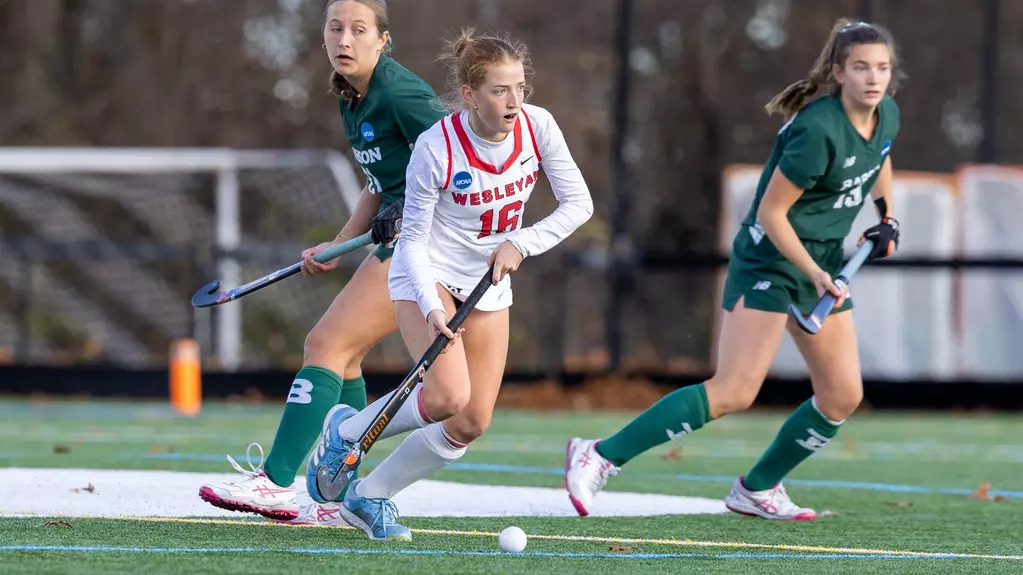
    The Cardinals came out flying and broke through in the 11th minute off a beautifully designed play. On a penalty corner, Georgia Adams ’26 inserted it to Emily Smith ’29, who took two touches, then slipped one over to Brooke Miner ’28. Miner stepped into it and fired the ball towards the left post, where Meera Patel ’29 was waiting to redirect it into the goal and put the Cardinals up 1–0. This was the score at halftime as the defense turned in its best statistical half of the season, not surrendering a single shot or penalty corner.

    The game stayed there through the third quarter, but the Cardinals found breathing room in the fourth on another penalty corner, off the stick of none other than Adams, who recently became the third member of Wesleyan’s 100-point club. 

    Adams spoke about the emphasis the team placed on penalty corners throughout the season.

    “Coach Kemp always says, there’s not a lot of time for improvement as players once the season gets underway,” Adams said. “We are the team we are, but the one thing you can change is your penalty corner plays. So we worked really hard throughout the season on being very adaptable. We would learn new plays based on the team we were playing. Williams was a great example of us executing a play exactly how it’s supposed to go.”

    While Williams added a late goal, the Cards were able to run the clock out in the last three minutes and earn their first NESCAC playoff win in 20 years. 

    Next up was the NESCAC no. 1 seed (and no. 3 seed nationally) Tufts Jumbos. Tufts thumped Wesleyan 4–1 on Saturday, Sept. 27, and six weeks later, neither team had lost since then.

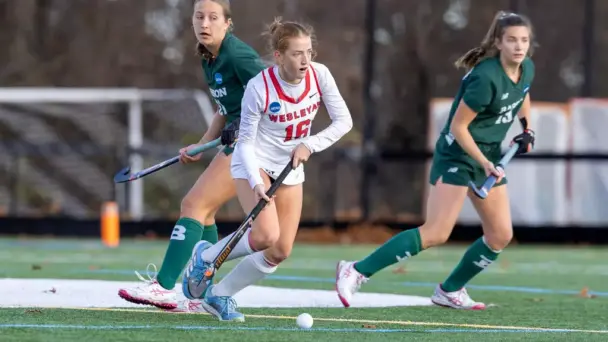
    Offense was scarce on both sides in the first quarter, but the Cards broke the game open six minutes into the second. Adams inserted the ball to the top of the arc, where Miner stopped it, and Sydney Cameron ’26 faked a pass, opening a lane for Feldman to step up and fire. Her shot deflected off a Jumbo stick, clanged off the crossbar, and dropped into the back of the net. It would have been a bad time to take a bathroom break, as the Cardinals extended their lead two minutes later. Patel weaved through a swarm of Tufts defenders and slipped a pass to Feldman, who redirected it into the net to make it 2–0. 

    The third quarter was tightly contested, with neither team finding a goal. Tufts controlled much of the fourth, earning four penalty corners, but the Cardinals’ defense held strong, allowing only one shot on goal, which Pace turned away with ease. With 450 in attendance, the Cardinals earned their biggest win in program history. Along with their October defeat of Middlebury, it was their second top-five road victory of the season. Most importantly, it sent Wesleyan to their first-ever NESCAC championship game, where they would face Bates the following day.

    Bates struck early, this time in the eighth minute off the stick of Brooke Moloney-Kolenberg. The Bobcats added another goal before halftime, putting the Red and Black in only their second two-goal hole of the year. Wesleyan’s offense responded with relentless pressure in the second half, dominating possession and outshooting the Bobcats 17–0. The Cardinals also generated eight penalty corners, but the Bates back line was unbreakable, turning away every chance and keeping the Cards off the board. Bates went on to win 2–0, capturing their first-ever NESCAC championship and becoming the first team in conference tournament history to record three shutouts in a single postseason. 

    c/o Jon Endow

    Feldman spoke on the frustrations the offense faced.

    “For two weeks, everything went right, and then against Bates, we couldn’t score,” Feldman said. “The Bates defense was unparalleled. They were such good tacklers and just so disciplined, and then their goalie was fantastic. But not being able to get good shots gets very frustrating, and we realize that in order to score, we can’t just do what we’ve been doing, and we have to get more creative than just trying our same old moves. So we learned a lot, and that was something that really helped us going into NCAAs.”

    The Cards found solace in this loss in the following days as they earned the no. 7 seed for the NCAA D-III Tournament and cleaned up in the NESCAC awards. Smith became the first Cardinal ever to win a major award, taking home Rookie of the Year. She was joined on the first team by Pace and Adams, both of their second-career first-team appearances. The sophomore pair of Natalie Shaw ’28 and Miner made the second team, giving Wesleyan a program record five All-NESCAC members. 

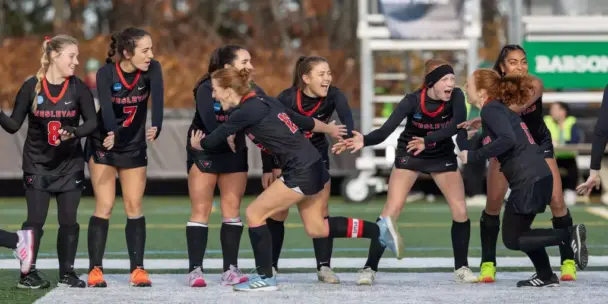
    Hosting an NCAA Tournament game for the second straight year, the Cards’ first-round matchup was against the Marywood University Pacers. The Cardinals’ offense couldn’t find a goal in the first quarter, but a day after winning Rookie of the Year, Smith provided the team with a spark, scoring less than a minute into the second quarter. The offense exploded in the rest of the contest, outshooting Marywood 39–0 en route to a dominant 7–0 victory. Six different Cardinals scored, with Kate Francini ’29 and Shaw scoring their first career goals. This win marked the Cards’ 10th straight win on Hicks Field, another program record.

    Next up was a trip to Babson College for a Sweet Sixteen showdown with the Hamilton Continentals on Saturday, Nov. 15. Earlier in the season, the Cards had suffered a pair of early three-goal defeats; after avenging one of them against Tufts in the NESCAC semifinals, they now had a chance to do the same against the Continentals.

    Wesleyan seized control early, dominating possession from the opening whistle. Ten minutes into the action, Smith weaved her way into the circle and swung a cross-circle pass to Feldman, who was waiting at the back post to flick it into the net. The Red and Black carried this momentum into the second quarter, drawing seven penalty corners and recording six shots on goal, but they were unable to extend their lead.

    Coming out of halftime, they faced an energized Hamilton side that pushed numbers forward, but the Cards’ formidable midfield and back line denied any shots from reaching Pace, allowing her to post her 10th clean sheet of the season. Feldman’s early goal proved the difference, sending Wesleyan to the D-III Quarterfinals.

    Adams spoke about the defense and how they carried over the lessons they learned from the Bates loss. 

    “We went down early against Bates, and that’s hard to come back from,” Adams said. “So our primary focus against Hamilton was coming out strong. And then the defense did such a good job of holding down the fort. They’re so communicative. I would hate to have to play them; they truly are one of a kind. To hold a team like Hamilton to those few shots and no goals was something that we were really proud of.” 

    The next day, Wesleyan faced the hosts and no. 3 overall seed Babson Beavers, their seventh top-10 opponent of the season. The Beavers entered Sunday 21–1, riding a 17-game win streak. To make matters more difficult for the Cards, they were on Babson’s home turf, which was field turf, a drastic and difficult switch from the AstroTurf the Cards are used to playing in the NESCAC.

    “It’s like going from driving NASCAR on a paved track to gravel,” McColgan said. “And Babson has been doing that all year, so they’re accustomed to it”.

    The matchup quickly settled into a defensive battle. Babson controlled the early stages and broke through three minutes into the second quarter on a penalty corner. From there, the Cards pushed back and controlled much of the remaining play, outshooting the Beavers 9–3 and earning two more penalty corners. Two of them came in the final minute, when Wesleyan generated a pair of quality looks but was ultimately turned away, falling 1–0. 

    “As a team we played, quite literally, until the very last second,” Adams said. “We left that game with no regrets on how we played, our mindset, our mentality, and how we prepared. If we played Babson 10 times, we’d win five of them. It just wasn’t our day, and that’s just the nature of the tournament.”

    While a Final Four berth would have been sweet, the Cards closed out the 2025 campaign with the most wins, most shutouts, longest win streak, and fewest goals allowed in program history. They also claimed the Little Three title for the first time since 2003, finished as NESCAC runner-up for the first time, and earned their first NCAA Elite Eight appearance. They finished the season 16–5 overall and 10–4 against NESCAC opponents, earning seven top-25 wins and didn’t lose to an opponent that ended the year ranked outside the top 12. 

    The individual statistics were also notable. Feldman led the team with 13 goals and 28 points, while leading the NESCAC with seven game-winning goals, three more than anyone else. Patel led the NESCAC in assists, with Miner and Adams also finishing inside the top five. Shaw was a model of durability, playing 1,253 of 1,288 minutes (97%) and going unsubbed in the final 15 games. As the final line of defense, Pace finished second in the NESCAC with a .806 save percentage.

    The 2025 field hockey team authored one of the most drastic rises in Wesleyan Athletics’ history. A program that had won just three playoff games in its 53-year existence won four in three weeks. The transformation the seniors spearheaded won’t leave with them. Eight of the 12 players who started more than 16 games are returning, and five of the six top point-getters were underclassmen. The 2025 squad didn’t walk away with a championship, but they claimed just about every other program milestone. More importantly, they created a culture where competing for championships is expected.

    Sam Weitzman-Kurker can be reached at sweitzmankur@wesleyan.edu