Students on work-study who can no longer work in their on-campus jobs will continue to receive their average weekly wages until they have exhausted their work-study allotment, Vice President and Dean of Admission and Financial Aid Amin Gonzalez ’96 announced in an all-campus email on April 2. According to Gonzalez, students will receive their first paycheck on April 10.
“[Students] will receive the income they were receiving prior to the move to remote learning, up to their maximum work-study allocation for the semester,” Gonzalez wrote. “Their payment will be based upon an average of the total amount of pay they already received for the spring semester (i.e., earnings received from Dec. 16 through March 22), divided by the number of paychecks the student received, up to the student’s work-study allocation.”
According to Gonzalez and Director of Financial Aid Bob Coughlin, roughly 1,100 students are on work-study this semester. Gonzalez and Coughlin estimate that 10% of students on work-study have already exceeded their allocations and would therefore not be affected by this policy.
“32% of [work-study] students never worked,” Gonzalez and Coughlin wrote in an email to The Argus. “Of the remaining work-study students who held positions this spring, 90% are either continuing to work remotely or will be eligible for scheduled payments.”
The Office of Financial Aid does not have an estimate of how many jobs have moved to a remote function or how many positions might be offered as a result of this change, as those decisions are up to each department. Gonzalez encouraged each student to reach out to their supervisor, if they haven’t done so already, to see if their work can be done remotely.
Part of the initial delay was a question of whether or not federal work-study would be paid out at all. The University was waiting on guidance from the federal government about if it would be legal to pay out students’ work-study allocations, which was eventually released on March 20, nine days after the University announced its move to remote learning.
Further delay in announcing the policy, Gonzalez and Coughlin wrote, came down to the need to develop a workaround with the current system.
“Once the policy was finalized, processing pay for unearned work, an unprecedented situation, added additional technical complexity,” they wrote. “I am thankful for the team that has worked tirelessly these past few weeks to successfully implement a plan into action.”
Gonzalez added that the Finance Office and Information Technical Services worked to adapt the current timekeeping system.
Even with the policy to pay out up to students’ work-study allocations, many are still finding themselves in challenging financial situations.
“My average income per week from doing work study and just my job on campus was around $200,” Melisa Olgun ’20 told The Argus. “And so when Wesleyan initially announced its closure, I had immediately calculated what my losses would be due to all of that…. With nine extra weeks, I was facing a pretty big deficit in my income. And I think what was really frustrating was that it took so long for students to hear back about what was happening.”
“When it was announced that the only compensation they’re going to do is an averaging of hours from the past few weeks, a lot of students, including myself, were just really frustrated with the response,” Olgun added. “There are students who are work study who exceed their work study—who do this routinely…. And students who are consistently exceeding their allotment are doing it for a reason. They’re not doing it for pocket money—they’re doing it to save money to pay off their loans.”
Olgun said that she is continuing to work remotely for the Office of Religious and Spiritual Life for five hours per week, in addition to picking up hours from the Office of Admission and receiving a few hours in pay per week from KidCity.
Shirmai Chung ’22 is similarly facing a cutback in her hours. She told The Argus that she typically works about 17 hours per week, working for Instructional Media Services, picking up shifts as an usher through the Center for the Arts, and working as a co-coordinator for EcoFacilitators through the Office of Sustainability. Now, she said she’s working eight hours a week through the Office of Sustainability.
“The problem is there are some international students who are technically not on financial aid through Wesleyan, but they had received merit scholarships from other external organizations or from Wesleyan themselves—for example, the Freeman scholarship,” Chung said. “My main concern is international students who are on scholarships who wouldn’t benefit, and also students who have already fulfilled the work-study allotment that need income, would not get anything from the reimbursement program.”
Chung told The Argus that the University’s Office for International Student Affairs (OISA) has told international students who are moving overseas that they can work remotely without worrying about their visas or work capabilities. OISA did not respond to The Argus’ request for comment.
If you have a story to share about changes to your employment, reach out to The Argus.
The Middletown Police Department (MPD) announced an arrest in the hit and run of former Bon Appétit employee Brooke Rich on Tuesday, March 31.
Middletown resident Jerod Wilson was charged on several counts, including manslaughter in the first degree, evading responsibility for a fatal motor vehicle accident, operating a motor vehicle without a license, and using a cell phone while operating a vehicle.
On March 4, witnesses saw Rich crossing north in the crosswalk on Washington Street around 9 p.m., according to the MPD’s press release. Wilson’s vehicle was traveling west on Washington Street and did not stop for the red light at the intersection of High Street, where Rich was crossing with the right of way. Wilson allegedly struck Rich and continued driving west, according to police.
Later that evening, Middletown detectives located the vehicle Wilson had been driving at his home, but no one answered the door after officers knocked several times, according to the MPD’s press release. The following day, Middletown officers spoke with Wilson, who said that he was not driving the vehicle that struck Rich on March 4, according to police.
Middletown detectives and officers in the traffic unit later obtained video that showed Wilson driving the vehicle several minutes before the accident occurred.
Wilson is set to appear in court on April 1, and is being held on a $500,000 bond.
c/o Middletown Press
Rich worked for Bon Appétit at the University for over 13 years and was a long-time Middletown resident. A poster in her memory was put up in Wesleyan’s Usdan University Center, and a candlelight vigil was held five days after her death on Veterans Memorial Green.
Following Rich’s death, her family started a GoFundMe to help with funeral costs, which raised more than $22,000. In the description, her children wrote, “Our mom, our queen, our everything best friend. Brooke Rich was a beautiful sassy power house. She took nothing for granted and held nothing back. But she continued offering all of us everything she had. Our little brother just told me all he wishes is that she was still here and the only way anything close like that can still happen is by keeping her spirit and memory alive we appreciate everyone’s support and we know our queen would too.”
Huffington Foundation Professor in the College of the Environment Fred Cohan studies the origins and diversity of bacteria, and is currently in the process of writing a book based on his favorite course: “Global Changes and Infectious Diseases.” In February of 2020, he wrote an article in the Conversation about the novel coronavirus disease (COVID-19), and the clue to stopping it. In March of 2020, Cohan posted a letter urging students to support the shutdown to keep our communities safe in response to the Wesleying article against University closure. The Argus followed up with him to discuss the origin of the virus, his connection to the infectious diseases, and the ways to stop the spread.
The Argus: I know you said you couldn’t really give advice, so I was hoping to get more of a biological perspective. What is the coronavirus, where did it come from?
Professor Fred Cohan: Well, this coronavirus, like pretty much any emerging pathogen that comes into humanity from nowhere apparently, is actually coming from a wild species of animal. And bats, unfortunately, have been the perpetrator of almost all of the recent emerging infections. So we go back a little bit, and we have two other coronaviruses that have come to humanity and they’ve both come either directly or indirectly from bats. But anyways, it appears to have come to us from a bat species in China, which kind of makes sense because it was in China that humans got first exposed to it. These emerging viruses are almost entirely spillovers, that is infections that are passed from another species to another.
A: Is it an RNA virus or a DNA virus and if so, how is it transmitted?
FC: All of the coronaviruses, that family, are RNA viruses. Almost all of the viruses that infect humans are RNA viruses. Exceptions are HIV—it is actually a retrovirus which alternates from RNA to DNA to RNA. A couple of examples of DNA viruses are herpes viruses, and smallpox and cowpox and monkeypox and related viruses. So how are they transmitted? I’m not sure exactly how they come out of the bats. It’s mostly a respiratory virus in humans, but in humans it does get into the gut and if it were to get to the gut of bats, it would probably be passed through their feces. And that might be how we got it. There’s not really a lot of information about how we got it from the bat. I assume it’s from poops. Have you seen the movie “Contagion?”
A: No, my family recommended I watch it now though!
FC: Highly recommend it. It came out in 2011, and what I like about it is it gives an entirely plausible scenario of how we got this particular virus in the movie from bats, which is pretty pretty similar to how we got other things. In these wild animal markets, these different species of animals are kept one cage on top of another on top of another. So the feces of one could just move on down to another. And if there are bats in the area—which is not unlikely as there’s also food in these markets—and if the bat defecates on top of the cage another animal could eat the feces along with the food that its caretaker is giving it.
A: To your understanding, how does the test for the coronavirus work?
FC: It’s a PCR [polymerase chain reaction] test. I don’t know more about it than that.
A: Many people have been relating this to the flu, and saying that as it gets warmer it may disappear. Could you touch on that, and if it’s realistic?
FC: I’ll tell you one thing. Anthony Fauci, who is the director of one of the National Institutes of Health [NIH], which is the National Institute of Allergies and Infectious Diseases [NIAID], no one can pin him down as to whether this will kind of fade out in the warmer months because we don’t know this virus. But the one thing I can tell you is that it’s transmitting just fine in Australia, which is having summer now. I’m not all that hopeful, but honestly I have not heard comparisons of the transmission rates between the Northern Hemisphere and Southern Hemisphere right now. Maybe the R0 [a statistic scientists use to measure the average number of people each contagious person infects] is lower in Australia. I just haven’t seen that yet.
A: I read your article featured in the Wesleyan Connection from early February, and it seemed like back then you had an idea about what could happen with the coronavirus. Do you think that epidemiologists are surprised at how bad it is getting or figured it might happen?
FC: So this disease was named before it was even in humans. It had a disease called Disease X. And virologists who study emerging diseases knew that there had to be another emerging infection and reserved the name Disease X for that virus in the future that would have all the properties of this one. It transmits easily, it transmits asymptomatically, it’s confused with other diseases, you don’t really know that you have it. People knew that there was this thing coming, and they named it Disease X. I want to tell you something about this global virology program that’s been set up to anticipate this and anticipate viruses in the future, if you want to hear about it.
A: For sure.
FC: There’s a thing that was proposed and it’s an informal consortium of scientists called the Global Virome Project. What this project aims to do is to discover, characterize, and genome sequence every virus on the entire planet that could possibly infect humans. And that’s a really ambitious project, though what makes it kind of manageable is that we know those virus families that have infected humans. And we know those orders of mammals, of birds that have been most likely to transmit their viruses to humans. So those are the orders of bats, primates, rodents, and artiodactyls [cloven-hoofed mammals]. Mostly the ungulates that we use for food: cattle and camels and so on. So they’re doing this, they’re out on the prowl in the jungles and deserts wherever, to try and sample the saliva, the feces, whatever, of wild animals of the right mammalian orders and just checking for viruses. They’ve done all sorts of clever things, like they’ll put some sort of candy on a string and an animal will eat it and then salivate on it and they can find out what species it was from the saliva. They can also sequence the virus. So things like that that you could do to find out about viruses that you’ve never even seen.
A: I should have asked this earlier, but what is your connection to virology and the coronavirus?
FC: There are two connections. One is the connection to the theory that we’ve developed about how to discover newly divergent species of microbes. And we’ve been doing that with bacteria for decades, and we just recently started doing that with viruses. The other connection is that, for the last decade or so, I’ve been teaching “Global Change and Infectious Disease,” and it’s become my favorite course to teach. I feel like every year becomes more and more important to get this information out there. I’m writing a book that’s based on the course, and every year I teach it, I give the students a draft of chapters as far as I’ve gone. I’ve learned a lot about this, and I’ve kind of reviewed the ethics that are important in the age of pandemics. It’s important to contribute both a biological and ethical point of view from the studies that I’ve done to prepare for the course.
A: When you say we, do you mean your lab at Wesleyan?
FC: Yes. There’s actually two projects I’m working on now, they’re both with my students at Wesleyan. One is the “Global Virome” part that deals with ecological diversity…. But what I’ve been doing on my own is really working on the book, and trying to work out—basically what the course and the book are about is all the ways that the demands that we put on the environment have come back to bite us in giving us infections. The demand we put on the environment is in categories of procuring food, using land, transport, travel—so energy in the case of global warming, and healthcare in the case of antibiotics. So the book is all about that, and how all those things contribute to diseases, emerging diseases and why it is that we really have this unending parade of new plagues. And then I have a whole chapter on what we should be doing to prevent this from happening. I’m very excited about trying to help in the fight against this coronavirus, and helping our students understand it better.
A: What exactly are you doing to educate students and help with the fight?
FC: I’ve written a couple op-eds that deal with this. So there’s an op-ed that I wrote…that dealt with how fear of infections might be the gateway to making us all environmentalists. The idea is that the ways that we disturb the environment give us new infections, so maybe if we could understand that we could kind of renew our enthusiasm for environmental protection that was such a big deal earlier in my lifetime. I think that putting in the connection to infections will make us all sensitive to the need to lessen our impact on the environment. In fact, it’s so true right now. It’s applicable in the case of the new coronavirus because this comes out of, presumably, our bushmeat hunting. Our hunting of wild animals, trading animals. If there hadn’t been that wild animal market, there wouldn’t have been that opportunity for bats to pass on their diseases by way of the animals that we’re buying. I’ll just mention one thing that upsets me a lot—in contrast to the case of SARS, back in 2003, the Chinese government unfortunately destroyed all the forensic evidence from that animal market in Wuhan. So we really don’t know, in fact we’ll probably never know, who the intermediate animal species was. Because it’s not something that’s out there in some other species because it was just the individual animals that were there at the market and exposed, for all we know. It’s all a mystery.
A: So just to clarify, you think this is something connected to human actions?
FC: Right, that’s the important thing. To give you an example…there’s another article I want to point you that I published in the Arcadia, Wesleyan’s political review. I wrote a pretty long piece called something like, ‘what we can all do to fight disease.’ And it really looks at the really big picture.
A: In your opinion, what do we need to do to limit the spread?
FC: We need to first off, keep our germs to ourselves. And this is something that has changed a lot. [Before], the typical apple vendor, street vendor, would spit on their apple and polish it with their hands. That is now seen as totally disgusting, and any vendor who does that will be seen as a pariah. Our ethics and expectations of people we do business with totally changed over time.
So this is the business of keeping our germs to ourselves—and social distancing is part of that, of course. If we should be exhaling and expelling viruses unknowingly, we can at least be sure we’re not going to infect anybody.
The next thing was keeping ourselves healthy. If we are not infected, we cannot infect somebody else. That is kind of a public responsibility, to look out for ourselves and make sure we don’t become sick. So this hunkering down thing is actually a big part of that. So those are the first two points.
Then after that is the socialism of the microbe idea, which actually has three levels. The original meaning of the socialism of the microbe was invented at the turn of the 20th century, early on in the germ theory era of disease. What people meant by that at the time is that we must care for others that are infected, or else their infections will become ours. And that was really a big part of the inspiration of the progressive movement in the early 20th century where people realized TB was an infection of poverty—so people asked, what do we need to do? We need to fight poverty and we will thereby prevent tuberculosis. When we do that, we and our families become less likely to become infected. So it’s not just altruism, it’s an altruism that has a payback to keeping us healthy. That’s kind of the traditional socialism of the microbe. What I’ve been thinking about is how to extend that idea, what are the other ways that we should be making investments and sacrifices for other people’s health, that will come back to benefit us.
One idea has to do with contributing to the public health of other countries that are too poor to take care of themselves. In this regard, there is a lot of worry about what’s going to happen when the coronavirus reaches the poorest countries of Sub-Saharan Africa. We don’t want these countries to be an amplifier of the disease. In my mind, it would clearly benefit all of us if we could stop that from happening. And more generally, I think that we can invest in public water supply, that will also be something that will come back to help us. For example, if we’re dealing with a poorer country that at least has some regions in it that don’t have secure water, that means there will be a lot of fecal-oral transmissions going on of salmonella, E.coli, cholera, and such. The problem with a lot of sick days [for those people], and that’s an awful thing. But it’s also beneficial for us to help the people in other countries develop their public health infrastructures because what happens is, when people get sick from an antibacterial infection, they’ll take antibiotics which will add to the worldwide burden of antibiotic resistance and that will tend to give us, in the developed world, superbugs that we can’t control.
Finally, the last part of the socialism of the microbe is that we need to invest in environmental protection, here and elsewhere, so that it becomes less likely that there will be emerging viruses coming out of nature. We talked about forest fragmentation and bushmeat hunting and so on. Those are things we should invest in trying to prevent and will make it much less likely to have to suffer from a pandemic in the future.
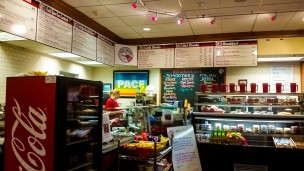
WesWings and Red & Black Cafe (RBC) will be closed indefinitely due to the outbreak of the novel coronavirus disease (COVID-19). WesWings and RBC owners Ed Thorndike ’89 and Karen Kaffen-Polascik announced the closures on Monday, March 16, on the WesWings website.
All non-student WesWings and RBC employees will continue to be paid for the hours that they normally would be working. Student employees will not be paid. Ed and Karen realized that the closure would be a financial hardship for many of their employees and decided that they needed to continue paying them, despite the restaurant’s closure.
“We immediately knew that this was not something that they could handle, as much as it was going to be a large financial hit for us, our staff, many of them do not have the financial wherewithal to weather such a long type of shutdown,” Ed said in an interview with The Argus. “We knew we had to try to maintain, as much as we could with them, a sense of normalcy, especially when it came to work and their paychecks.”
However, Ed and Karen acknowledged that WesWings and RBC will also be taking a huge financial hit in the next few months.
“We’re doing everything we can to make sure our staff is paid, that our bills are paid, that our vendors are paid, but the reality is for the next six to nine months, Karen and Ed are not going to get paid,” Ed explained. “But we have the financial ability, through lines of credit with banks, to weather it and everything, to get through. And we know that long term, we’ll make it. Right now it’s just a matter of getting everything so that everyone else can get through.”
c/o @Weswings Twitter
And they made sure that their inventory didn’t go to waste, either. Two employees went back to WesWings after the closure to pick up and distribute leftover food to other employees and St. Vincent de Paul, the soup kitchen on Main Street, according to the WesWings Twitter account.
Before making the decision to close, Ed and Karen experimented with modifying their dining services. On Monday, March 16 RBC was open according to schedule. As a precaution, Ed and Karen closed the dining room so that students would get their orders to go.
“That was something that the governor had not yet made the call to tell restaurants to do that,” Ed said. “So we had done that ahead of that being a state mandate with restaurants and bars not being able to have dining rooms open.”
That morning, Ed and Karen immediately noticed an uneasiness among the customers and staff.
“You know, like we initially had people coming in, and they were maintaining kind of an okay distance away from each other,” Karen recounted. “And then people were kind of still sitting on couches, and then we were like, okay, we’ll make this a text-in only.”
However, the transition to a text-in only system had limited success. Despite these attempts at implementing social distancing, Ed and Karen, as well as their staff, did not want to continue.
“You know, we’ve been through some of the busiest days that you can imagine, where we feed 500 people in a couple of hours, and we have a line out the door and hundreds of tickets everywhere,” Ed remarked. “I mean we can handle crowds like that. This was different, it almost felt like you were afraid of your customers. And that just made it just uncomfortable and very difficult to keep on doing it, even when we weren’t that busy.”
Ed and Karen cite the safety of their staff as the main reason for their decision to close.
“In the end, it’s just lunch,” Ed said. “We’re not on the front lines like doctors or nurses…and it’s ridiculous for us to be jeopardizing the safety of our staff so that we can make a smoothie.”
But Ed and Karen can recall only two times in the past when WesWings and RBC have closed unexpectedly. The first was when Johanna Justin-Jinich, a student at Wesleyan, was tragically shot while working at Red & Black Cafe in 2009. The other was due to an ice storm during October of 2011.
“The ice storm was in 2011…an ice storm that shut [us] down,” Ed recounted. “I guess it was right around Halloween, a Halloween ice storm. And we lost power, and so we were shut down for…I think it was about five days. And then, back in 2009, you know, [at the] very end of the semester, the shooting with Johanna. And that happened on Spring Fling. We closed for the rest of the semester, both locations.”
Neither of these instances were as lengthy as the expected closure for COVID-19.
In order for WesWings and RBC to reopen, a few things would have to happen. Primarily, there would have to be a significant demand for dining options.
“We’re not looking simply to just be a nice option, but to provide a service that is needed,” Ed explained “And so, I think a lot of it depends on that.”
Another factor is the progression of COVID-19.
“A lot of it depends on the state of where, where the pandemic is, y’know—are we further shut down than we are now, as far as just businesses, are there how many more cases, where are we in the curve?” Ed explained. “You know, are we at the end of the curve, have we ‘flattened the curve,’ or are we not even at the peak yet? And so I think we’re taking into consideration the safety of our staff, of our customers.”
With these next few difficult months ahead of them, Ed and Karen look forward to opening their doors again in Fall 2020. In the meantime, they’re asking that the Wesleyan community buy gift cards—which can be used to purchase items at both Red & Black and WesWings—to provide immediate funds.
“It’s an excellent way for people to help, in particular business, obviously in our case our business, with their immediate cash flow needs,” Ed said. “Because what we get out of it, obviously, is money right away deposited to our account. And so we have money, funds we can actively be using for our business.”
These gift cards may also be transferred to others. Ed and Karen are hoping that people may be able to purchase gift cards, and donate them to WesWings and RBC for students to use if they are running out of points.
“Our hope is obviously, come September, everyone is back, and helps us through.” Ed said.
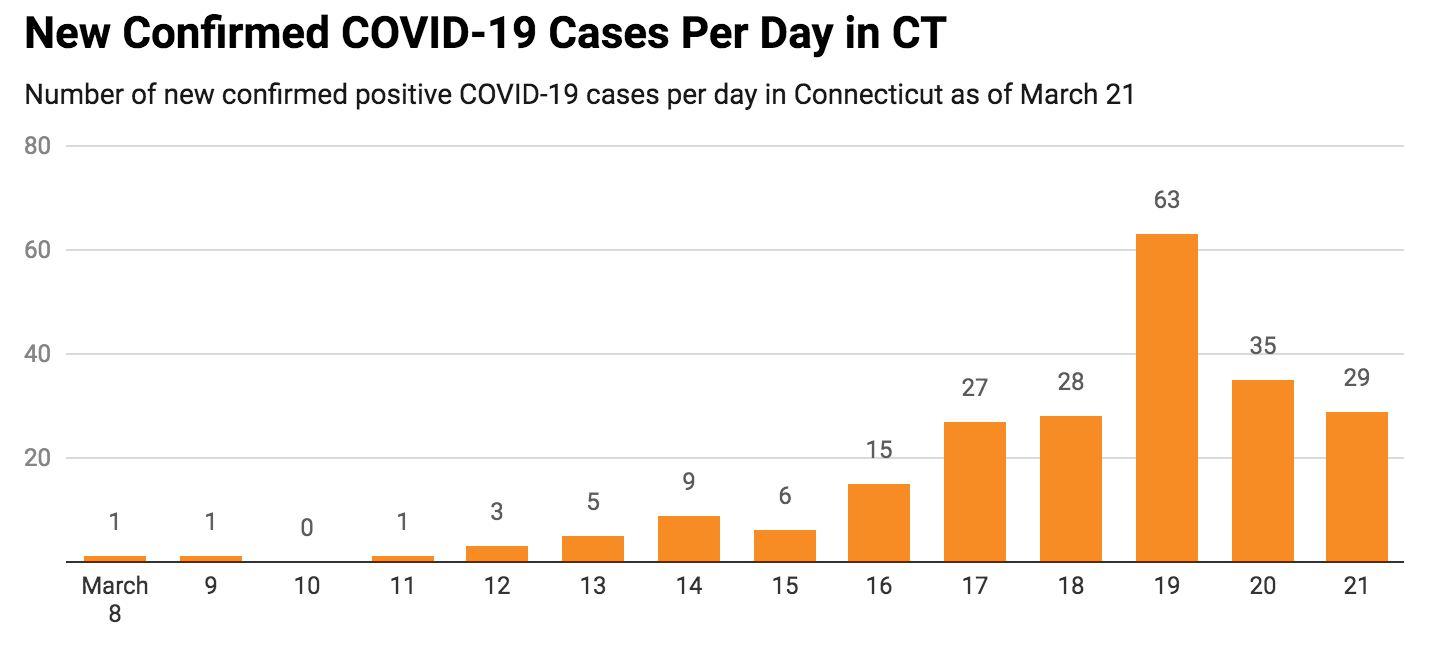
A Middletown resident has tested positive for the novel coronavirus disease (COVID-19), Middletown Mayor Ben Florsheim ’14 announced on Saturday, March 21. This marks the City’s first confirmed case of COVID-19.
The patient is a 50 year-old man who, according to the announcement, is currently self-quarantining. According to WTNH journalist LaSalle Blanks, the patient had recently travelled to Florida. It is not known where the patient contracted COVID-19.
Florsheim urged Middletown residents to follow the guidance from the Center for Disease Control and Prevention (CDC) and the Connecticut Department of Public Health.
“This is the first confirmed case but will certainly not be the last,” Florsheim wrote. “Please, take seriously the guidance we have been sharing from [the] Centers For Disease Control (CDC) and Connecticut Department of Public Health. Stay home, wash your hands, and maintain social distance. We’ll get through this—but it will take time, and will take all of us.” City Health Director Dr. Joseph Havlicek said in the City of Middletown’s press release that he was not surprised by the confirmation of a COVID-19 case in Middletown, as community transmission of the virus has been happening in the area. Florsheim emphasized the importance of individual actions amid the spread of the virus.
“The details of this case really underscore the fact that anyone can get this, we can be carrying it without realizing it, and the idea that it is only something to worry about if you’re elderly is dangerously wrong,” Florsheim wrote in a message to The Argus. “Everyone has to be part of the solution, which means staying home and supporting people on the front lines.”
Middlesex Health is currently in the process of setting up an outdoor testing facility, according to Middlesex Health’s Public Relations Director Amanda Falcone.“Earlier this week, we placed a trailer and tent in front of the Middletown Emergency Department entrance on Crescent Street,” Falcone wrote in an email to The Argus. “We still need to secure the necessary approvals, but this setup should ultimately allow us to evaluate patients outdoors who may have COVID-19.”Middletown residents can call the City Health Department hotline at 860-638-4965 with their questions about COVID-19 between 8:30 a.m. to 8:30 p.m. on weekends and between 8:30 a.m. and 4:30 p.m on weekdays. Residents should contact their primary healthcare providers if they think they are exhibiting symptoms of COVID-19.Expect further updates at wesleyanargus.com and on The Argus’ Twitter account, @wesleyanargus. Claire Isenegger can be reached at cisenegger@wesleyan.edu or on Twitter @claireisenegger. Jiyu Shin can be reached at jshin01@wesleyan.edu or on Twitter @jiyu_shin.
Free meals will be available for curbside pickup at Bielefield, Snow, Macdonough, and Spencer Elementary Schools on Saturday, March 21 and Sunday, March 22 to support those impacted by business and school closures due to the novel coronavirus disease (COVID-19). The meals are available to anyone, extending the community reach beyond students and families at the schools. Meals will be served between 12 p.m. and 4 p.m. on both Saturday and Sunday. People who are unable to travel to any of these locations may also contact MealAssist@mpsct.org to request help in getting access to the meals, which Middletown Public Schools will work to accommodate.
Middletown Public Schools Chief of School Operations and Communication Marco Gaylord partnered with Lan Chi’s Vietnamese Restaurant owner Chu Ngo and community leader Patti Vassia to organize this one-time meal assist program with local restaurants. Each day, 1,300 meals will be available across the four schools, according to Vassia and Ngo.
Though this version of the weekend meal assist program is a one time occurrence, MPS hopes to gather enough meals so families can pick up on Friday and be provided with meals for the following weekend. Since Middletown Public Schools transitioned online on March 16 due to the COVID-19 outbreak, free breakfast and lunch has been offered every week day from 9 a.m. to 1 p.m. at the elementary schools and Woodrow Wilson Middle School, a program that the city plans to continue until schools reopen.
“Next week, we hope to have enough inventory where, if people pick up meals on Friday, we can give them enough for the weekend,” Gaylord said. “That’s our hope…. We’re taking it one day at a time. It really depends if we get our inventory in.”
Gaylord realized that this weekend, MPS didn’t have enough meals for students and began asking local restaurants for help. Ngo reached out to Gaylord and offered to coordinate with the restaurants, as she had previously established connections with them through her past nonprofit work.
“I offered to take over the task because I know there are many restaurants in Middletown and we’re all very caring restaurants and communities that love the community that we’re in, so in the normal circumstance we would all be happy just to provide these meals for free, but this is not that time,” Ngo said. “Many of these restaurants have supported the nonprofits throughout the year for so many years already, and this is a time where they can all come together and help each other and support each other.”
Within two hours, all 26 businesses Ngo contacted agreed to provide meals at $5 per meal.
“We figured this is just a good time for everyone to stick together and help out wherever we can and do what we can in this moment,” Esca Restaurant & Wine Bar owner Elisa Bramato said. “I know they provide assistance for the kids during the school week, but we know that people have been laid off and it’s just a very difficult time for everyone so we thought that maybe we could help out in some way just by each of us picking a time and a school and giving back on one day.”
To pay the restaurants, Ngo reached out to the Middlesex Chapter of United Way, a community-oriented nonprofit organization where she previously served on the Board of Directors for almost five years. She also contacted Vassia, who tapped into her nonprofit networks. Together, they raised the $13,000 necessary to compensate the restaurants within a few days.
“I talked to a few people and then a few people talked to a few people and convinced a few people, and that’s how our community works,” Vassia said. “United Way and the Community Foundation were the leaders in providing a good percentage of the whole thing, and…there was the Rotary Club and private donations and they all came together rather quickly.”
As industries and communities continue to be affected by COVID-19, Ngo highlighted the importance of community support in this time.
“It’s very important to have a wonderful well-connected network and also be in a caring, close-knitted community, that whenever you need, whichever time we’re in, we always manage to come together and pull every effort together,” Ngo said. “This is not me only. I cannot take credit for that. This is the entire community, from nonprofit to private individual company to friend and to city hall and the school system. They do a wonderful job. And we’re just here to support them.”
This article has been updated to reflect that the fact that, according to the WSA’s Twitter account, the University has not yet determined how or if the funds can be legally donated.
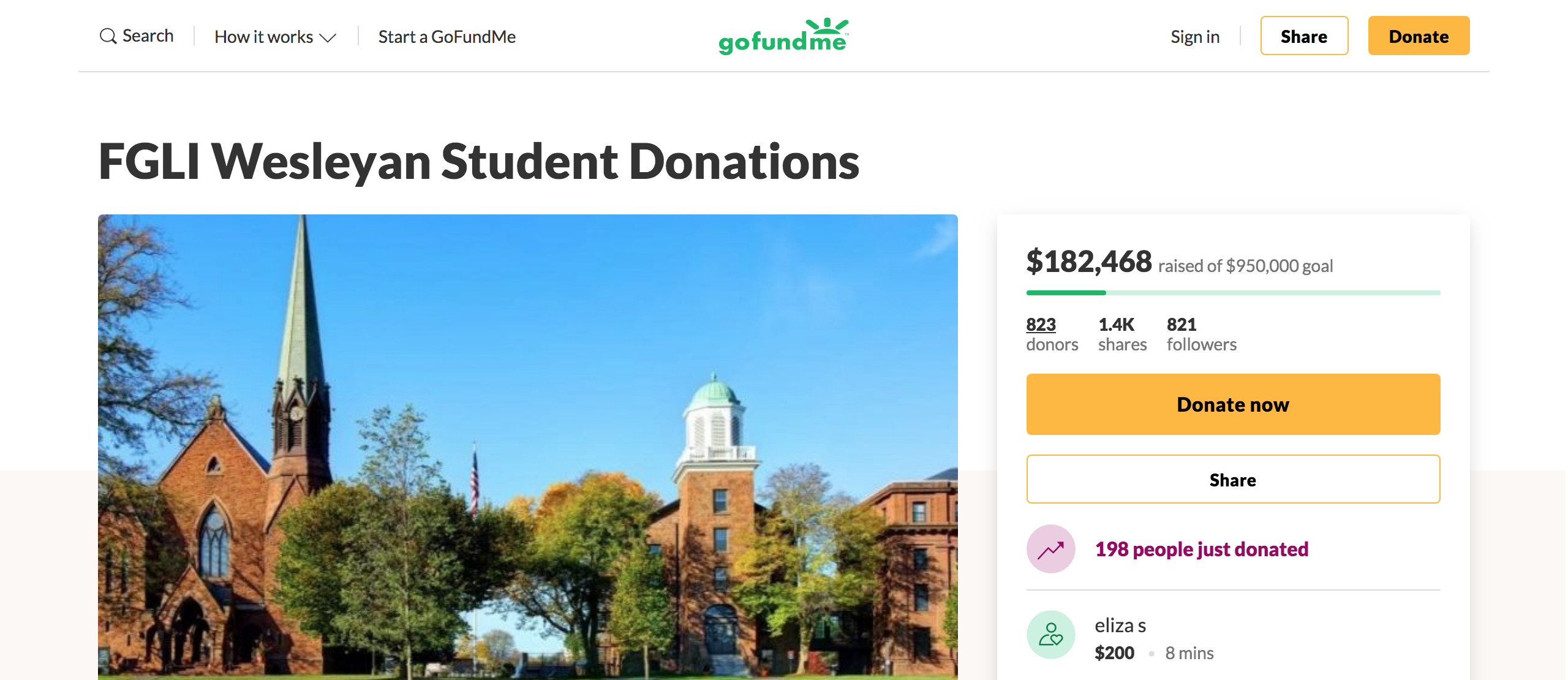
The Wesleyan Student Assembly (WSA) unanimously passed a resolution on March 17 to give $100,000 to the independently-organized First-Generation Low-Income (FGLI) Wesleyan Student GoFundMe and creating an $80,000 WSA Supplementary Emergency Fund (WSASEF). This money comes from the remainder of the WSA’s Student Budget Committee’s (SBC) budget, which is funded by the Student Activities Fee (SAF).
The WSA’s pledged money to the FGLI fundraiser was recorded as an “offline donation” to bypass GoFundMe’s service fees. The fundraiser is intended to provide both immediate and long-term support for FGLI students. Rather than asking students to prove their need or cite specific expenses, the organizers asked those requesting funds to rank their level of need from 1 to 5.
At the time of publication, the FGLI fundraiser has raised over $180,000 from 827 donors and the WSA’s $100,000 contribution would be the largest donation to the fundraiser.
WSA SBC Chair Aditi Shenoy ’20 spoke with The Argus about the decision to make the SBC’s budget available to high-need students.
“The SBC’s mission, at least, is to provide funding to build a thriving community on campus; at times like this, putting our money into the hands of those who need it is part of that mission,” Shenoy wrote in an email to The Argus.
Jessi Russell ’20, one of the GoFundMe’s organizers, is currently working with the WSA on the logistics of transferring the donations. They attended the remote meeting of the WSA General Assembly (GA) to advocate for the fundraiser.
“I was sitting in on the three hour meeting and I had the opportunity to advocate for this GoFundMe and I just want to say I felt heard the entire time,” Russell said. “I think that the WSA kept in mind the fact that the University can be very successful at meeting short-term goals, whereas community organizing can be better with long-term relief such as recurring bills, things that folks who are very high need will not be able to get or will not be able to provide receipts for.”
Russell also hopes that the WSA’s donation will add legitimacy to the fundraiser and encourage more people to donate.
“Obviously we’re at the beginning stages of the campaign right now and part of our problem has been proving our legitimacy both to the administration and I think to potential donors, especially the older alumni,” Russell said. “This lump sum of money, which is what some alumni could also be batching and providing, is momentum. And it’s proof that it’s just not a few students trying to spearhead this effort. It is truly supported by multiple members of our community, including the majority of our community that are not low income. And that means a lot, I think.”
WSA Community Committee Chair Emily McEvoy ’22, who sponsored the resolution, also highlighted the importance of institutions like the WSA contributing to the fundraiser.
“The GoFundMe is a noble and unprecedented student organizing effort that needs institutional support more than anything else: if it has to be us to provide it, we will do that, and use it to pressure those with even more resources,” McEvoy wrote in an email to The Argus.
In addition to the $100,000 pledge to the FGLI fundraiser, the WSA intends to create the supplementary emergency fund within the week. This $80,000 fund will serve as an alternative source of funding for FGLI students, if the University denies or only partially funds a student’s request to the University Student Affairs Emergency Fund. If a student’s request is denied, Vice President for Student Affairs Dean Mike Whaley will advise students to contact the WSA to begin the WSASEF appeals process.
Shenoy, who sponsored the resolution, will chair all appeals decisions alongside other senators. University administrators will not be involved with the appeals process.
“Since the WSA will be using the WSASEF for funding requests that get denied by the administration, we would encourage students, in their petitions to Dean Mike, to ask for whatever they need, even if it seems like a lot [or] not fitting under the current criteria (for example, for money for groceries, healthcare, storage, etc),” Shenoy wrote.
“There are no funding criteria beyond facilitating an emergency transition because we recognize this is an unprecedented time,” sponsor of the resolution and WSA Student Life Committee Chair Huzaifa Khan ’22 wrote in a message to The Argus. “We hope to fund as much as we can.”
The WSA is currently working with administrators to sort out the logistics of allocating funds to students once their requests for funding are approved.
“We’re still working to see what the administration can do to allocate our funding as our back up, the WSA Office, is swamped with work,” Khan wrote. “Students shouldn’t worry, however. Their funding will be allocated one way or another.”
Any funds left in the WSASEF by May 24 may be put into the FGLI fundraiser. The WSA will decide what to do with the funding before its final meeting this academic year.
While the sponsors of the resolution initially intended to use all $180,000 for the WSASEF, they decided to donate the majority of these funds to the FGLI fundraiser during Tuesday’s meeting.
“The reason the resolution was amended tonight was due to the realization that the WSASEF would have institutional and legal restrictions in terms of what the money could be used for,” Shenoy wrote. “The need for receipts and reimbursements would lead to some level of means testing (although likely much less than the level used by the administration). The GoFundMe, since it is outside the institution, has no such restrictions; that is why we decided to donate the majority of our funding to it.”
Shenoy, along with the rest of the WSA, hopes to provide continued support for students as the semester continues.
“As the representatives of the student body and stewards of the SAF [Student Activities Fee], we want to do as much as we can, as quickly as we can, for students in need,” Shenoy wrote. “We will continue working our hardest to use our power to do all we can for the student body, whether that’s through our direct lines of communication with the administration, bringing clarity to members of the student body, or by donating our resources to those in need.”
Jocelyn Maeyama can be reached at jmaeyama@wesleyan.edu.
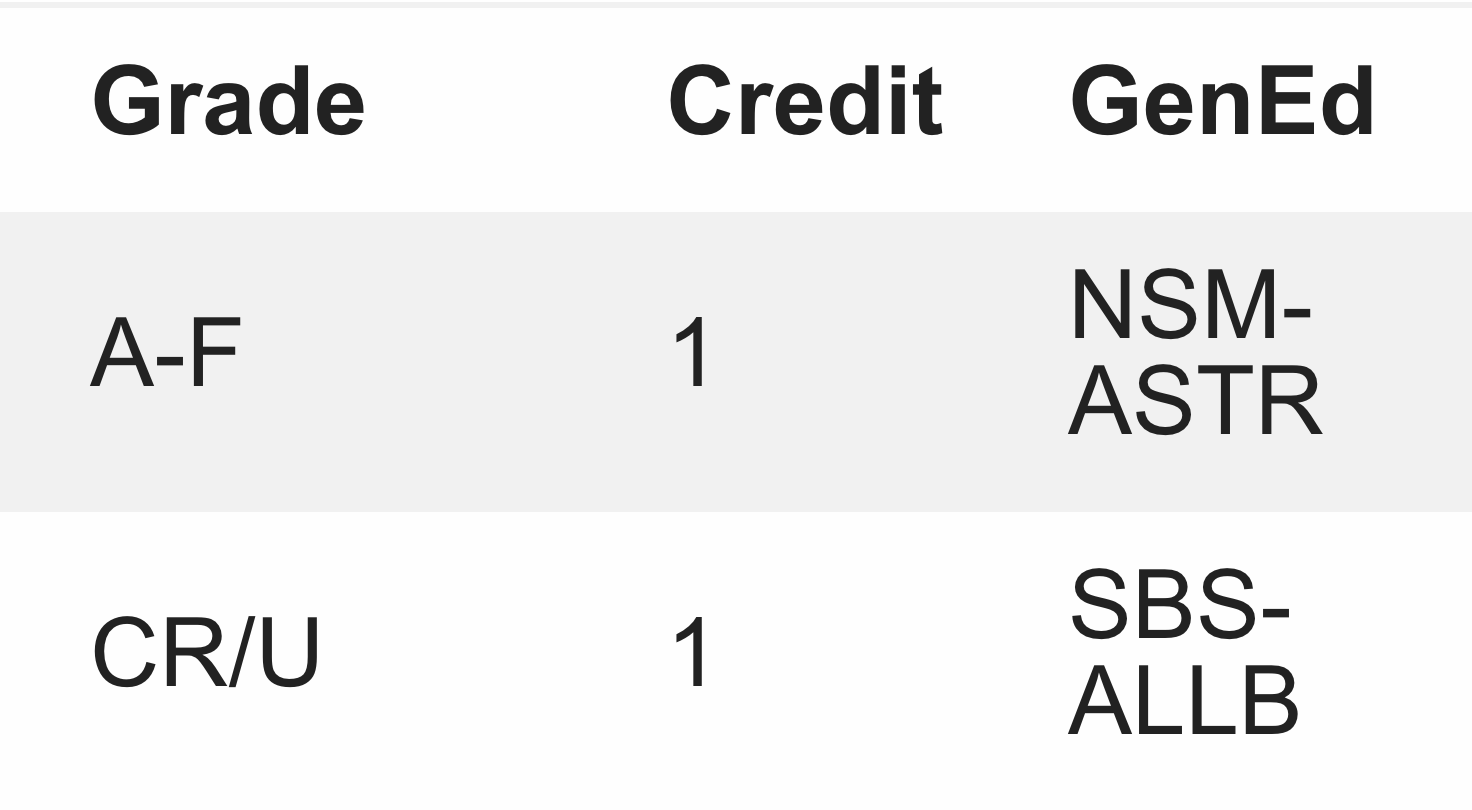
Undergraduates will be able to switch to a Credit/Unsatisfactory (CR/U) grading mode for each of this semester’s courses, according to an all-campus email sent by Interim Provost and Senior Vice President for Academic Affairs Rob Rosenthal. Rosenthal also wrote that all departments have agreed to accept the CR/U grading mode for classes counting toward their majors, minors, and certificates, though students should consult with their departments about thesis tutorials and graduate courses.
Students will have until May 6, the last teaching day of the semester, to inform each of their professors if they are switching grading modes, according to the email. For students who select the CR/U option, professors will not have to write evaluations unless they are giving a student a grade of “Unsatisfactory.”
“Overall there was just a sense that we wanted to take the pressure off both faculty and students, because this is really unprecedented,” Associate Provost Sheryl Culotta said in an interview with The Argus. “We didn’t want faculty to feel uncomfortable knowing necessarily how to best grade work that is discussion and things that are coming in a very different format from what they’re used to, and we didn’t want students to be worrying about their GPA.”
This decision comes after the announcement on Wednesday, March 11 that all of Wesleyan’s in-person courses would be suspended through the end of the semester and transition to distance learning models due to the spread of the novel coronavirus disease, COVID-19.
“It’s clear that some classes will be taught very differently than had been anticipated,” Rosenthal added in an interview with The Argus. “In some ways, it’s not the class they signed up for. So I know students were very, very nervous about all this, and it just seemed to make sense to allow them this time to switch to a credit/non-credit if they wanted to.”
The ability to take a thesis tutorial CR/U—and what effect that change may have—is a department-by-department decision, Rosenthal said.
“For thesis questions, we just want to make sure that the theses students are checking in with their departments, because a lot of theses students may want to know…can I still be given honors?” Rosenthal said. “And that’s a department decision…. We just didn’t see a one-size-fits-all solution.”
Similarly, Rosenthal explained, students should check with each department about if their graduate courses can be taken CR/U.
“All the departments agreed that they would waive this requirement for undergraduate classes,” Rosenthal said. “Some did not want to waive it for graduate classes, so rather than have a problem with that, we just agreed, ‘Okay, so it’s for undergraduate, and if you’re in a graduate class, you should check in with that department and see what their regulations are.’”
If a student takes an incomplete in a course, they will have until the first day of the fall semester to turn in their work rather than 30 days from the end of the semester, the typical deadline.
Faculty have been told to update students over email on the details of how each course will proceed before Friday, March 20. Rosenthal added that faculty may make changes to the syllabus about how the final grade of the course will be calculated and that all such changes should also be announced by the March 20.
Dean of the Natural Sciences and Mathematics Joe Knee noted that a concern for many students will be graduate school applications.
“We’re obviously giving this as an option to students to choose one or the other, and so students are going to have a certain amount of anxiety with trying to make that choice, and I think the faculty and certainly the advisors, which will still be available to students, can help consult on that,” Knee said. “We’re kind of assuming long term that, after this subsides, that medical schools and other professional schools and so forth will kind of understand what happened this semester and take things with a grain of salt as to what the grades actually mean for that particular semester.”
Middlebury College is also allowing students to take their courses pass/fail, as of Monday night, and students at many other schools are circulating petitions that ask their administrations to allow them to do so. No other NESCAC schools have yet publicly announced a change to their regular grading mode policy at the time of this article’s publication.
“It’s really a difficult situation,” Rosenthal said. “It’s like wartime, I keep saying to people. It’s not: ‘Do you want to do it or not?’ It’s: ‘We have to do it, and let’s figure out how we’re going to best do it.’”
Update: While all departments will be accepting CR/U courses this semester, whether those courses will be counted toward the department-specific CR/U caps will be on up to each department’s discretion. Students should contact department chairs for more information.
We are continuing to seek out answers about how Wesleyan will be operating for the rest of the semester. Please email us at argus@wesleyan.edu with your questions, concerns, and tips, and we’ll try to get information out as soon as we can.
The Office of Study Abroad suspended all programs on Thursday morning, per an email to all abroad students from Associate Director of Study Abroad Emily Gorlewski and Interim Provost Rob Rosenthal. Students were instructed to return to the United States as soon as possible, if they were legally permitted to do so. The decision comes as the novel coronavirus strain, COVID-19, continues to spread rapidly across the globe.
The Office assured students that they would receive academic credit for the semester.
“Not all the programs can guarantee it, but Wesleyan is for all of the programs,” Gorlewski said in an interview with The Argus. “Students who are on like a CIEE program might be directly enrolled in a university, and the university might be like, ‘No, we’re not doing anything online,’…and so if that can’t be guaranteed from their program, we’re gonna be able to do something for that. We don’t actually know what, but they will go up in North College, and we’re all gonna be talking about planning for that.”
The decision comes after President Donald Trump’s announcement on Wednesday night that all travel from Europe would be suspended for 30 days for non-U.S. permanent residents. Gorlewski spoke to The Argus about the sudden change, and how it would affect students.
“Twenty-six countries jumped up to Level 3 without ever going to Level 1 in some cases, or Level 2 cases,” she said. “That is when we decided definitely Europe is out, and I was like, this is just going to happen again in a couple weeks in every location, so you know, we were ill-prepared. We were prepared because we knew that it was going to happen or suspected that it was probably going to happen at some point, so we have done all we could to prepare, but we didn’t expect it. Last night, all of a sudden, we thought it would be incremental, it would go one, two, and then three, we didn’t expect zero to three.”
“We don’t want people to get stuck, we were scared every minute last night that our students were literally stuck in Europe for a month,” she added.
Booking last-minute flights to the United States may also pose a financial burden to many students currently abroad. Gorlewski said that the Office of Student Affairs’ emergency fund would be available as a resource to students. Vice President of Student Affairs Mike Whaley confirmed that the emergency fund will be accepting requests from students who need financial assistance for travel.
“We’re gonna see what we can do for students, we don’t want anybody stranded, we don’t want inequities in who’s able to leave and who’s not able to leave, we want to make sure that all the students have the same safety and resources,” Gorlewski said.
Typically, Whaley said in an interview with The Argus, the fund has about $20,000, but the University has expanded its funding due to the COVID-19 pandemic.
“Given the unusual circumstances right now, we’re reviewing requests and the University has made more funding available there,” Whaley said.
Gorlewski said that at the beginning of the semester, roughly 20 international students were studying abroad and many of them will not be able to return to Wesleyan or to the United States due to the ban. Gorlewski also said that they have been instructed to return home.
“If they’re not able to go home, they can contact the Office of International Student Affairs and/or our office and we can see what we can do for them,” she said. “They should let us know if that’s not an option for them.”
All students who are returning from abroad were asked to fill out a Google Form to inform the office of their travel plans.
The Vassar-Wesleyan-Wellesley program in Bologna had already been cancelled after the Center for Disease Control (CDC) declared Italy a Level 3 country, and students came back from South Korea after their program was suspended, as previously reported by The Argus.
“We made the decision all together with Academic Affairs and higher officials, the provost, that we would call the Bologna program when the CDC level got to 3,” Gorlewski recalled. “Three is their highest level, so we’re like, ‘Okay, at that time, it’ll definitely be time for them to go home.’ And, that same afternoon, it suddenly went to Level 3. It went to Level 3, we called it, you know, those students, it’s lucky it was that program because it was pretty easy to move everything online for that program.”
In the email to students abroad, Gorlewski and Rosenthal apologized for the turn of events.
“We are truly sorry that your semester abroad has come to this unfortunate end,” Gorlewski and Rosenthal wrote. “Please know that you have our support and we will assist you in any way we can.”
This is an evolving story, and we are trying to get answers about how Wesleyan will be operating for the rest of the semester. Please email us at argus@wesleyan.edu with your questions and concerns and we’ll try to get information out as soon as we can.
Amid the rapid spread of the novel coronavirus disease (COVID-19), the University will be switching to remote coursework for the rest of the spring semester and is asking all students to move out by March 23 if they are able, University President Michael Roth ’78 confirmed in an all-campus email. Students can petition to remain on campus for the remainder of the semester or to extend their move-out deadline to March 30. Petitions must be submitted by March 18th. The University has also cancelled all on-campus events until further notice.
This decision comes after several peer institutions, including six other NESCAC schools, have moved to remote classes and begun asking students to move off campus.
Connecticut Governor Ned Lamont declared a public health emergency and a civil preparedness emergency for the state on Tuesday, March 10. At the time of this article’s publication, there are three confirmed cases of Connecticut residents who have tested positive for COVID-19. The third case, confirmed on Wednesday, March 11, is the first for which state officials do not know how the patient was infected, as announced at a press conference by the Connecticut Department of Public Health on March 11.
Vice President for Student Affairs Mike Whaley met with students on Wednesday afternoon before the final decision had been made to switch to remote learning. Whaley explained that students who are housing insecure, require access to campus resources to complete their coursework, or for another reason cannot go to their permanent residence will be able to petition to stay on campus. Whaley said that it was likely that students who left campus would be compensated 25% of the year’s payment for housing and dining costs, or half of the semester’s costs. Whaley also said that an emergency fund will likely be used for students who are not able to afford last-minute flights and that these situations will be evaluated on a case-by-case basis.
Whaley also said that just under 400 students on campus either have chronic respiratory problems or are immunocompromised. The substantial proportion of students who may be at greater risk due to the spread of COVID-19 contributed to the University’s decisions to move to remote classes and distance learning, Whaley said.
Students have raised concerns about the impact of a sudden move-out date on low-income or housing-insecure students, who may be unable to return home due to cost of travel or other insecurities. A widely circulated petition, which had received over 2,000 signatures at the time of publication, requested that the University not close campus due to concerns about students’ ability to quickly leave campus. Students who met with Whaley also raised concerns regarding the effect of this decision on international students, who have student visas that may be affected.
How coursework will be administered has not been officially determined, Whaley noted, explaining that professors are currently developing methods through which remote classes may operate. Professors will notify their students how their classes will be conducted by March 20, according to Wesleyan’s Health Services COVID-19 website.
The announcement follows escalating measures from University administration over the past several days, including instructions for students from CDC-designated Level 3 countries to self-quarantine upon return to the United States and an announcement that all conference competition for the Spring 2020 athletic season would be cancelled.
“I have always known Wesleyan to be an inventive place that rises to new challenges, and I have every confidence that the remainder of the semester, while taking a much different form than in the past, will be successful,” Roth wrote in the all-campus email. “While it may not diminish any sadness and frustration, it’s important to note that my colleagues and I have searched far and wide for ways to avoid this suspension of in-person classes and campus activities. Realizing that the closeness of our richly interactive community is what makes us more vulnerable to this disease has led us to this unhappy decision. And now, we are determined to find ways to empower student learning while most are away from campus.”
Correction: The petition deadline is still March 18—students will receive responses on a rolling basis, before March 20 at 5pm.