
Miss[(ed) it]? You missed out
Miss[(ed) It], a performance of five pieces “based entirely on text overheard at Usdan,” ran Sept. 27th and 28th at the ’92 theater. It seems only fitting to begin reviewing a play which took text from others by doing the same myself, so without further ado:
“Alternative!” (Kara Ingraham, ’11)
“Very Wesleyan.” (Joe Newman, ’09)
“I’d advise you to come a little tipsy; you’ll enjoy it even more” (Irina Itriyeva ’08)
Now, had I taken those quotations out of context, added masks, modern dancing, and of course some sodomy with a banana, you would have understood what took place on stage. The five pieces were too different to make many general statements about the overall show, but I can confidently state that not a moment of it was dull. The play used space in an innovative and exciting way, engaging the audience by changing the performance area from one piece to the next. Lighting design, headed by Ariela Rotenberg ’10, was also impressive in each piece.
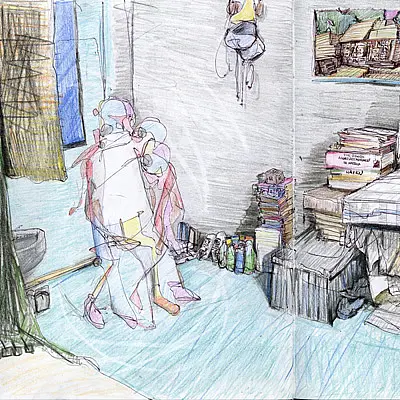
I am sure that “Zoom,” the first of the five pieces, was brilliant piece in its own avant-garde way. However, it was lost on my obviously plebeian and lowbrow intellect. The play featured three ‘scenelets:’ children climbing into a tree-house, a couple lying in bed, and some dancing bugs. The participants of each scenelet repeated variations of the phrase, “I like it.” I beg pardon of all involved, but I did not. The set was excellent, and the staging was visually well-composed, but the piece would have been stronger if the three scenelets were more explicitly linked.
“Zoom” was followed by “Apeshit,” a chaotic depiction of monkeys hellbent on breaking out of their fence prison. It was clear that the cast members were enjoying themselves, and there was a rather bizarre homage to “A Midsummer Night’s Dream” that garnered quite a few laughs. The set and costumes were simple but well-done, and the piece involved the most imaginative use of grocery bags and bananas that I’ve seen for some time.
It was around the time that “Mish Erd” took the stage that I found myself genuinely enjoying the performance. Rejecting artsy pretension, Joanna Firestone ’10 and the ensemble put together a gleeful display of unabashed silliness. As cast members wrapped in sheets lay in the background reading ridiculous statements (“I’m a girl–I have to shave my fingers”) other performers danced like the Boogie Club on crack. One cast member gave birth to a bag of Fritos, which she then fed to others before throwing the bag in the air in a paroxysm of joy. Its weirdness was accessible rather than alienating, so the piece read as an enjoyable celebration of blissful oddity.
“Portrait of a Lady” began with a spectacular visual: a shower of cards fell amidst a blue sheen, and landed before a very puzzled-looking man. The piece is a collage of images, linked by the man’s forlorn pursuit of a tall female painter. Because it had just followed three pieces which capitalized on the “weird and disjointed” aesthetic, “Portrait” was in danger of seeming repetitive. However, the last moment, in which the man timidly kisses the painter’s canvas, only to have her smash it over his head and pull him into a passionate embrace, was so endearing that it gave the whole piece a sweet and distinctive charm.
The final piece, entitled “(Un)titled,” was an example of what a play of found text can aspire to. As sharp squares of light appeared and disappeared to the sound of inhalations and exhalations, Margot Kistler’s ’09 character declared, “That looks fucking amazing,” and I had to agree. As the two actors became trapped in an ever-changing grid of light, their efforts to escape together were both “hilarious and heartbreaking, ” as Gabe Fries ’09 put it. It was a beautiful piece, and easily the most impressive of the performance.
Perhaps the best thing about the play was that it involved such a large cast and crew. A project on which over fifty people collaborated is an excellent way to bring new people to Wesleyan’s often-cliquey theater community. So while it certainly wasn’t the best hour I’ve spent in the ’92, the cast radiated such enthusiasm that I’m glad I didn’t miss it.


Leave a Reply