
Shasha Seminar Brings Academics, Experts to Talk International Economics
The University hosted the annual Shasha Seminar on Friday, Nov. 13, and Saturday, Nov. 14. This year’s theme was “The New Global Economic Order.” Organized by Professor of Government Basak Kus, the two-day event brought 21 speakers together to discuss topics such as the rise of the Chinese economy, the potential of artificial intelligence, and the role of the media in economics.
The seminar is a gift to the University from James Shasha ’50 P’82, and aims to provide University students, alumni, and scholars with the opportunity to discuss global issues in small seminars. Themes in the past have included internet privacy, guns in American society, and mass incarceration.
Unlike last year’s event, which featured a wide cross-section of experts, including founders of non-profits, an actress, and a rabbi, this year’s Shasha Seminar drew on a more narrow cohort of scholars specializing in international political economy, public policy, and cybersecurity. The event also differed from last year in its cost: Student tickets this year cost five dollars, while last year’s Seminar was free for all students and faculty.
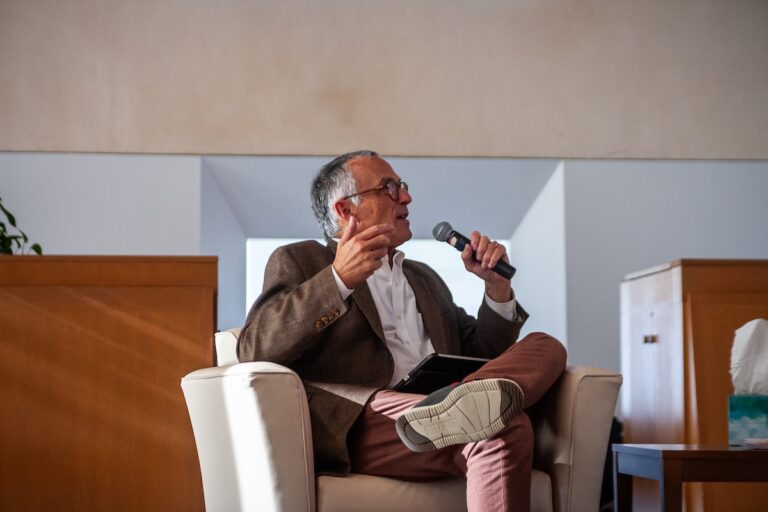
The seminar began on Friday in the Memorial Chapel with an opening keynote address by Ford Foundation Professor of International Political Economy at Harvard University, Dani Rodrik. Rodrik drew on case studies from China’s development to explain weaknesses in global governance and how to remain hopeful during a period of transition.
“My task, as I see it this evening, is not to give a sermon,” Rodrik said. “I’m going to try to provide an optimistic take on where we are, and as difficult as it might seem to you, how to generate the most out of the new global economic orders. We’re clearly in a moment of transition, and I don’t claim to know where we’re going…. What I’m going to suggest is that there are bits and pieces of evidence that suggest that a better future is possible.”
All events on Saturday were panel-style discussions, each featuring two to five panelists in dialogue with a moderator, who posed open-ended questions for them to discuss. Audiences were given the opportunity to ask questions after each panel. This was a major shift in the format of the event from last year, where attendees had the option to choose from multiple seminars and converse with panelists in casual settings, such as over breakfast.
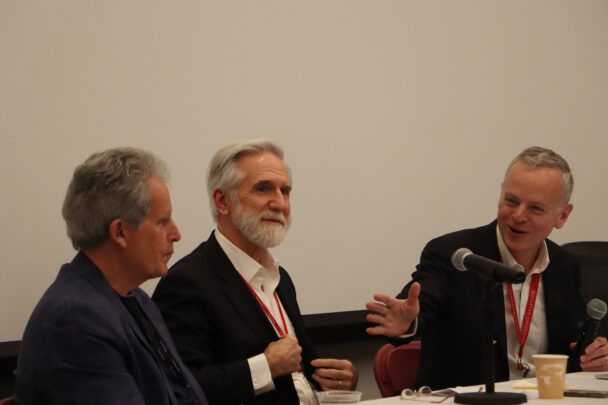
The afternoon on Saturday started with “Decoupling from the Dollar,” moderated by Assistant Professor of Political Economy at the London School of Economics Benjamin Braun. Panelists traced the change in crediting, noting that foreign holdings in American equity assets are higher than before, while official U.S. reserves have sunk.
University of Virginia Professor of Politics Herman Mark Schwartz highlighted that the power and credibility of modern banking lies in the crisis support behind it.
“If a bank gets in trouble and it doesn’t have enough Treasuries, or if the whole financial system gets in trouble and it doesn’t have enough Treasuries, the Ghostbuster question arises: Who are you going to call?… They have to go to the Fed,” Schwartz said.
“Decoupling the Dollar” was followed by the “Political Economy of AI and Digitalization,” the largest panel of the day. Five speakers alternated between short presentations on how AI has impacted their work.
Panelists also discussed how AI is changing labor markets and international economic competition, particularly between the United States and China.
In her closing remarks, Associate Professor of Government Lindsay Dolan encouraged the audience to think about the malleable nature of international cooperation.
“What I would like to encourage us to think about as we connect these to our expectations for international cooperation is what the specific dynamics that we have surfaced in our conversations in all of these discrete issue areas are, and what their properties are,” Dolan said. “Are they positive-sum dynamics? Are they zero-sum dynamics? Are they negative-sum dynamics? These are going to have important implications for the kinds of strategic problems that states are going to face and the incentives for them to cooperate in either friendly or unfriendly ways with each other.”
Attendee Syed Noorwez ’29 reflected on the importance of campus events that facilitate difficult discussions.
“I think a lot of the reason we don’t discuss these things is because it’s not necessarily popular,” Noorwez said. “We do see that these technologies have some kind of utility in our world, so we kind of shy away from the discussions, especially given the controversy behind them. But I think that in order to apply these things best we can without harming the people and the things around us, we do need events like these.”
While Rodrik had hoped that attendees left feeling optimistic about the future of the American economy, particularly regarding AI, Steve Rosloneck ’93 was not sure whether the conclusions of the Seminar reassured him.
“I probably went up and down through the weekend and landed in a similar spot [for optimism], all things considered,” Rosloneck said. “I think the helpful thing for me was to get a little bit more backstory and the trajectory of some of these systemic or huge world-moving events and the connection…. It helps to have some real-world context.”
University President Michael Roth ’78 commented to The Argus on the value of discourse as the global order evolves.
“I think it’s a very important topic, and it’s very much a changing environment where the hegemony of the United States has been significantly declining,” Roth said. “Not just vis-a-vis China, but vis-a-vis the rest of the world, and that creates a very different environment for both Americans and people outside the U.S.”
Aarushi Bahadur can be reached at abahadur@wesleyan.edu.
Akari Ikeda can be reached at aikeda@wesleyan.edu.

Leave a Reply