
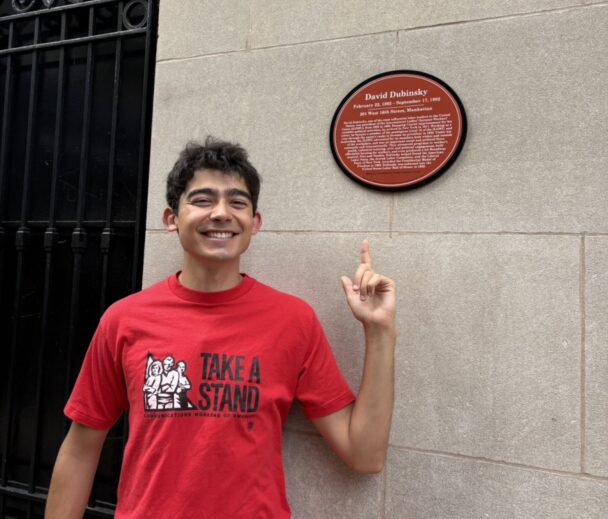
Luca D’Agruma ’27 on Union Stewardship and Collective Bargaining in a New Political Age
How does a college student meaningfully engage in national politics? Luca D’Agruma ’27 seems to have it figured out. From working with the University’s United Student Labor Action Coalition (USLAC) to acting as a junior delegate at the 2024 Democratic National Convention, D’Agruma is proud to be a voice for workers on campus and in his broader community. The Argus sat down with D’Agruma to discuss the development of his political values, his belief in collective action, and the goals he plans to accomplish in his senior year.
The Argus: Why do you think you were nominated for WesCeleb?
Luca D’Agruma: I’ve been doing a lot of public-facing work at Wesleyan, and I think that is definitely what I’ve been known for. I can’t say I didn’t expect it, but it is quite an honor and a joy to be nominated.
A: What kind of public-facing work are you engaged in at the University?
LD: I would say the most meaningful work has been with USLAC, the United Student Labor Action Coalition. I joined USLAC in my freshman year. I had heard about it before I’d even gone to Wesleyan, and it has been such a meaningful space to support workers in and outside of our community, and to build something that can outlast my time here. Working with the Wesleyan Union of Student Employees, which represents undergraduate workers at the Office of Residential Life, has also been meaningful.
A: Have you had trouble with University administration while working with these organizations?
LD: Often, there’s a very simple narrative of student activism that can be reductive, where we’re on one side, and the administration never listens to us. We’re supposed to be intransigent, loud, and annoying, and they’re supposed to be completely immovable. In reality, we’ve had some productive working relationships with members of the administration. I’m continually hopeful that they will make good decisions in the future, but there is also a responsibility of organizations in the community to be willing to stand up and ask for better, so that has led to some conflict and disagreement. I’ve never been one to shy away from that conflict, because conflict can be very productive and lead to better outcomes when people challenge power. So, while there have definitely been some campaigns that didn’t pan out as we had hoped, I think we’re in a very special and opportune time for students thinking about how to make an impact and make Wesleyan better. There’s always a potential for collaboration, but neither I nor anyone else from the movement I belong to is afraid of having an adversarial or confrontational relationship with admin.
A: What accomplishment are you most proud of from your time at the University?
LD: When I came to Wesleyan post-COVID, it felt like campus was very disengaged, and I felt I had a responsibility to bring Wesleyan into some of the important fights happening in the world. I’m grateful and honored to be investing in USLAC. I like to think of it as a powerhouse organization, and I’m grateful that my investment has paid so many dividends in the community that we’ve built. Serving as a shop steward in my union and being a voice that speaks up for members and supports them when they need help has also profoundly changed my experience at Wesleyan and shifted how I view the world.
A: What would you say to students who are apprehensive about getting politically involved on campus?
LD: The Wesleyan bubble is real. It’s easy to feel like what we do here doesn’t affect people, or that organizing that is centered at the university level can be fruitless. There are many reasons why people may feel like they have no power, not only over the University, but more broadly over such massive forces that are making our lives worse. But something that has been made abundantly clear to me over the past several years is that not only do we have the potential, we have the power. You don’t need to make organizing or politics your everything. It doesn’t have to consume your life like it does for me or some others. But we all have a responsibility to contribute in the ways that we can. Once you start, it can be fairly addictive. It’s empowering to know that you can actually have control over your life and the decisions affecting you. Those little victories can be built upon and profoundly reshape broader struggles. There’s such a powerful ripple effect when people stand up for themselves, and it’s never fruitless to start to engage in that and to start trying.
A: You were previously a junior delegate at the Democratic National Convention. What do you think of that experience now?
LD: Looking back, I have a lot of regret over how I engaged with the election. I thought then, and still feel now, that it was profoundly important, and there were very high stakes. Looking at the aftermath of this Trump presidency, we can only feel that even more keenly. But at the same time, I regret not standing up and saying more about how the Democrats completely failed so many people in not only nominating Joe Biden, but also being the face of a genocide, and I’m disappointed that I wasn’t able to do more to change that. I think it’s going to be incredibly important for people of conscience and compassion to think about how we can make sure that those mistakes never repeat themselves. Looking ahead, I’m going to continue to be involved in politics, but in a way that won’t sacrifice my principles. There is absolutely a way to do so, and I think we all should try our best to make our politics a reflection of our better selves.
A: Do you have a message for Wesleyan students as we look toward midterms and the next presidential election?
LD: I’ve slowly realized that we can’t rely upon politicians to save us, and we can only truly rely on ourselves and movements created by ordinary people. It’s important for people to be engaged however they can, whether that’s in a community organizing group, a nonprofit, or with a rapid response network. We’ve seen the power of collective action over the past two years outside of electoral politics, in Minneapolis, Los Angeles, and across the country where people are against data centers and ICE. I think that’s where the power is located. I’m going to be supporting Alexandria Ocasio-Cortez if she runs for president, but I like to think beyond election cycles. There are broad ways people can contribute to change. It starts very small, and we can’t wait for politicians or elections to bring about the change we need.
A: What are you focusing on academically this year?
LD: I’m majoring in history and writing a thesis on construction worker unions in the neoliberal era. I think it’s obviously fascinating. Right now in USLAC, we’re doing a ton of work on the University’s construction practices, and it’s been illuminating to analyze this practice’s history while we’re seeing the effects of exploitative labor here on campus.
A: What do you plan to do after graduation?
LD: You’re catching me in September, so at least I have the good fortune to be able to say I don’t know without contrition or a sense of embarrassment, but I don’t know. What I do know is that I want—and it may sound trite—but I do want to be doing work where I feel like I can make a difference. I’m very interested in politics and continuing to organize, but there are a ton of areas in which I’m excited to work. I want to work; I want to be in the trenches and to make sure I have something to show for it over the next couple of years. For most of my time at Wesleyan, I’ve been so excited to leave, to get to work, and to be able to contribute in a way that I haven’t had the time to do. But for now, I’m just trying to make sure I can enjoy it while I still can.
A: Do you have a favorite Wesleyan memory?
LD: I think it’s quite silly, but last year, my intramural soccer team—shoutout to the Pierre Groupies—won the intramural league, which was, to us, a great achievement, and I’m very excited to do so again. I did get the winning goal, the first goal ever in my intramural career. So that was quite life-affirming and just a sweet memory.
This interview has been edited for length and clarity.
Philip Reynolds can be reached at preynolds@wesleyan.edu.

Leave a Reply