
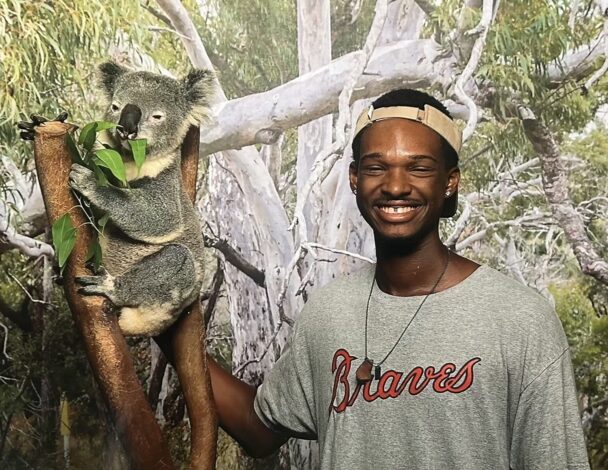
WesCeleb: Ronald Ceesay ’27 Talks Documentaries, Senior Class Presidency, and Adventures Abroad
In just a few years, Senior Class President Ronald Ceesay ’27 has conquered campus involvement, from coordinating the tour guide program to leading the First Things First Pre-Orientation. His latest endeavor entails reviving the Lucid Colors Collective, the University’s student-run visual arts club focused on highlighting artists of color on campus. This week, The Argus sat down with Ceesay to discuss his happenings.
The Argus: Why do you think you were nominated to be a WesCeleb?
Ronald Ceesay: My first-year roommate, Miles Pinsof Berlowitz ’27, was the former Editor-in-Chief of The Argus, so I commanded him to nominate me. No joke, I think I’m around a lot on campus; I’m in a lot of different pots. I’m always walking around, pretty visible.
A: What drew you to the film major?
RC: I really like to see different types of stories. I’ve always liked to read, but I think the best way to express myself is through visuals. I think there’s something very dynamic in film; there are so many moving parts to it, and there’s so much you can do with it.
I like documentaries, and I think they are sometimes more interesting than fiction work because human reality is so much more interesting than what you can make up. I feel like I’m always learning. For instance, I’ve learned about farm work, and now I’m learning about leather art and the Black food diaspora. In narrative, I get to really drill into those themes that I may be interested in.
A: Can you share more about your experiences making documentaries?
RC: I used to think, “Oh, documentary, that’s boring,” and then I took this documentary class with Assistant Professor of Film Studies Sadia Shepard called “Introduction to Collaborative Documentary Filmmaking” (FILM104) my first semester. I met some of my best friends there, and we had to make a documentary about farming and food access in just that semester.
A: What was the most interesting part of the filmmaking process?
RC: We found the statistic that there were over a million Black farmers in the United States less than 100 years ago, and now that number in Connecticut is barely a percentage. We found only one Black Muslim farmer [Azeem Blessings Kareem] in the entire state of Connecticut, and documented his journey from a lower-income neighborhood of Hartford to leading this BIPOC farmers’ collective. He’s a hip-hop artist and he does so much cool, interesting work. That was my first time doing documentary stuff, and I have stayed involved in it ever since.
A: What have you taken away from your leadership experience at the University, outside of filmmaking?
RC: I’ve learned a lot about how the University works, which I think is super illuminating because you go to this college campus for four years, and you’re like, “Why doesn’t this happen? Why does this happen? Or why are these mechanisms the way they are?” From when I first started in student government until I left sophomore year, I learned so much. I went to the Board of Trustees, and I learned who the administrators are, what they deal with, and was able to build really close relationships with them. So now as a tour guide, when someone asks something on a tour, I actually know how to answer the question.
A: You’re also the senior class president. What do you do in this role?
RC: My cabinet’s main goal is planning events for the senior class, mainly Senior Week. We have a lot of cool events potentially teed up for the fall. If you’re a senior, fill out the survey! Maybe we’ll have a fall ball or a career event. Hopefully a mixer of some sort for the whole senior class. And then in the spring, we’re going to have Olin Prom and a Taste of Middletown.
A: What drew you to pursue roles in student leadership? Were you always politically active?
RC: I come from a very politically active family, and I was very active in high school student government. I like to be engaged and to give tours, as I think it’s a way of re-falling in love with the University. I have many problems, of course, with the school, as anybody would, but tour guiding is a way that I like to give back. I like to share my perspective and give my point of view and try to make things a little bit better, whether that’s in student government, or Lucid Colors, or tour guiding.
I’m a coordinator for the tour guide program, and I really do love being able to help students on their college journey because it’s so hard, especially now. I think it gives me a different perspective of the school when I actually have to articulate why I may like this place or even the things that I may not like about this place
A: You were an orientation leader. Can you tell me about that experience?
RC: I was the orientation leader for the First Things First program, which is a pre-orientation for first-generation low-income students. I did it when I came to the University. Even though I went to an expensive private school in Connecticut, I never really grappled with my identity as a student on financial aid, or a student who had some level of high need. So when I did First Things First, it was really where I learned more about what it meant to be a part of this diverse, wide community. It was really impactful and really helpful. I met some of my first supporters through this program, and it’s a really caring environment.
I really wanted to be a part of the program as a leader and help other students. I became really close with a lot of my other orientees, and I’ve met them on their later paths, and they’re up to all these different things. I’ve done it for three years, and it was my last cohort, so it was a little bittersweet. I think it’s really important work because before you’re thrown into the throes of New Student Orientation and the whole school year, I think it’s really nice to have people care about who you are going into this whole new process because it is really hard.
A: You are also involved in Lucid Colors. What can you tell me about it?
RC: Lucid Colors was a student-of-color visual arts collective. It was founded around 2014, and then it died around COVID time. It was brought back briefly my first year, and then it went down again. So I brought together a group of really awesome students and some of the best creatives that I know, and we came together to form this collective and to do this multimedia visual arts showcase at the end of the year (2025). We transformed the entire space of the Digital Design Commons and put up all types of art, from photography and sculptures to visual graphic design work. Our first showcase last fall was really well attended, and we had a lot of different people come.
A: Remind me, where did you go abroad?
RC: I went to Sydney, Australia.
A: How was that?
RC: Oh, I hated it. The beautiful sun, the koalas, the ocean…joking. I had a great time; it was a fun experience. I met a lot of people from all over the world, and I traveled a lot. I went to New Zealand, Bali, Vietnam, and I did this whole mountain trip that my parents probably wouldn’t have been happy about if they knew exactly what I was doing. It was a nice break in my time at the University where my Google Calendar was not as full.
A: Sounds amazing! What advice would you give to your first-year self?
RC: I like how involved I am now, and I probably would end up here regardless, but I would say to do fewer things. Every space in your calendar is not an invitation to be filled. Instead, it should be like, “Oh, let me take a nap, or let me go to the farmer’s market.” I think a good idea is to speed date a lot of different things. I wish I did that a bit more. Try a lot of random things and put yourself out there to do new things.
A: Can you describe your experience at the University in three words?
RC: Eye-opening, layered, spirited.
This interview has been edited for length and clarity.
Maggie Smith can be reached at mssmith@wesleyan.edu.

Leave a Reply