
The Role of the Grotesque in Art: Exploring the Goldrach Gallery’s Latest Exhibit
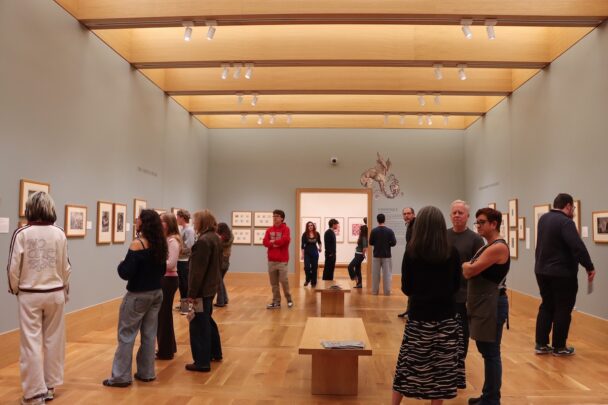
Apt, considering the approaching Halloween season, the Goldrach Gallery’s exhibition this the semester is titled “Grotesque: Art Beyond Restraint.” Curated by Miya Tokumitsu, the Donald T. Fallati and Ruth E. Pachman curator of the Davison Art Collection, the featured works will be on display in the Pruzan Art Center. The gallery is open between 12:30 p.m. and 4:30 p.m. from Tuesday to Saturday.
Upon entering the exhibition, viewers are met with displays that explore the idea of the grotesque throughout centuries of artwork.
“Commonly associated with horror and abjection today, the grotesque has historically also been a locus of generation for caprice, wit, ribaldry, and ornament,” Tokumitsu wrote.
The exhibition is divided into four sections, starting clockwise with “The Licentious Body,” which examines the grotesque through its unsavory distortion of the human form.
“While some aesthetic sensibilities idealize the body as proportional, finely contoured, and intellectual, grotesquerie embraces the body’s unruliness,” Tokumitsu wrote.
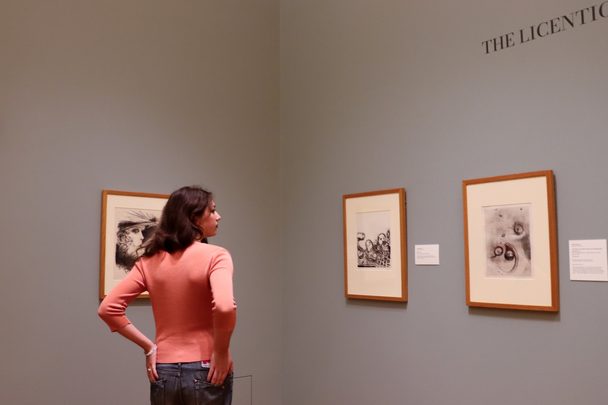
In Odilon Redon’s “…And Eyes without Heads Were Floating like Mollusks” (1896), human eyes are warped into strange, invertebrate-like forms. The eyes are given no dignity in this work, evoking imagery of sliminess and disgust.
Melchior Meier’s “Apollo and Marsyas and the Judgment of Midas” (1581) compares the idealized and the grotesque body. Apollo’s physique is beautiful and proportional, standing in contrast to the donkey ears of King Midas and the flayed skin and exposed musculature of the satyr Marsyas. Both men were punished for rejecting the superiority of Apollo’s music. Here, grotesque imagery is placed in juxtaposition with the divine, a reminder of human hubris and weakness before the gods.
The next section of the exhibition is titled “The Carnival Realm,” exploring the distortion of boundaries that occurs in both theater and performance.
Jacques Callot’s “Varie Figure Gobbi” (1616) depicts, in exaggerated form, the many court dwarves that he would have encountered working for Grand Duke Cosimo II de’ Medici of Florence. They were hired as entertainers and are shown in hyperbolized, grotesque proportions. On a more problematic note, this work offers a glimpse into the grotesque as a way to laugh at caricatures of a marginalized group.
Similarly, Jean Charles François’ “Chinese Ball” (1756) presents another form of othering, this time through orientalist depiction of Chinese people. The scene resembles a European court, complete with European interior design and musical instruments. The Chinese figures are displayed through the Western technique of Chinoiserie, creating an exaggerated and strange theatrical scene.
“In both the grotesque and the carnivalesque, familiar entities are recast and recombined to create strange and fascinating encounters,” Tokumitsu wrote. In other words, within this work, the grotesque lies at the intersection between the foreign and the familiar.
The third section, “The Monstrosity of Ornament,” looks into the grotesque as decoration. During the Renaissance, many viewed these symbols as dangerous.
“If forms can break the rules of nature and propriety, what effects might this imagery have on spectators?” Tokumitsu wrote. Various works depict images of gargoyle masks, human-animal hybrids, and other warped bodily forms.
Finally, “The Dreadful Image” returns to the traditional associations of the grotesque with horror, death, and decay.
Dieter Roth’s “Small Landscape” (1969) stands out as a less traditional and particularly disgusting artwork within the exhibit. Made from soft cheese and emery paper in a plastic sleeve, the work portrays the decay of organic matter and the process of decomposition right before the viewer’s eyes.
Carl Schmidt Helmbrechts’ “Empusa” (1894) embodies a more classic element of horror. Empusa are female demons whose bodies contain both animal and metallurgical elements. They’re typically depicted as either frightening or seductive, embodying a dual nature of both beauty and horror, as well as nature and civilization.
Although the exhibition is divided into four groups, the categories are by no means neatly defined.
“Visitors are therefore encouraged to dwell on the dreadful within the carnivalesque, for instance, or the licentiousness of ornament,” Tokumitsu wrote. “The grotesque is fundamentally about upending categories and rupturing boundaries, and it behaves no differently within this gallery.”
“Grotesque: Art Beyond Restraint” will be on display until Saturday, December 12th. Make sure to come visit!
Katerina Vasyukevich can be reached at kvasyukevich@wesleyan.edu.





Leave a Reply