
Bucket List Provides an Experiential Introduction into a World of Electronic Musical Entertainment
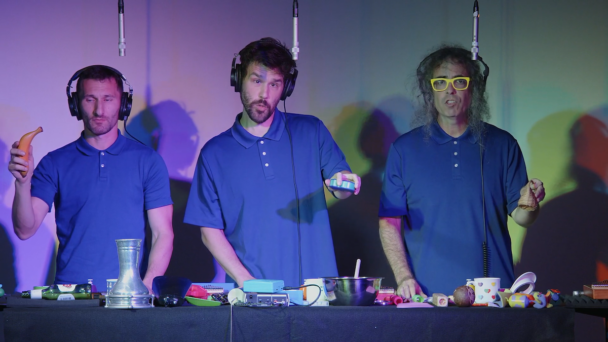
Bucket List, an experimental music band conceived at Stanford University, performed in Ring Family Performing Arts Hall a little over a week ago. The band consists of Mark Applebaum on keyboard and guitar, Andy Meyerson on percussion, and Travis Andrews on guitar. All members perform vocals. Their performance was titled “Achievement: Presented by the Achievement Institute,” and it consisted of 13, interlocking, “scientifically engineered” songs, each representing an individual (as the title suggests) achievement.
Bucket List began their set with a theatrical performance. The three bandmates put on lab coats, transforming into investment- and optimization-hungry scientists, spewing a five-minute monologue begging for donations. The speech was obviously ironic and purposefully hard to follow. This choice for the opener was definitely against the grain, and I found myself quite bored. However, after listening to “Achievement” in its entirety and understanding its message, I realized that there was more meaning to deduce from the monologue.
“Achievement I: Enhance REM Sleep” commenced, and the lights dimmed; the music began and aimed to put you to sleep. It was great at that. But beyond its melatonin-inducing effectiveness, I was fascinated by its placement. Performatively, why would you start a concert by aiming to put your audience to sleep? Interpretively, wouldn’t someone enhance their REM sleep at the end of the performance? The order of achievements doesn’t take place over a single day; instead, it seems to follow someone going from a teenager to an adult, but I still find placing a song about sleeping at the beginning of a concert odd. If you assume the performance is a critique of Silicon Valley, I think this first achievement makes a funny jab at the industry by calling them vampires.
The concert continued with many satirical song titles that poke fun at life. They expressed this idea through song titles that use verbs that, given the task at hand, carry a certain irony. To name a few: “facilitate” in “Achievement III: Facilitate a Successful First Date,” “perform” in “Achievement VII: Perform Skillfully in Upcoming Congressional Testimony,” and “efficaciously introduce” in “Achievement XIII: Efficaciously Introduce Fetus to the Genius of Mozart.” The usage of “fetus” in the last achievement feels pointedly detached. I find that the titles of their songs are an amazing guide to the argument Bucket List is trying to make.
Beside each musician on stage, there was a table with a varied assortment of items and a microphone. To help visualize, it looked like a high-tech ASMR (Autonomous Sensory Meridian Response) video. Bucket List had entire songs where they used an object to make noise, but, to my surprise, I enjoyed these songs the most. For example, they used candy wrappers, hair combs, and glass bottles. They made all these songs with common household items somehow hypnotizing.
“Achievement VII: Perform Skillfully in Upcoming Congressional Testimony” was the only spoken-word performance. There was no instrumentation, just rapid-fire nouns, always ending in the suffix “-ment.” Each word was divided into three, one syllable per member. The words went off in rounds, being reset by Applebaum repeating “-ment.” This was clearly an important song to the performance, as its lack of musicality and placement directly halfway through the set made it stand out. The title leads with the irony of the words “perform skillfully,” enforcing the belief that you are not telling the truth in your testimony. I think I would benefit from a second listen to understand the word choice better, but lyrically, I think the repetition of “-ment” could double as the word “meant.” And this repetition (along with the idea of performing) shows that the end goal of the testimony is to shift blame away from oneself and make it clear what someone meant to happen, as opposed to what happened under their watch.
Bucket List accomplished a lot in this work, too much for me to feel like I understood everything in one listen. But there is no doubt that I would listen to “Achievement” again, and any other work of theirs. This was my first experience with experimental music, and it was the most unique and interesting time I’ve had.
Brandon Paulucci can be reached at bpaulucci@wesleyan.edu.


Leave a Reply