
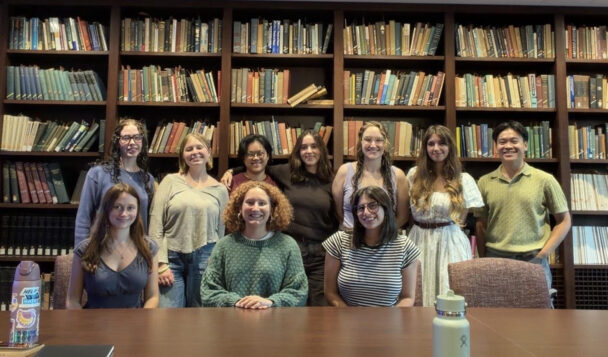
“The Gap Publication”: University’s First Academic Student Magazine Focused on Feminist Scholarship
According to The Princeton Review’s 2026 ranking, Wesleyan University houses the 14th most politically liberal student body in the nation. Given this reputation, student alignment with feminist causes may be taken for granted as a majority view. One burgeoning student publication has indicated in its official club bio, however, that among the University’s rich array of active academic and professional student publications, “none focus on issues of gender, meaning the issue is frequently marginalized in academic works.” The organization seeking to fill this absence is named “The Gap Publication” (The Gap).
The Gap intends to publish professional, gender-critical writing in a magazine format regarding this gap in discussions on gender, beginning this semester. This collection of scholarly long- and short-form pieces, interviews, student independent research projects, and book reviews will address a range of focused sub-topics within feminist literature, including economic agency, activist histories, and political science policy analyses. The Gap plans to welcome diverse topics related to broader gender discourse. However, the academic orientation of the pieces is critical to the publication’s mission, according to Editor-in-Chief Julia Schroers ’27.
“I was interested in introducing a publication that handled issues of gender—which is an issue that tons of publications, individuals, and student groups tackle on campus—in a way that was from a perspective that was really academic,” Schroers said.
The organization, spearheaded by Schroers, began development early last Spring and will begin publishing this semester. The magazine gets its name from the gender wage gap and defines itself as “dedicated to identifying, exploring, and filling in the gap regarding women and gender issues in the social sciences.” The plan also includes speaker events where campus faculty can present on gender issues in their field.
Schroers, a College of Social Studies (CSS) and government double major with a concentration in political theory, was inspired to create The Gap after a conversation she felt kept reappearing in her life: that the study of women in the social sciences was only a “side hobby” for academics within the practice.
“My understanding of the social science[s] is that [they] seek to unveil the secrets of the political and social universe…[and] women are a huge part of that, sometimes in really literal ways, and sometimes in more subversive ways,” Schroers said. “What inspired the publication is a desire to create a space and platform that took gender seriously as an academic part of the study.”
The open-ended nature of the publication is an outcome Schroers is “delighted by,” as it allows students to pitch on everything from teaching as a feminized space and the politics of dairy production to the impacts of gold valuation in India on the family unit.
Despite the publication being entirely student-run, The Gap plans to put submissions through an academically rigorous review before publication. Each piece will go through at least two content editors and two copy editors. Editors will be matched with students familiar with the methodologies and standards of that niche.
“[The pieces go through editors who] are trained in the specific methodology [and] are able to check if this is how a traditional experiment ought to be set up, or if this is a successful or generous way of interpreting archival research,” Schroers said.
Assistant Director of Student Involvement Gina Pacitto emphasizes the importance of an explicit publishing plan, saying, “Before approving a new club, we ensure there is a clearly defined long-term mission that drives the organization, along with a plan for longevity.”
Despite the rigorous process the pieces undergo before publication, the tone of each article remains open-ended, and it is up to the editors and writers to determine a facet of publication Schroers says is extremely important. Following this process, the organization plans to publish contributors’ submissions on a rolling basis on their upcoming website.
When asked about what makes a good project, Schroers was very clear on the requirements.
“Be rigorous, be ethical, and be curious,” Schroers said.
CSS major, data analysis minor, and human rights minor Helen Xie ’27 is one of the editors involved in this process. Xie first became involved with the publication after an experience she shared with Schroers in their CSS colloquium.
“We [barely] read any women that were on the syllabus in that colloquium in the CSS,” Xie said. “We basically read from two women overall in the whole tutorial, and so…there’s this sort of gap in the knowledge academically right now, about women and their perspectives.”
As an editor, Xie works closely with authors to preserve their individual thought processes as laid out in their work while remaining academically sound.
“There is a lot of discussion had between editors and writers,” Xie said. “[Both parties are] humble about what we know and what we don’t know, and able to draw on both our knowledge and external research to make sure that what we’re producing is sound and accurate…not just sort of us blabbing.”
Xie said she looks forward to the club regaining its footing as the academic year kicks off, and the club already has support throughout the University.
“We’ve had pretty good participation so far, which [is] pretty awesome,” Xie said. “It’s nice to know that this is actually a place that people felt was missing on campus, and that there is like something that we are providing for the Wesleyan community.”
While The Gap has just launched, Schroers has long-term aspirations for the club’s impact on the University.
“My long-term hope is that [The Gap] is the place that students and staff will know to go to when they have something to say about gender, when they are teaching a class about gender…they will find community and support and rigorous intellectual engagement here.”
Willow Simon can be reached at wsimon@wesleyan.edu.


Leave a Reply