
Meet Rabbi Levi Schectman: The Man Who Opens His Door to All, at Chabad Wesleyan
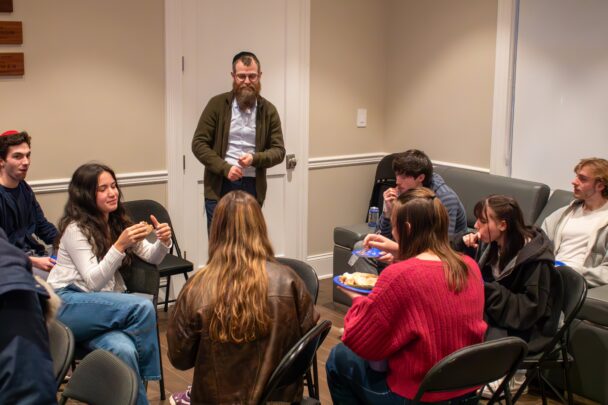
Though Rabbi Levi Schectman only has four children of his own, he often adopts anywhere from 15 to 175 into his home on certain evenings. On Friday, Sept. 11, at Chabad’s Rosh Hashanah dinner, Schectman and his wife Chanie hosted 70 hungry students over the two nights of the holiday.
At any and all Chabad events, Schectman exemplifies his commitment to building relationships. Whether Schectman has only met a student once, or it is his 50th time seeing them at Chabad, he is able to individually recall each student’s name and background.
Chabad is a Hebrew acronym for three faculties: Chachmah, Binah, and Daas, meaning wisdom, understanding, and knowledge. Schectman and Chanie are the first full-time leaders of Wesleyan’s Chabad, having worked 16 years on and around campus. Since the COVID-19 pandemic, their community outreach has only expanded, with a new class debuting this Wednesday, Sept. 23, and an opportunity to celebrate faith and community each week through challah bakes, shofar blowing, and four-course home-cooked meals.
The Argus sat down with Schectman in the midst of the High Holy Days: the holiest 10 days of the Hebrew calendar, which begin with the celebration of the Jewish New Year, Rosh Hashanah (Friday, Sept. 11 to Sunday, Sept. 13), and end with self-reflection during the Day of Atonement, Yom Kippur (Sunday, Sept. 20 to Saturday, Sept. 21).
The Argus: For those who may not know, can you explain what a Chabad is?
Schectman: Chabad is an intellectual approach to Judaism with an emphasis on the spiritual dimension. It is also a movement, in that we try to reach every Jew to give them opportunities to celebrate, understand, and learn more about their tradition.
A: How would you describe Wesleyan’s Chabad?
LS: Chabad’s not really like a franchise where you just open up a training manual, and know what to do. It’s more of a personal feel. It’s very much about relationships. The Chabad operates independently from the University and has a respective community that they serve internationally. Over the years, my wife and I have done a lot of listening and learning to better understand what students here are looking for and how they can benefit most from what we have to offer.
Specifically, we’ve seen that Shabbat dinner here is huge. That’s the highlight of Chabad at Wesleyan that has grown exponentially over the years. Then we have different classes throughout the week, tailored to certain interests that students here have. We’re starting a new class called “The Wandering Table: A Kosher Culinary Tour of the Jewish Diaspora” through JewishU. It’s about Jewish history and different travels throughout the millennia and what people picked up from those travels. We’re going to actually make those foods, each representing different Jewish cultures. I’m very excited about that; I think that’s something that would speak to a lot of students here.
A: Do you and your wife teach the class together?
LS: This one is going to be me. The chief, or the CEO, of Chabad Wesleyan is really my wife, so that’s where everything goes from. I only do what she tells me to do. I’ve been told that my brisket is better than my sermon, so maybe I’m more apt to be in the kitchen.
A: I’m amazed at your family’s ability to provide for so many students in your home. How did you prepare the dishes for as large of an event as the Rosh Hashanah dinner this year?
LS: After being here for so many years, we’re not starting from scratch every single year. I have taken notes on what worked from a prep standpoint and what didn’t work; we have our process already spelled out from years past and look at those notes in the summertime. Then, we start putting our meat orders in, because we can’t get enough kosher meat in Middletown itself. For some places, we’ll have to go to New York, West Hartford, or New Haven. Chanie will put together the menu. The only things I’m left to do are the brisket, the challah, and the matzo ball chicken soup. This year, on the day of Rosh Hashanah, everything had already been checked, double-checked, and ready to go.
A: Tell us a little about your background. Where are you from? How did you know you wanted to be a rabbi?
LS: I grew up in Milwaukee, Wisconsin, and I went to a regular Jewish day school. As I grew older, I realized that I wanted to do something to give back. I grew up in a Chabad atmosphere, and there was a natural sense to give back to the community. Being a rabbi in Chabad made a lot of sense to me because you’re not just a pulpit rabbi giving sermons, you’re really involved in all facets. Whether it is cooking Shabbat dinner, meeting students one-on-one, giving classes, or building a sukkah with students, Chabad is really all-encompassing. So I didn’t have one moment where I decided this is what I want to do. It was more gradual, just getting involved and traveling around the world and meeting different Jewish communities.
A: What is the process of becoming a rabbi?
LS: I can only speak to the Chabad process of becoming a rabbi. The way it works is that you have your formal education in Chabad, you go to different yeshivas, which are a type of university dedicated to the study of the Talmud, then you do one year of rabbinical training, where you study a specific area of the Talmud, Jewish law, or Chassidic philosophy and get tested on that. After that, we go into different communities to be in the field. I’ve been to Poland to lead a seder for a Jewish community without a permanent rabbi. I’ve also been to Russia, South Africa, Israel, and different communities in America. You kind of get a feel as you go; it’s not so bureaucratic.
A: How did you meet your wife, Chanie?
LS: One of my years in yeshiva, I went to school with Chanie’s older brother, and when it came time to get married, he mentioned: ‘Hey, I know this guy who I think would be great for you.’ Then we went through a matchmaking process. Research is done by both sides of the family to determine if it’s a good match. The kind of personality, values, and if there are things to talk about. Then we start dating. Each side has full discretion to decide whether they want to continue or not continue dating. The matchmaker reached out to my family and went back and forth, and it looked like a good match. We went out a number of times, and we both thought we had good chemistry and our values aligned with what we wanted to do with our lives. Then I proposed, and we got married.
A: Where did you go to yeshiva?
LS: I went to a number of places, which actually is fairly typical in Chabad circles. I started off in Chicago, and then I went to Los Angeles, California, and then Brooklyn, New York, and then I went to Israel, and Atlanta, Georgia, for a year for more rabbinic training. And then my last stop in New York was when I got engaged and married.
A: What drew you to Wesleyan? How did you find Middletown from New York?
LS: Middletown for me was great because, having grown up in Milwaukee, though Brooklyn is fantastic, I definitely prefer more of a laid-back, easygoing type of atmosphere. We came in the middle of the summertime, so we definitely came here on a little bit of a blind date, and it was a little bit of a curve, but thank God, it’s been a successful 16 years.
A: I’m interested in how Chabad has adapted to modern times while sticking to its traditional roots, and how you have used technology to cater to students’ needs. Can you speak on this?
LS: It’s a balance, for sure. I think a Chabad approach is that something that’s new doesn’t make it bad. It’s all about the use and the purpose of what it’s used for. So, if it can be integrated in a way to encourage students or to spread what we’re doing in a healthy and positive way, I think all the more power to it.
A: We’re currently in the holiest time of the year in the Jewish calendar. What should the University (regardless of faith) be thinking about and doing during this time to take advantage of meaning?
LS: It’s a time to look inward, and find out what’s really anchoring us, especially nowadays with the world changing faster than it’s ever changed before. Thinking about, “what’s true to me, and what’s my real value? In the shakiest of times, when things feel uncertain, what can I go back to and hold on to?,” whether it is friends, family, or our group tradition. For everybody, it’s going to be different. But I think that’s a global, or at least a University, message: We have to stop and have some introspection about what’s truly a part of us that we can feel comforted by and hold on to.
A: Do you ever have opportunities to explore campus or go to student events?
LS: Now is definitely the busiest time. We do have some events that we go to, like my boys like going to hockey, and we go to some basketball, and sometimes for a senior thesis we can make it work. Just like how the students have so much going on, it’s hard to get everything in; it’s the same thing for me.
A: Is there anything else you’d like to share with the community?
LS: I would say that we’re very fortunate and blessed to be here. We found a very warm and welcoming community here, and I think it’s very heartening when students tell us that they find that we are an anchor for them, and that their connection to Judaism has been either created or strengthened through Chabad Wesleyan. We’re looking forward to continued success in a growing community.
This interview has been edited for length and clarity.
Jade Acker can be reached at jacker01@wesleyan.edu.
Leave a Reply