
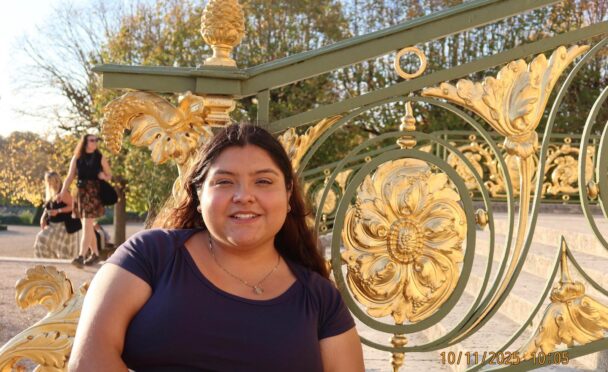
Andrea Herrera ’27 on WSA Initiatives, Presidential Duties, and the Importance of an Up-to-Date Google Calendar
Andrea Herrera ’27, newly elected president of the Wesleyan Student Assembly (WSA), is no stranger to leadership. Through her work in admissions, research with the Human Rights Advocacy minor, and role as president in many other clubs, Herrera leads her organizations with an impassioned focus. The Argus sat down with Herrera to talk about her goals for the WSA and the importance of an up-to-date Google Calendar.
The Argus: Why do you think you were nominated to be WesCeleb?
Andrea Herrera: I am a very involved individual. I have this joke that people always see me running from place to place because I am involved in so many things.
A: What are you involved in on campus?
AH: I have been president for the Latin American Student Organization for a little bit over a year now. I work with the [United Student Labor Action Coalition], the Women of Color Collective, and I have been president of the collective for a little bit. WSA is a really big part of my involvement on this campus. I am also a QuestBridge scholar and I am serving as the president for [the Wesleyan QuestBridge Chapter] as well. My friend and I [also] brought [the Wesleyan Student of Color Pre-Law Society] back my sophomore year, and we are getting ready to transition into senior advisor roles and give it off to the next group.
A: How do you manage your busy schedule?
AH: Google Calendar is my best friend. But, also, I get involved in things that I love and that align with my passions; when I’m doing things that I like, I don’t feel a sense of burnout. It just feels like I am doing something fun. It’s also a lot about balancing work and friends. I have a really good friend group that is always there for me when things go awry.
A: You mentioned that you are a QuestBridge scholar. Could you speak to your experience in the program and how it brought you to Wesleyan?
AH: I’m a [campus] tour guide, and my “Why Wesleyan” speech is always about how Wesleyan chose me before I was able to choose them. I ranked Wesleyan as my number one school for QuestBridge because I got to see it my [high school] sophomore summer and fell in love with it. But it was an expensive school for me, so I didn’t think much of it until the beginning of my senior year when I got an email from the office of admissions that said, “Hey, look into QuestBridge, you should apply.” And I was like, “Okay, I’m gonna try it and rank Wesleyan, and the worst they can say is no.” The day that QuestBridge decisions were released, I was really shocked and happy to be able to be at Wesleyan. So I always think Wesleyan chose me in a way.
A: Do you have a certain project you worked on that you feel most passionate about?
AH: One of my biggest passions is working within admissions. When I joined the WSA, it was the year they had overturned affirmative action. I was really concerned with how that was going to affect diversity and making sure that Wesleyan was attainable for everyone. I worked on a lot of initiatives to make Wesleyan more welcoming that year. [WSA] did a student writing campaign where we wrote letters to students of marginalized identities, and let them know that there’s a community for them at Wesleyan.
I also worked on the WesExplore program. When I was a first-year, I was able to host a [prospective] student, and I thought Wesleyan’s hosting program could be a lot better. My student arrived at noon, went to bed late, and then their flight [back home] was at 8 a.m. So they didn’t really get to see what Wesleyan was like. They got here, had some programming, saw campus for two hours, then left. A lot of our sister schools have better programs, and they are supporting a lot of FGLI [first generation/low-income] students and students with marginalized identities on campus. I was grateful that admissions let me play a role in figuring out how we could fix the program. I think that’s one of my biggest accomplishments on this campus.
A: What inspired you to work in admissions?
AH: My first semester was a little bit rough. There was a time where I didn’t know if Wesleyan was the place for me, and I wanted to make sure that if someone in the future ever felt like me, they would have resources to make them not feel alone. I wish I could have gotten to see Wesleyan better. I wanted to fly in for WesFest. I remember emailing with Wesleyan, and saying “I can’t go to Wesfest. I’m coming all the way from Houston, and I can’t really afford a flight. Is there any way that you guys can pay for this?” And [the University] never responded to me. My transition would have been easier if I knew what I was getting into. A lot of people have told me they were so grateful that they got to see campus before saying “yes to Wes.” I’ve seen a lot of the positive impact through my work within admissions.
A: Why did you run for WSA president? How did you run your campaign?
AH: During my junior year, I was on edge about running, but I was passionate about working within the WSA. I wanted to see a more collaborative space, and for people to not think of WSA as an outside [space] that you just come into with your problems. I ultimately decided to run because of the intersectionality that I hold due to being involved in so many things on campus. I can see when the WSA can work with groups on campus to help make something better. For example, we are trying to partner with Wesleyan Sustainability to find a sustainable way to run our textbook exchange program.
Honestly, one of the biggest things that I was shocked by was the amount of love and support that is on this campus. My friend, who’s a really artsy, creative person, was like, “I’m gonna make you buttons,” [and made] buttons with my face on it. Everyone walking around campus was like “Can I get a button?”
A: Looking forward, what goals do you have as WSA president?
AH: We’re definitely going to continue working on AI. Last year, we finished working with the [Educational Policy Committee] on Wesleyan’s AI policy, and I was grateful to see that professors have taken on conversations about AI within the classroom. In every class I took this past week, my professor has said, “These are my AI regulations, but we can build upon what my expectations are for you and what you expect from me too.”
A lot of the chairs for this year have their own passion projects that they’re pursuing. I want to be able to support them and do a lot more cross collaboration within the WSA. My vice president and I have also been talking about having a lot more of an open WSA . We were thinking about hosting office hours ourselves, so people can come and talk to us about things they need our support for. But honestly, I’m just really excited to get back into the rhythm of working, and to see what new ideas the first-years bring.
A: What is your major?
AH: I’m an American Studies and government double major and Human Rights Advocacy minor. I really love all of my majors, but I have a special place in my heart for the Human Rights minor.
A: Could you talk more about your work in Human Rights?
AH: I did the minor with a partnership with the University Network for Human Rights. I was fortunate enough to be assigned to the Mexico Project. They address clandestine graves and also forced disappearances and femicide. That has always been one of the topics I have been really interested in. [The Mexico Project] crosses over with asylum immigration and how women often don’t get protected in asylum law. I talked to a bunch of families, did a lot of ethnographic research, and then the following summer I went back to Mexico City to do research. Being trained on how to properly “do advocacy” is a big thing that you learn in the minor.
A: Are you continuing to work on the Mexico Project?
AH: I still touch base with the people that I worked on that project with because it is such important work. Last year, one student reached out to me and was really interested in working on the Mexico Project, and I was able to connect her with the person that I did the internship with, and she spent this past summer working with them. Having that partnership with the project is something that I love. Even this past summer when I was in Mexico City, I got to see some of [the members of the Project] and say hi. It was just super rewarding, and it made me realize that advocacy work is something that I want to do for the rest of my life. I wouldn’t have discovered that if it weren’t for the minor.
A: Is there any advice that you would give your first-year self?
AH: My freshman year self was panicking and freaking out about everything. Part of me wishes I could go back to my [old] self and be like “If it doesn’t work out the way you want it to, you often discover a new path.” I never once intended to come in and be an American Studies major or Human Rights minor. I took a class and decided to go down that path. I never intended to do union work on campus. But I bumped into someone that was like, “Hey, you are a Spanish speaker. We need Spanish speakers. You should come and sit in one of our meetings.” And naturally, that kind of took its course. I know it sounds cheesy, but truly, you will find your path and everything will be okay.
A: Any final thoughts?
AH: I am ultimately glad that I am at a privileged position of having Wesleyan administration work with me. I think what makes Wesleyan so beautiful is the passions that people carry with them, and the ability to fight for the things that they love and really make change.
Leah Ziskin can be reached at lziskin@wesleyan.edu.

Leave a Reply