

Behind the Rise: Investigating The Cards’ Rapid Transformation Into a NESCAC Powerhouse
At the end of Christine Kemp’s interview for Wesleyan’s head field hockey coaching job, Director of Athletics Michael Whalen ’83 asked whether she thought the program could win.
“Think we could get an AstroTurf?” she replied.
Kemp was being hired to run a program that had two NESCAC playoff wins in its history. The team had not beaten an opponent on AstroTurf since 2014, a streak that would eventually reach 24 games. Field hockey is meant to be played on the surface, and Kemp knew the recruits she wanted were going to schools that had it. The conversation about winning, she told Whalen, had to start with the field.
Three years later, in the middle of the 2022 preseason, Whalen told her he wanted her to meet someone. Peter Hicks ’72 asked her about her vision, and soon after, the Hicks family put up $1.5 million for a fully donor-funded field. The turf was ordered in January 2024, and by the end of the 2025 season, Kemp’s squad had won more games than any team in program history, reached its first NESCAC final, and made its first NCAA Elite Eight.
Before accepting the athletic director job in 2010, Whalen had asked University President Michael Roth ’78 a broader version of that same question: Was Wesleyan willing to build the conditions winning required? He was coming from Williams, where, as the head football coach, he had gone 32–8 over the last five seasons and seen what it looked like when a NESCAC program had the backing to win. Wesleyan asked for excellence in the arts, humanities, and sciences. Whalen wanted to know whether Wesleyan was ready to give athletics that kind of backing.
Roth had not arrived at Wesleyan with athletics on his agenda.
“That was a mistake,” he told The Argus. “At a place like Wesleyan, where a quarter of our students are athletes, when you change the culture there, you change the campus dynamic in a very positive way.”
To examine how this change happened and what it has meant for athletes and the campus, The Argus reached out to 321 upperclassmen student-athletes with a survey that inquired about time commitment, offseason expectations, team culture, department support, and the role of athletics in campus life. The survey received 97 responses, for a response rate of 30%.
The Argus also interviewed Roth, Whalen, 15 current student-athletes on the record, 4 head coaches, and 6 alumni. Interviews focused on the rise of Wesleyan athletics, admissions standards, fundraising, coaching expectations, team culture, and the changing place of athletics in campus life.
The systems that helped build the rest of Wesleyan had never been pointed at athletics. Admissions had to understand what coaches were seeing in recruits, and development had to see teams as part of the fundraising picture. Admissions came first. In the NESCAC, where teams cannot offer scholarships and academic standards are non-negotiable, the admissions office can determine what kind of program a coach is allowed to build. Whalen calls the relationship a “lifeline” and says he works to make it mutual.
“I’ll ask admissions, what are your initiatives?” he said. “They’ll say, ‘Gee, we’d love to get more kids from Florida or Texas.’ So then I’ll talk to coaches and be like, we should try to get out to Florida for showcases.”
Coaches do the first round of evaluation themselves, assessing whether a student is viable at Wesleyan. Head Basketball Coach Joe Reilly, who has spent 31 years in the NESCAC, said experience has taught him how to spot red flags before sending a recruit forward. Admissions, he said, is better positioned to identify the “green flags” that match what Wesleyan is looking for.
Admissions then runs the file through the same rating it uses for any applicant—grades, test scores, recommendations, etc.
“Each athlete gets an academic ranking, and if their ranking is low, we can’t take them, no matter how good they are at their sport,” Roth said.
As part of the NESCAC admissions agreement, he signs off on every recruited athlete admitted, and the pool has to match the academic profile of the class as a whole.
Roth pointed to the process as evidence that academic expectations had not changed.
The academic process held, but athletics also became a larger part of the class. Admissions told the Argus that in 2015, the four-year trailing average of varsity athletes as a percentage of the first-year class was 20.8. In 2025, that average was 25.8%. During that time period, the entering class size also grew from 756 in 2012 to 830 in 2025. Athletes entering grew from 157 to 214, accounting for 77% of the overall increase.
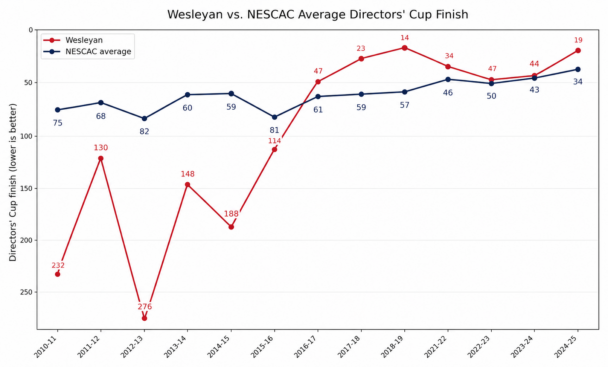
With quantity came quality. Wesleyan averaged a 155th-place finish in the Learfield Directors’ Cup—the standard measure of Division-III (D-III) athletic department performance—across the award’s first two decades (1995–1996 to 2015–2016). In each of the last seven completed years, the school has finished inside the top 50.
The Blueprint
Joe Reilly had just finished a two-hour practice when he went back into his office to watch it back. In 29 years as a head coach, he has missed one practice and one game: once to bury his father, once when his wife was in the emergency room. Last season, his team finished 30–2 and reached the Final Four.
Reilly’s program already looked like what Whalen wanted more teams to become. He brought a Division I level of structure to a D-III setting: year-round expectations, a clear standard players were expected to meet on the court and off it, and fundraising and recruiting folded into the job. For Reilly, that standard had to fit inside Wesleyan’s larger promise.
“A lot of schools, your four-year basketball experience is your experience in college,” Reilly said. “Here, the 4-year Wesleyan experience sets up your next 40. That’s a big part of our recruiting pitch.”
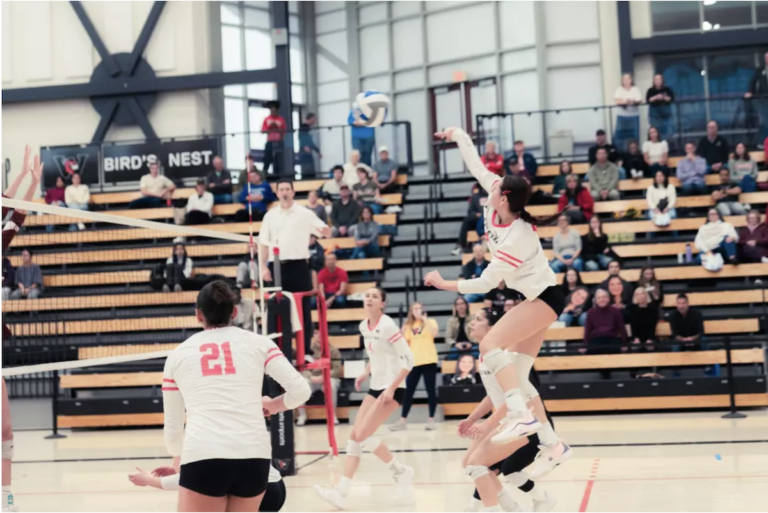
The hires that followed pointed in the same direction. Kim Williams’ women’s lacrosse program has reached seven straight NCAA tournaments. Ben Somera’s volleyball team has made the NCAA Sweet Sixteen every other year since 2018. Christine Kemp pushed field hockey to its first Elite Eight. The classroom numbers held up. Field hockey carried a 3.79 GPA this fall. Nineteen lacrosse players and more than half the volleyball roster earned NESCAC All-Academic honors, which require a 3.50.
The job also required coaches to help build the financial base of their programs. Whalen told candidates up front that fundraising was part of the job. A coach who did not want that responsibility should look somewhere else. In the past, he said, some coaches treated fundraising as optional, and their teams felt the difference.
“Some coaches who did not want to put in the time to raise money would effectively lower the experience for their teams, cutting back on travel, gear, or other parts of the varsity experience rather than building the resources to support them,” Whalen said.
Whalen described how athletics, like every department at Wesleyan, works through an annual process where budget requests are submitted and considered by the university. That process has provided a “consistent foundation,” but not enough to fund the department’s growth on its own. As Wesleyan’s programs improved and competitive expectations rose, generating additional support through philanthropy and other revenue streams became a greater emphasis. A decade ago, donor funding covered less than 20% of athletics’ annual operating budget. Today, Whalen said, it is around 50%.
But a fundraising model creates its own imbalance. Programs with large alumni networks, wealthy parent bases, or recent winning histories can raise more easily than newer or lower-profile teams. The athletic department tries to manage that through the Cardinal Fund for Athletics, the discretionary fund Whalen oversees as athletic director. Unlike team-specific gifts, which generally follow donor intent, money directed to the Cardinal Fund gives more flexibility to support programs with less fundraising capacity.
Whalen also noted that athletics is included in Wesleyan’s university-wide capital campaign for the first time in school history, with a $10 million goal inside the university’s larger $600 million campaign. Much of that money is intended for endowments. Annual gifts help coaches cover immediate needs, but they have to be renewed each year. Endowment money is invested, allowed to compound, and paid out over time, giving programs a more stable source of support.
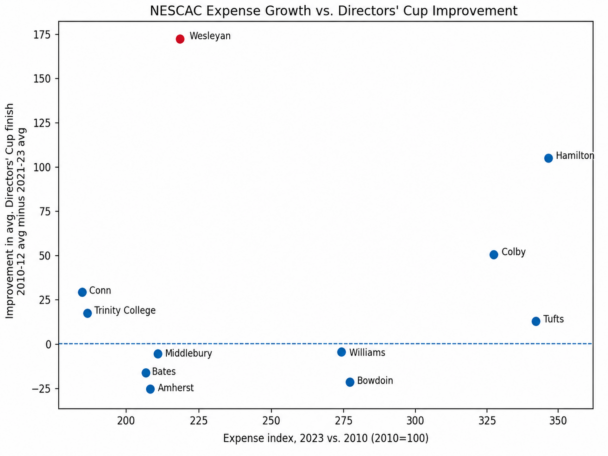
Even with that growing emphasis on fundraising, the broader numbers complicate the idea that Wesleyan simply spent its way up the league. Federal Equity in Athletics data show that Wesleyan’s self-reported expenses rose from $4.25 million to $9.56 million from 2010 to 2023, a 125% increase. But inside the NESCAC, that growth was not unusual. Wesleyan ranked 6th of the 11 NESCAC schools in percentage expense growth, below the conference mean.
Time and Money
At 7 a.m. on a Wednesday, Fisher Hirsch ’26 found himself in downward dog. All 12 members of the Wesleyan men’s golf team were on the floor of the team’s room in Freeman Athletic Center. Hirsch was leading yoga, one day after the team had met for a 7 a.m. run. A few years earlier, that would have been hard to imagine. There had been little team structure. Players went to the course when they could, and some went weeks without seeing certain teammates. Now, they start and end every practice together.
In The Argus survey, 53% of respondents said their program had become more structured since they arrived. Respondents reported spending an average of 25.6 hours per week on their sport. That figure is not directly comparable to the NCAA’s 20-hour limit on countable athletically related activities, because the survey included optional workouts. But that distinction is revealing: There is a gap between what is formally required and what athletes feel they have to do. 67% of respondents said offseason “voluntary” activities are strongly expected within their team, and another 14% said they are generally expected.
The NESCAC has begun formalizing part of that offseason reality. Under a pilot program now in its third year, fall teams receive ten coach-led spring practices, while spring teams receive ten in the fall. Outside those windows, teams still hold captain-led workouts.
Whalen acknowledged the tension between the rule and the reality around it.
“We say to the kids these are optional,” Whalen said, “But they probably don’t feel optional to the athletes because they know their peers at other schools are doing it.”
“If an athlete has to leave practice early for an exam,” he added, “They will make it up after. That’s the expectation that’s been set.”
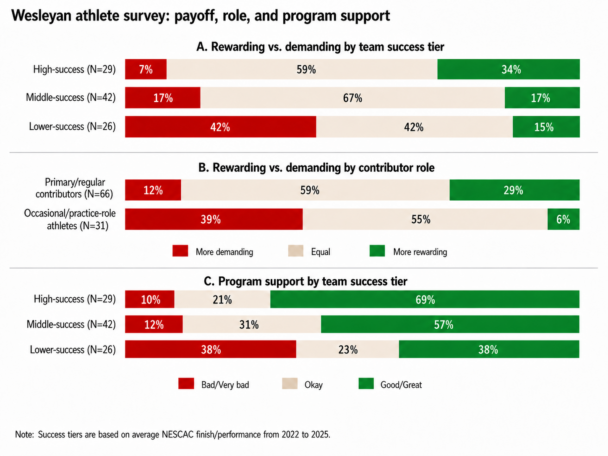
For many athletes, that grind is worth it. Over 75% of survey respondents described being a student-athlete as at least as rewarding as it was demanding. But the aggregate numbers concealed sharper splits. Primary and regular contributors were far less likely than occasional contributors and practice-role athletes to say the experience was more demanding than rewarding.
Wesleyan Athletics programs were grouped using their NESCAC finishes and D-III rankings over the past four seasons. On Wesleyan’s higher-performing teams, athletes were far more likely to call the experience more rewarding than demanding. On lower-performing teams, the numbers nearly inverted.
One athlete on a lower-performing team described the gap:
“Many of my friends who go to a D-1 school, if their team’s bad, that’s still the experience,” the athlete said to The Argus in an interview. “The sport is why they’re there. Here, you come in thinking the sport is going to be one part of everything else Wesleyan has. But when you’re not playing, and the team isn’t winning, and you’re still putting in 30-something hours a week, you start to feel like you’re missing out on the rest of the school.”
There was also a split in how athletes felt their programs were supported by the department. Athletes on higher-performing teams were much more likely to rate their program’s support from the athletic department as good or great. On lower-performing teams, nearly as many rated that support as bad or very bad.
The men’s golf team has operated without a permanent head coach since the program’s longtime coach died in 2022. Jon Wilson, Wesleyan’s director of golf and women’s head coach, was also responsible for overseeing the men’s program, a setup that players said could be difficult when both teams competed on the same weekend. In the fall of 2024, the athletic department struggled to find drivers for tournaments, often arranging transportation at the last minute. In September, the men’s team missed a tournament because no one could be found to take them.
Whalen said the missed tournament was unacceptable and took responsibility.
“That’s my fault,” he said. “No excuses.”
Whalen rejects the idea that lower-profile teams are ignored. He pointed to the guardrails the department has built: end-of-year athlete evaluations, annual meetings with every head coach, budget reviews, and an open-door policy for athletes who feel their experience is falling short. He said this allows them to distinguish between a one-off complaint and a pattern the department has to address.
Still, some athletes said the unevenness was larger.
“It’s not that the athletic department doesn’t care,” another athlete said in an interview with The Argus. “It’s that you can feel where the energy is, and it isn’t with the struggling teams.”
The Divide
The same structure that can narrow an athlete’s experience can also make teams some of the strongest communities on campus.
“You’re sold on having a lot of really good friends right when you come into school,” Will Miller ’26, a captain on the men’s lacrosse team, said. “Coach [John] Raba spends a lot of time selling you on the fact that you’re going to have 50 guys you can ask questions to and rely on, which is really nice when you’re 18.”
The appeal is obvious. A team gives athletes answers to the first questions of college: who to eat with, who to ask for help, and where to go on weekends. What starts as support can become a boundary, however. The more a team organizes a student’s life, the less reason there is to look outside it.
The clearest place to see the divide is in Usdan. The main dining hall has two sides, usually described as quiet and loud—but students also understand the split another way: non-athlete side and athlete side. In a 2022 Argus piece, former Opinion Editor Akhil Joondeph ’26 surveyed more than 200 students at Sunday brunch in Usdan, asking whether they were athletes. The numbers were what he expected, but his main observation was that non-athletes often scoffed, as if the divide were too obvious to ask about, while the athletes answered earnestly.
Joondeph, a non-athlete, was direct about his own group. Non-athletes, he wrote, found athletes “an easy target for frustration”—visible, conventionally social, and a numerical minority easy to scapegoat. The divide is hard to undo because it gives both sides a story that feels true. Athletes see a team that makes Wesleyan easier to enter and a life that is easy to stay in. Non-athletes see a group that got a ready-made version of college while everyone else had to build one.
The divide has become harder to avoid as campus social life has lost some of the places where different groups used to mix. Fraternities have a very small footprint on campus. There is one bar [Mezzo Grille] on Thursday nights where much of the campus turns up. Aside from that, spaces where everyone shows up are sparse. At the same time, Wesleyan is recruiting athletes who are more likely to have spent years inside serious athletic structures: club teams, showcases, private training, and year-round competition. Serious commitment is not unusual at Wesleyan. Musicians, theater students, and chemists arrive with versions of it, too. What makes athletics different is that the commitment comes with a social structure already attached.
Wesleyan has not become a campus of separate lanes. But the forces pushing students into them are stronger than they used to be. Roth said he has thought about that tendency.
“What I find so important at Wesleyan is that people don’t stay in their lanes,” Roth said. “The dynamic is, though, when you get better at something, you spend more time on it, and then naturally you spend more time with your teammates than non-teammates. I hope it’s true that that hasn’t happened at Wesleyan as much.”
Miller, who spent much of the conversation describing what the team had given him, was blunter about the cost.
“I wish it wasn’t that way,” he said. “There’s more cliquiness around athletes than anyone even realizes.”
The athletic problem at Wesleyan used to be that the school’s idea of excellence stopped short of the field. It does not anymore, and the costs haven’t been obvious. The teams are winning, the academic standards have held under more competitive rosters, and the budget has grown roughly in line with the rest of the conference rather than ahead of it. Whalen has also built a department meant to last beyond him: Athletics is in the capital campaign for the first time in school history, teams are building endowments, and coaches now understand the expectations of the job in a way they did not 15 years ago. The harder question is what it means for the athletes living in it. Wesleyan brought athletics closer to the center of the university. Whether athletes can still move easily between the field and everything else is the next thing to find out.
Sam Weitzman-Kurker can be reached at sweitzmankur@wesleyan.edu.

Leave a Reply