
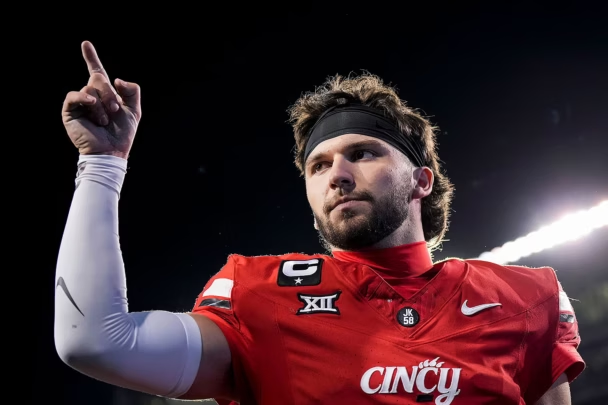
Brendan Sorsby’s Gambling Scandal Indicates Dangerous Future for the NCAA and the Sports Betting Industry
On Monday, April 27, Texas Tech University announced that its football program’s quarterback, Brendan Sorsby was checking into a gambling addiction program. In the current state of the sports industry, where player contracts and sports betting has taken NCAA athletics to new financial heights, this news is a wake-up call for the sports world as betting continues to be put under the microscope of controversy.
The NCAA has strict policies on its athletes, staff, and employees betting on sports. Gambling on one’s own team leads to permanent ineligibility for NCAA competition, as well as if they participated in any form of gambling scheme that influenced their play. The latter was enforced this past January, as 39 college basketball players were busted for participating in an underground gambling ring. If players place bets in their sport but not on their school, they are subject to 50-100% of their season eligibility being removed. If a college athlete bets $800 or more, 30% of their season is nullified. If bets are placed on pro events, there are similar suspensions, unless the NCAA does not hold a championship in the sport in which the bet is placed.
The majority of the controversy surrounds a bet Sorsby made in 2022 while redshirting at the University of Indiana, when he placed a bet on his own football team. This would deem him ineligible to return for his final year of eligibility in the NCAA. However, Sorsby’s betting issues go much deeper than just this individual event in 2022. The Athletic reported that he’s placed hundreds of bets since he began competing in college football.
The NCAA, in recent months, has experimented with lessening its betting policy, but ultimately, the schools were the ones who shot it down. Last October, the NCAA allowed for a 30-day trial period for student athletes and staff associated with athletics programs to bet on professional sports, but 2/3 of Division I (D-I) schools voted to rescind the rule after the month-long period. This was in the wake of the Chauncey Billups and Terry Rozier investigations by the federal government and the NBA at the beginning of the professional basketball season, so a large part of their disapproval of the policy stemmed from the controversy.
However, it is not like schools are completely against sports betting, and their non-athlete students certainly are not either. A 2023 study from the NCAA found that almost 60% of students surveyed had engaged in at least one sports betting activity. Additionally, 16% of surveyed students have engaged in some risky betting behavior, and 70% of those students believe “consistent sports gambling will increase their monetary earnings.”
Within the last eight years, the NCAA has seen revenue sharing skyrocket and the amount of money being generated around college sports increase exponentially. Various parts of the Sorsby story contribute to this, most notably the legalization of sports betting and the ability for college athletes to receive financial benefits. Despite it being a sports industry–wide issue, the NCAA had a large role in the story of sports betting legalization. After all, the association was the defendant in the Supreme Court case that enabled states to legalize sports betting, Murphy v. NCAA (2018). Additionally, the inclusion of a name, image, and likeness (NIL) policy due to the ruling in another SCOTUS case, NCAA v. Alston (2021), began the era of college athletes earning these perks. Most recently, the court case House v. NCAA (2025) led to D-I schools directly signing their student athletes to contracts. At this point in the NCAA’s history, there has never been more money surrounding the sports, coming from sportsbooks, prediction markets, sponsorships, and now the schools directly.
Having written both about the Murphy decision and the House decision over the course of the last semester, I’ve investigated how these cases are impacting the business of sports and how they could have detrimental effects on athletes. But the situation around Sorsby combines both issues, as we now have the highest profile case of a star student athlete engaging in sports betting, despite already being promised $4 million in NIL for the upcoming athletic season.
There have been a couple of these cases in years past, but no player involved has been as high-profile as Sorsby. The closest comparison is Hunter Dekkers, the former Iowa State University quarterback who pled guilty to underage gambling in 2023 and was ineligible to complete his NCAA playing career. However, Sorsby is coming off an impressive season for the University of Cincinnati Bearcats, where he threw for 2800 yards and had a 27–5 touchdown-to-interception ratio. He was seen as one of the premier talents in the transfer portal this offseason, and Texas Tech was the highest bidder for the Denton, Texas native. He was a major name in the early Heisman Trophy watch, but now his future in college football is uncertain due to his gambling nature coming to light.
But if he’s getting paid by either NIL sponsors or by the school directly, why would he be betting? That gets to the psychological impacts that sports betting has had on athletes since its creation. As I wrote about in February, pro athletes are speaking out on the concerns of the sports betting fan and the impact on player-fan relationships. There are notable increases in death threats, threats on athletes’ families, and sour interactions in general between players and fans since the legalization of sports betting. It has weakened the bond between player and fan, and players are calling for restrictions on sports betting to help improve the relationship.
These are adults who play sports for a living, making these serious concerns, but it becomes even more dangerous in college. Despite how professionalized college athletics may look nowadays, we have to step back and remember we are talking about 18–22-year-olds. Based on the information publicly available, Sorsby placed his first bet when he was either 18 or 19. Naturally, this age group is more susceptible to pressure and has a delineated sense of risk that makes them more vulnerable to the criticisms of bettors. Even worse, these bettors are their peers—D-I colleges are rampant with sports-loving students who bet on their own schools to win and harass student athletes when they lose.
It creates situations where harm is more likely for these student athletes, especially when you factor in the influx of money around college sports now. At no point in history have student athletes been more impressionable by possible sponsors, including sportsbooks, because not only are they possible partners and spokespeople, but they are also possible consumers. This dual relationship they may have with companies creates the circumstances where something like what is currently happening to Brendan Sorsby can happen.
The NCAA and its D-I schools did the right thing by banning their student athletes from betting on professional sports last November. However, the restrictions currently set are clearly not enough to prevent athletes from pursuing these opportunities. The money isn’t going anywhere for the time being, but what can be done is improving the relationship between athletes, fans, and companies so they aren’t as susceptible to harmful behavior like Sorsby is alleged to have been. This isn’t just the NCAA’s job, though. It’s a task that the entire sports industry needs to undertake to protect its professional and pre-professional athletes. However, when it comes to the issue Sorsby’s recovery journey has presented, the NCAA needs to do the legwork to kickstart these regulations.
Max Forstein can be reached at mforstein@wesleyan.edu.
Leave a Reply