
So You Think You Can [Review] Dance? A Recap of Spring ’26 Performances
“I don’t dance” may be a common refrain, but it seemingly has no place at the University. This spring, campus was inundated with bold, graceful, and energetic performances spanning across styles, cultures, and experiences. We couldn’t make it to everything, but in case you were so unfortunate to miss a chassé like us, or just wish to relive your favorite jeté, we are here to help.
The Precision Dance Ensemble’s show provided what leader Amelia Haas ’28 described as “lyrical, or contemporary, or jazz, that’s not like, sexy jazz,” which brought precise, controlled movement set to popular songs ranging from Fiona Apple to Jamie xx to the stage.
Alternatively, X-Tacy leader Ivan Lopez ’26 said his group prides itself “on being the baddiest, sexiest, and hottest,” while clad in heels, fishnets, and corsets galore.
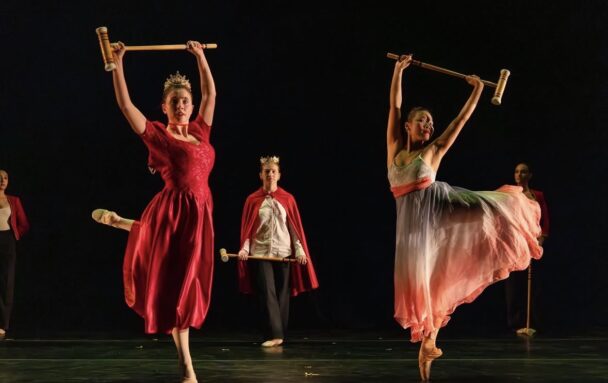
For fans of ballet, Wes Arabesque staged “Alice in Wonderland,” an elaborately produced world of dance through the looking glass featuring everything from large numbers to beautiful solos.
FUSION Dance Crews’s “Fast and Fusion” leaned into what member Annabella Javier ’29 described as “hard hitting, technical hip-hop,” which Troupe blended with sex appeal for its “Slumber Party” show.
SUYA celebrated African and Caribbean dance in joyful, powerful numbers while Wesleyan Latin & Ballroom’s expressive showcase platformed Latin culture. Collective Motion (CoMo) gave students the chance to move regardless of style or experience level. Terpischore defied explanation, centering joy and exploration.
Long before any group made it to the stage, student choreographers worked magic, creating and then teaching the moves. Some, like Haas, choreographed for the first time. Others, like Lael Blackmore ’26, used their choreography to impart a final message.
In her dance with Nini Hayes ’26 for CoMo, Blackmore created what she said was “an ode to [Hayes] and to friends in general, especially the kind who make everything feel brighter.”
For FUSION leader D’Vine Straughter ’26, choreography is a process of learning not just moves, but culture.
“While we learn the dance, we’re also learning the different styles that we’re putting together,” Straughter said. “I think what’s so good about fusion in general is I like to focus on learning new styles and how do I fuse that with what I know now, and that, in and of itself, pushes the culture, and also pushes the appreciation for hip hop.”
The weeks of painstaking learning and rehearsal paid off. Eclectic Society, the Patricelli ’92 Theater, Beckham Hall, and Psi Upsilon were all packed with shouting admirers of the art form for the past couple of weeks. For CoMo, the group’s move to the ’92 Theater meant new possibilities after past performances being held in the Memorial Chapel.
“This spring, we were lucky enough to get to dance in the ’92 Theater for the first time, which was huge, because we had access to the marley flooring, the lights, and the more sophisticated audience seating,” Blackmore said.
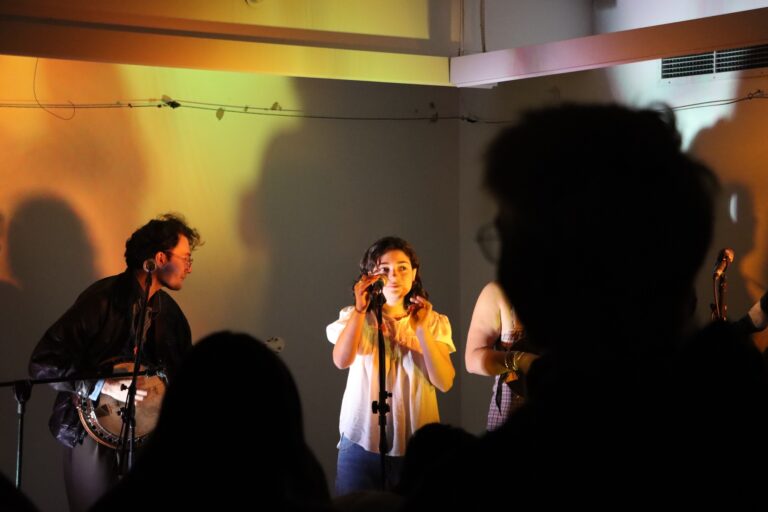
For venues without chairs, people sat criss-cross applesauce, happy to be in the presence of the performers—a feeling shared by the performers.
“The audience/performer relationship is the best part about dancing on campus,” Lopez said. “There is a mutual exchange of energy between the dancers and the audience. Our shows feel like a once-in-a-lifetime opportunity because they are!”
At the X-Tacy show, everyone whooped as shirts were cast aside, legs opened, and asses shook. No matter the style of dance, leaders would implore the audience at the beginning of the show to give performers their energy, joy, and voice.
Clever costuming, props, and audio-visual elements (courtesy of Sound Co-op) elevated the dancers. Troupe’s colorful hoodies provided an ode to young Justin Bieber, the King and Queen of Hearts wielded menacing croquet mallets, and Precision danced in perfectly complementary earth tones. For Wes Arabesque, access to props and costuming marked a new high point in the club’s growth.
“Because the club is more established now, and we were able to get more funding from the [Wesleyan Student Assembly], we are able to do that, which also made it easier, whereas in previous semesters and years, we’ve sort of had to make do with what we could,” leader Henry Ewing-Crystal ’26 said.
CoMo saw a similar increase in production value this year, with Blackmore noting that they “started to get funding for costumes.”
For other groups, just the fact that they were performing marked new heights. Straughter noted that this was only the second year of Suya as a performance group.
“They have some rules and regulations that they like, and so it was a lot smoother of a process,” Straughter said. “And so many more people joined. And so it was, so much more of a big collective, and it felt so much bigger than just showing up to practice with each other and learning dances.”
The value of these groups goes far beyond the moments on stage, however, as they provide connection and culture to both performers and audience members.
Symone Christian ’29 said she joined SUYA because she “wanted a bit of home with me” after participating in West African dance in high school.
Straughter, a non-African member of the group, spoke about the important of SUYA as a group.
“They’re basically displaying and representing, you know, their identities and the parts of the world that they come from, which is so integral to a community and a campus that doesn’t see much, see or hear much of Afro beats and just that style of music in general,” Straughter said.
For Lopez, X-Tacy was the dance space where he found freedom and expression.
“X-Tacy is not just a club; it’s a second family,” Lopez said. “X-Tacy is truly a special place for queer people of color to express themselves in ways they’ve never been able to before.”
Campus dance groups uplift not just the performers, but each other. Straughter discussed how Suya leaned on their experience in the FXT Dance Collective (Fusion, X-Tacy, and Troupe) for support when they first wanted to perform. For Lopez, X-Tacy’s continued presence in the campus dance scene has had broader effects.
“From heels to props, X-Tacy has managed to de-stigmatize sexuality and sensuality in choreography, which has influenced how these elements are approached and incorporated by other dance teams beyond X-Tacy itself,” Lopez said.
This sensuality could be seen throughout performances, presented openly and confidently across styles.
For FXT, collaboration is built into the organization.
“The beauty of the FXT hip-hop collective is its ability to uplift collaboration and community, even across groups,” Javier said. “In the spring, each team puts on its own production, but in the fall, the teams converge into one. Additionally, we make sure to bond with each other through social events, such as potlucks, formals, and team dinners.”
No matter the style, origin, or group, dancers across campus have found joy in their performances this spring.
“I have absolutely re-fallen in love with dance because of my friends and teammates in FXT and Precision,” Javier said.
In turn, audience members fell in love with the mesmerizing movements of our friends and classmates, having the pleasure of watching them move and inhabit their bodies so fully.
“Although we love performing for our amazing supporters and friends, X-Tacy’s members, more importantly, perform for themselves every single time,” Lopez said.
There will be more dance performances on campus this semester. The Kpop Dance Crew is having its showcase on Friday, May 1, and Wes Burlesque is performing on Friday, May 1, and Saturday, May 2.
Molly Wynne contributed reporting.
Amelia Haas is an Assistant Arts & Culture Editor for The Argus.
Jade Acker can be reached at jacker01@wesleyan.edu.
Abby Slap can be reached at aslap@wesleyan.edu.

Leave a Reply