
Sports Need More Violence: A Case to Solve the Flopping Problem
As the European soccer season and the NBA playoffs approach their climaxes, I’ve had a nagging feeling that something’s wrong. These sports are designed around feats of remarkable athleticism paired with unfathomable technique and skill, yet as the two seasons rage on, I can’t help but feel that the former is missing from both. Sports are supposed to be displays of the strongest, fastest, most dynamic movers on the planet, but at the risk of sounding like your cranky uncle at Thanksgiving dinner, the games have gone soft. My solution: Legalize violence.
This antidote should manifest itself in two ways that we’ll dub “in-game” and “out-of-game” violence. To begin with the former, basketball and soccer are both going through parallel crises of what constitutes a foul. Players seem to have discovered the exact collision they need to draw to get the whistle blown. In the NBA, Shai Gilgeous-Alexander, despite his obvious talent, makes a mockery of the rules, flopping and manipulating his body so the officials have no choice but to send him to the free-throw line. Professional basketball is a sport played between ten titans of men, supremely athletic and physically gifted, yet so often the modern game revolves around a hand grazing another hand or the slightest bump on the hip. Not only does it make watching the sport slower and far less entertaining, but the referees seem clueless on how to address the issues at hand, inconsistently calling fouls even when common sense dictates the opposite decision should be made.
Soccer, unfortunately, is the same. Far too many matches come down to the smallest nudges, and just about every VAR review in the penalty area does not revolve around whether the force of the impact was enough to constitute a foul; instead, these checks are often dependent on whether there was any hint of contact or not. This equivalency of any bodily contact to a foul is remarkably detrimental to the sport, rewarding flopping and torturing fans who long to see a goal from open play.
This brings us to my proposal: legalizing in-game violence. To be clear, this isn’t me advocating for violence. When I say legalize, I mean that the threshold of contact needs to be significantly raised to constitute a foul in both soccer and basketball. This will be a massive win for viewers, as play will be more continuous with fewer frivolous interruptions, and players will have to rely on their physical gifts instead of gaming the system.
The reason we watch sports is to witness the pinnacle of athletic achievement, to gaze in awe as people use their bodies to do incredible, miraculous things that we can’t do with ours. Raising the threshold for contact will tremendously benefit this sense of spectacle, as athletes will be forced to duke it out for victory. Watching Shai get to the line, possession after possession, is far less entertaining than witnessing 6’7” Toumani Camara stuff Paolo Banchero as he goes up for a dunk. The duels, the physicality, the daring displays of athletic supremacy are one of the most magical, enchanting aspects of sports, and if a little more contact becomes permissible, players will stop trying to mindlessly draw fouls with late-release three pointers and legs stuck out in the paint to draw contact. Instead, they’ll achieve their final, idealized form, avatars of strength and power who clash and make the Earth tremble.
Soccer is the same. One of my favorite viewing experiences in recent history was Gabriel Mãgalhaes and Erling Haaland practically wrestling each other to the ground during Arsenal F.C. and Manchester City F.C.’s high-stakes bout, two titanic powerhouses using their physical might to gain the upper hand. The best part: Throughout most of the game, this thrilling grappling wasn’t called a foul! Instead of blowing the whistle at every minor inconvenience or brush of contact, the referee let play go on, in turn letting us witness the deep, primal spectacle of two huge pieces of meat and muscle desperately trying to gain an inch on each other.
Put simply, this physicality makes the game exciting, bringing us to the edge of our seats as tackles fly in and the most superior athletes on the planet finally use that superior athleticism to their advantage, instead of cynically obsessing over flopping and diving their way to victory. Brian Brobbey, the Dutch striker for my beloved Sunderland A.F.C., is the perfect example of this, an old-fashioned center forward who appears to be built from granite and raw steak. Unlike the modern attacker, who uses his positioning and guile to draw light fouls and flops at every given chance, Brobbey is a true warrior who relishes each duel with defenders. He muscles, shoulders, and stiff arms his way through opposing backlines, and every time he has the ball at his feet, I’m glued to the edge of my seat waiting to see how far he can make it. If modern soccer and basketball want to bring back physicality, raising the threshold for what’s considered a foul will certainly inspire players to rely more on their astounding conditioning.
The second focus of my argument, what I would call “out-of-game” violence, is, admittedly, a tougher sell. Put bluntly, I want more brawls. At their essence, team sports are theater. The pulse-pounding drama, the epic narratives that unfold over the span of years or decades, the inherent humanity that often overrides tactics and strategy coalesce in each game to heighten the stakes and invest us in the action. Perhaps the most dramatic, epic, and inherently human manifestation of these narratives is a good old-fashioned brawl. Tempers flare as colossal athletes size each other up, breaking from their usual composure and laser-like focus. They have real, true hatred in their eyes as frustration mounts. While I feel morally obligated to specify that I don’t actively want to legalize fights, I’m proud and open about the fact that if we had even a few more, it would make soccer and basketball a hell of a lot more fun.
I enjoy technique, tactics, and intricate game plans that revolve around the perfect execution of remarkable physical feats. Sure. But if I look back through my most cherished memories in sports, there’s always at least a little pushing and shoving involved.
Netherlands vs. Argentina in the 2022 World Cup quarterfinal. One of the best games of the decade. Wout Weghorst’s unbelievable last-gasp goal to equalize is an iconic moment and so are the brilliant penalty saves Emi Martínez pulled out to send Argentina through. As memorable as these moments are, however, they’re dwarfed in comparison in my mind, and the minds of many fans, by the moment that gave this game the nickname “The Battle of Lusail.” (No, I didn’t just make that up.) As the second half died down with the Netherlands down a goal, Argentina’s Leandro Paredes kicked the ball away from the scene of a foul in frustration, and it just so happened that he kicked it directly towards the Dutch bench.
The scene that ensued has been etched into my brain since. The entire band of the Netherlands rushed towards Paredes, full of hatred, growing frustration, and pure nationalistic zeal, and before long, a full-blown war broke out, with both teams shoving and shouting for a full minute. The Dutch captain, the always-composed Virgil van Dijk, was among the first to enter the fray, mercilessly body-checking Paredes to the ground.
If you just read those paragraphs and didn’t instantly search up a clip, that means that either 1) I’m a bad writer, or 2) You don’t love sports! How can you not feel the passion, the raw emotion, the weight of how much it means to the men on the field, as well as to the fans in the stands who they represent? The drama! The tension! The intrigue!
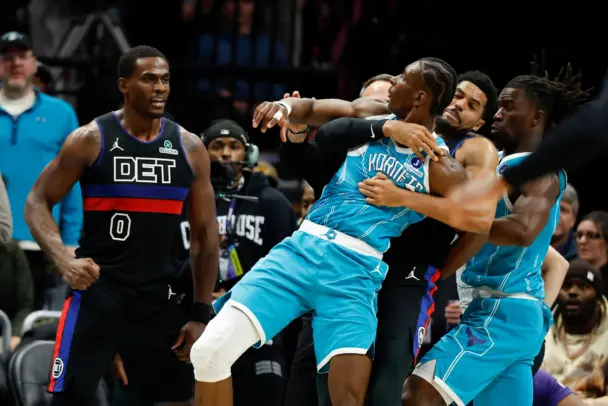
To see a brawl break out in sports is remarkable. These players, who stay so grounded and calm in any given situation, are so full of ferocity and indignation that they’re willing to sacrifice their composure (and their place on the field) to stick it to the other guy. It’s a sight to behold, whether it be Paredes’ faux-pas, Moussa Diabaté lashing out at Jalen Duren after a foul in the paint, or the often-unflappable Nikola Jokić screaming in Luguentz Dort’s face after a cheap trip. Shakespeare couldn’t write it better.
One could make the case that team sports aren’t a place for this sort of debauchery, which instead belongs in combat sports like mixed martial arts and boxing. While I can sympathize with this argument, the crucial difference is that the violence is routine in the latter sports, performed indiscriminately without care for who the fighter is up against. In non-combat sports, however, fights and brawls are driven not by the rules of the game but by true frustration and emotion from the players, which, setting aside any ethical considerations, is damn good television. The aforementioned Haaland and Gabriel, for example, seem to have developed a genuine hatred for one another, and each time their sides play, it becomes more gripping to watch their passionate duels and flaring tempers than the rest of the game. Brawls in soccer and basketball are, above all, deeply personal, and that quality heightens narratives and amplifies drama like little else.
The lack of in-game and out-of-game violence in modern basketball and soccer is, in my view, directly tied to the increasingly boring, uninteresting games fans are forced to sit through. In two sports currently driven by cold, heartless play designed to maximize the likelihood of a whistle being blown, a raising of the foul threshold would force players to do what they’ve always been meant to: use their exquisite athleticism instead of playing to the referees. Perhaps as a symptom of the more physical, gritty style of play that would emerge, emotions would run higher and tempers would flare more often, giving fans what they came for and delivering epic climaxes to the emotional journeys that compose each game.
I am well aware that this article is, at best, irresponsible and at worst, downright sadistic, and by no means do I hope any of the recommendations I give are considered by professional sports leagues (I’m sure Adam Silver is a big fan of The Argus), as they will most likely cause injuries, send poor messages to children who look up to athletes, and, most obviously, incite violence, which is never a good thing to incite. The fact of the matter is, however, that basketball and soccer are experiencing serious problems with their watchability and entertainment value for fans. I can’t claim to know exactly how to fix these issues, but what I do know is that a little good old-fashioned fisticuffs never hurt anybody.
Lucas Chiorini can be reached at lchiorini@wesleyan.edu.

Can I put you on to contact sports? Watch a Springboks-All Blacks game and enjoy the cathartic violence!