
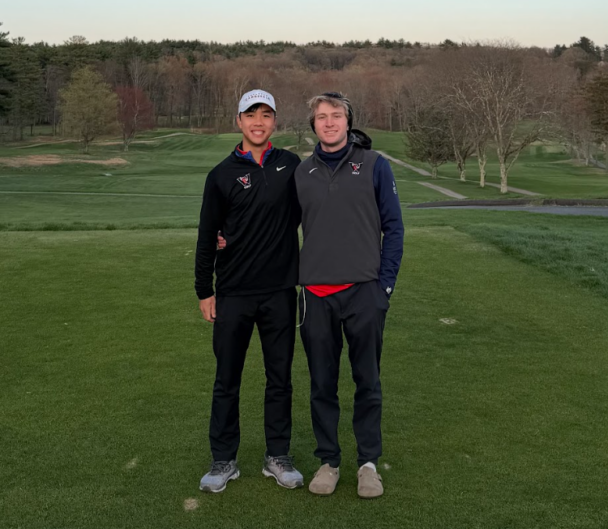
One Goal, One Tournament: Alex Lee ’26 at the Little Three
At the end of last year, every player on the Wesleyan men’s golf team had a one-on-one meeting with head coach Jon Wilson. Wilson laid out four pieces of paper with different questions and gave each player 30 minutes to write before they discussed. Alex Lee ’26 wrote a lot for most of them. For what he hoped to accomplish in his senior year, he had one thing: to play in the Little Three.
On Tuesday, April 21, at 8:30 a.m., eight red and white Wesleyan golf bags lined the range at The Orchards. Fisher Hirsch ’26 was looking for an AirPod that had fallen out during seated spinal twists. Lev Abramson ’28 was workshopping ways to complement the baby fades Zach Liu ’26 was hitting on repeat. Jackson Hayes ’27 was interviewing 73-year-old coach Jon Wilson for the team’s Instagram.
Lee was in the far left bay. He was loose enough, but the day sat on him in a way it didn’t on anyone else. He comes off as unflappable, but he’s warmer than that. He’s quick to laugh and never too serious about himself. The quiet focus on the range was real, but he had also spent all of the day before keeping himself busy so he wouldn’t psych himself out about today.
Lee did not play high school golf. He grew up playing tennis at an elite level and walked on last spring alongside Drew Haxton ’28. Wesleyan has six strong players, and stroke-play events only take five, so he knew he would never see those tournaments. The Little Three takes eight, and when Wilson told him the day before that he had made the lineup, Lee knew this was going to be his only competitive round ever.
The Little Three is a one-day tournament between Wesleyan, Williams, and Amherst, where eight players from each team play alternate shot in the morning and singles in the afternoon, with each grouping featuring all three schools. This year’s edition took place at Amherst’s home course, Donald Ross’s The Orchards, host of the 2004 U.S. Women’s Open.
Lee hadn’t known he was playing the #1 spot until warmups, when Haxton caught sight of the lineup. Wesleyan stacked the top of its alternate shot lineup to create advantages further down the order. Lee’s first collegiate swing came from the middle of the fairway on the first hole. Haxton had put him in a perfect position off the tee, and Lee pulled a six-iron, just trying to get it somewhere near the green, but caught it off the hosel, the ball traveling farther right than forward. Haxton hit a good recovery, but Lee followed with a duffed chip. After a steady lag putt from Haxton, Lee poured in a nervy six-footer to tie the hole with Williams. From the second hole on, he settled in, hitting a wedge from the trees to 10 feet and stringing together good shots. It was solid the rest of the way, but against the top of the Williams and Amherst lineups, it wasn’t enough, and they lost 8&6 and 6&5.
Between rounds, coach Wilson found Lee on the putting green. He told him to stop trying to play tournament golf and just play his golf. There was no test left and no interview. He had already passed those. The only way he’d regret the day was if he went out in the afternoon and didn’t play like himself. Lee rolled a few putts, chatted with the friends who had come out to watch, and did some cat-cow on the putting green.
Williams’s Jack Estrella and Amherst’s Thomas Zhang were walking down the eighth fairway together, talking about their tournament at Bethpage Red last weekend. Estrella shot two 71s and Zhang a 66. Lee had just hit his best drive of the day, but he was still 40 yards behind his afternoon singles opponents, who were hitting it 300 yards all day. Nonetheless, he was all square with two top-10 players in the region, having stuffed baby draws into the second and sixth and gotten up and down from difficult lies in the rough on the third and fifth.
Lee and I were walking down the fairway together, discussing whether Advil would help his back or just dull what he could feel in his swing. We had walked down fairways together close to a hundred times in our first two and a half years of college, both bogey golfers, sometimes planning rounds, sometimes just texting in the morning to see if we could sneak in nine. Sometimes we’d have serious conversations, but mostly we just enjoyed each other’s company and talked about the shot we had just hit. That part felt the same. The part where he was all square with two guys who had a tournament scoring average of 73 did not.
Lee had a full eight-iron into the green. He caught it well but misclubbed and came up 20 yards short, while Estrella hit a flip wedge to 15 feet and also shook his head in disappointment. Lee couldn’t get up and down, and then Zhang and Estrella both birdied the par-five ninth to go two up. Lee had spent the past year gaining distance off the tee, building more consistent ball striking, grinding through early mornings, and qualifying rounds in awful weather. He was a legitimately competitive golfer now, but they were on a different level. He didn’t fall apart, but he ended up losing 5&4 to both players; he was making pars and bogeys while they were making birdies and pars.
When his matches were over, Lee asked Zhang the fastest way back to the clubhouse. Zhang pointed him in the right direction and carried on with his match. I had left minutes earlier to celebrate Johnathan Harlukowicz’s ’27 walk-off albatross, but from the 17th tee, I could see Lee in the distance, moving slowly towards the clubhouse. He was exhausted and couldn’t wait to sit down, but he was also appreciating the final moments of an extraordinary day.
“I will remember every shot from that day for years to come,” he told me later that night.
Alex walked on a year ago, wrote one thing on a piece of paper, and did it.
Sam Weitzman-Kurker can be reached at sweitzmankur@wesleyan.edu.
Leave a Reply