
Jo, I Liked Your Show: JoJo America and How We Talk About the Things We Enjoy
ONE DEBUT SHOW HERE. SOUNDCHECK AND SOME TALK. I met Jo (Josephine Hirsh ’28) outside the Hewitt Workshop at 9-ish p.m. for soundcheck. There’s that half-a-picnic table right across from the little white rectangle the stage was being thrown up on, and one smaller man in a beige t-shirt who looked at me with disapproval when I motioned to walk in behind her. It’s a small room, and from the table outside, I watched Jo walk between amps and compare different chords while another group of two students followed her around and made changes. The floodlights were on, and I sat outside. People were playing some board game in the lounge to my right, and Jo was doing her thing with the amp people and the sound board, but everything was behind a closed door or a window, and all I could hear was a car or two.
Soundcheck takes about 10 minutes. I went to the bathroom. When Jo was finished, we walked back towards her dorm. She said something about not knowing what to do in the meantime—between now and her 10:10 p.m. start time. Jo had a puffer on and a pink skirt. She smiled often.
“When I would perform back home, it would be with the guys, all of us, I would have a guitar and something to do with my hands on stage,” she said. “Before a show, we would sit around and tell each other that we had each other’s backs. We’d get ready together, but I’m going up alone now.”
Jo performed regularly in high school in a small band with good friends. We talked for a minute about her break—more than a year—without performing at all.
“Last year my mother told me I didn’t need to do this [make music] if I didn’t want to,” she said. “We justify this stuff to ourselves and then at one point you say it enough and it doesn’t sound right, then we make new answers … I don’t like who I am when I am not making music, I go a little crazy… I want people to know I make music, I want to keep making music, and performing seems necessary.”
We spoke for an hour before the show, mostly not about the show. The walk to the workshop was slow. Jo and about 13 of her friends walked together in a long line, with Jo towards the back of it. Six or seven people came up one at a time to tell her how excited they were.
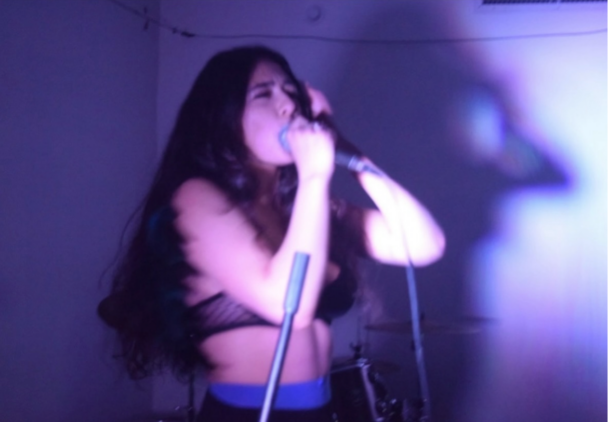
There was a pretty decent crowd of people leaving as we made our way in. One guy had a guitar that was held together and over his shoulder with a bunch of painter’s tape—it was out of tune, he banged away outside the venue with a wide laugh, and words I couldn’t make out. A friend of Jo’s came around, taking pictures of everyone involved. It was an empty room for the first three minutes and then a full one until the end of the set. The performance was extremely striking. Jo wore a costume: blue leggings and a bra with wings. She shortchanged the set time just a little bit, though—people heard an upcoming single, “Head like a Hole” twice. Nobody seemed upset. One guy I hadn’t met—save watching him suck Nitrous through a tube 10 minutes before—hit me on the shoulder and said, “God, I really love this stuff.”
Someone will come along—someone much smarter than me—and that person will be able to tell you exactly what makes music good music, and exactly why Jo’s sound is accomplishing something basically special. Jo’s put out two singles since March: ”What You Want” and “Fight Me.” Both come in around three minutes long. Last Friday, “Head Like a Hole” came out. I can tell you that they are all worth your time.
FAMILY BUSINESS; “NAPPING AND DOING THIS” I sat down with Jo a few days ago with a small list of bad questions. “Why do you make music? Do you have fun? What exactly is the kind of music you make called?” The answer to the last one is Electro-pop. We were in her car waiting for the rain to stop.
Jo’s father is a professional musician, he’s been part of two bands: The Hatters and currently Dangasterpus—most of the money comes from scoring productions, though. These bands are professional bands (go look).
“They are [professional bands], but it was also a massive part of my childhood,” Jo said. “These guys in small bars or in a green room, all friends of each other’s families. It was something we all did for fun. My mom would be dancing on stage. He [Jo’s dad] would call me up onto the stage when I was a little girl, and we’d sing songs together.”
Jo’s own music is inspired by her dad’s band, which is known for playing mostly blues and gospel.
“It’s something that’s supposed to make you move, and I work a lot with that: syncopation and strong emotive chords,” Jo said. “It’s not the same sound, it’s an incredibly different sound, but I mean I meant to take a lot after that.”
Jo also frequently listens to music, even while writing her own.
“It’s napping and doing this,” Jo said. “Making music is just sitting in my room alone for a long time. I listen to a lot of music too while I write. [My dad] taught me everything I know about the production and mixing side of things, but yeah I listen to a lot of music.”
It’s a difficult thing to tell you what a song sounds like, but I got a list of the stuff Jo listens to when she writes: Uffie, Kreayshawn, You Spin Me Right Round—Dead or Alive, Phil Collins, General Public, Major Lazar, Tove Lo, Disclosure, and MIA.
ONE EXTRA THING. When we have something we really like, be it a movie or music—a book or an experience—these things become really difficult to talk about. Of course, I feel like this thing Jo has is really significant. It becomes tempting to raise the stakes of a performance or a person’s output as high as we possibly can in an effort to communicate to other people just how much we really love it, and that strikes me as a bad habit. Jo’s music is very good. And I don’t mean to say that it cannot be important—or that there is no such thing. What I do want to say is that at the end of the day, we do a serious disservice to the things that we love when we pretend that the feeling they are capable of producing isn’t enough to say great things about them. Good music is good music. JoJo America is good music. You should go listen.
Matt Vetter can be reached at mvetter@wesleyan.edu.

Leave a Reply