
Unapologetic in Its Darkness, “Banana Fish” Musical Shines Bright
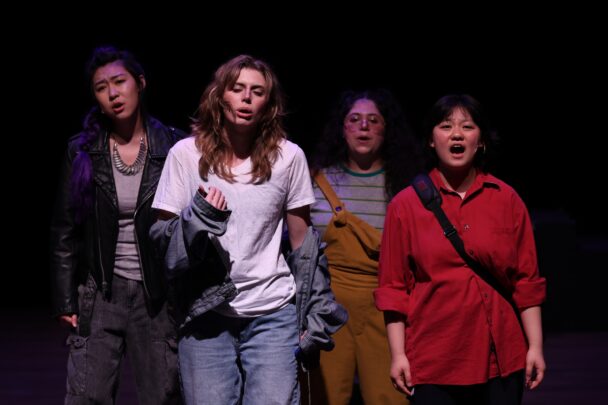
“Banana Fish” debuted at the ’92 Theater to thunderous applause, teary eyes, and a few rewatches of the 2018 anime on which it is based. Written by Lola Cortez ’26 and directed by Lucia D’Elia ’26, the original musical was a component of the former’s senior honors thesis in music.
As a diehard fan of Akimi Yoshida’s original manga and the subsequent anime, I’ve had my eye on the production since I saw an excerpt performance at the Student Playwright Showcase last semester, and I was lucky enough to watch the final performance of the full debut this past weekend. A tour de force of orchestration, fight choreography, and soul-wrenching direction, the production was a joy to experience and an amazingly earnest adaptation.
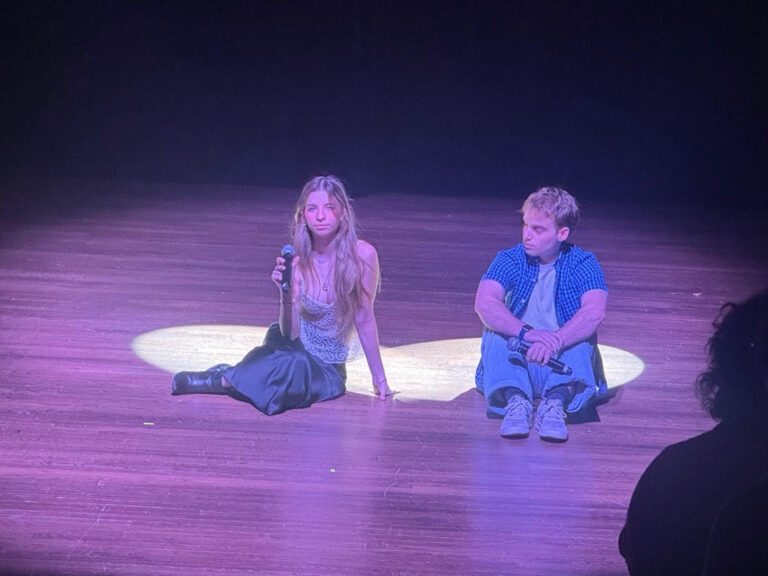
The show opens with two tantalizing vignettes of unexplainable murders and doesn’t let up over the next two and a half hours. While 19-year-old Eiji (Rachel Duan ’29) breaks through the hard exterior of 17-year-old Ash Lynx (Lola Cortez) and becomes an increasingly necessary pillar of his sanity, Ash’s best friend Shorter Wong (Fiona Jin ’27) is forced to betray Ash or else feel the wrath of the transnational Lee crime family at the hands of Yut-Lung Lee (Hao Fu ’26). Ash unpacks the violence he faced at the hands of men like Corsican mob boss Dino Golzine (Haakon Kohler ’27) as the teens and preteens are forced to grapple with having everything and everyone they love taken away.
“I had to figure out how to address such a talk about violence,” Cortez said about writing the song “Give Them Hell.” “When I was figuring that out and kind of grappling with the darkness of it, I would always kind of turn to shows like ‘Cabaret,’ shows like ‘Les Mis’ and ‘Spring Awakening’ which have never been unapologetic in their darkness. They talk about the loss of youth; about sex, both consensual and unessential; about abuse; about domestic violence.”
Cortez first discovered the show during the pandemic, and it immediately struck a chord. Cortez noted that “Banana Fish,” which came out in manga form in 1985 and in anime form in 2018, had a resurgence in popularity during the pandemic.
“Everyone was getting really trapped and helpless, and everyone was connecting to the plot, connecting to Ash and Eiji in their relationship,” Cortez said. “I had to log off of my [AP U.S. History] class. I was sobbing at the ending. I was so devastated. And then I rewatched it immediately: I finished the show, went to class, decompressed for one day, and went right back to the beginning.”
Starting with two TikTok ukulele covers of “You Are My Sunshine” from the separate perspectives of Ash and Eiji, Cortez and an army of supporters on Discord got to writing an entire “Banana Fish” musical. And writing. And writing.
“I was still writing songs two weeks before run-throughs,” she said. “Our cast could label songs that I had done really early on, like, ‘Oh, that’s 16-year-old Lola; that’s 17-year old Lola,’ because you could hear it in my voice in the demos that I made.”
Her director jumped in with some clarification.
“They were written: You were just orchestrating them,” D’Elia said. “We actually switched some music for the actual production, because it just wasn’t lining up [with the fight choreography] in the right way. There were too many moving parts.”
Without a doubt, the orchestration and fight choreography were the highlights of the production. Cortez orchestrated the entire production herself in the digital audio workstation Logic Pro, while D’Elia pulled on her decade and a half of Brazilian jiu-jitsu, Muay Thai, and rugby, which combined with a writer willing to stand in as a testing mannequin, kept fights feeling like dances.
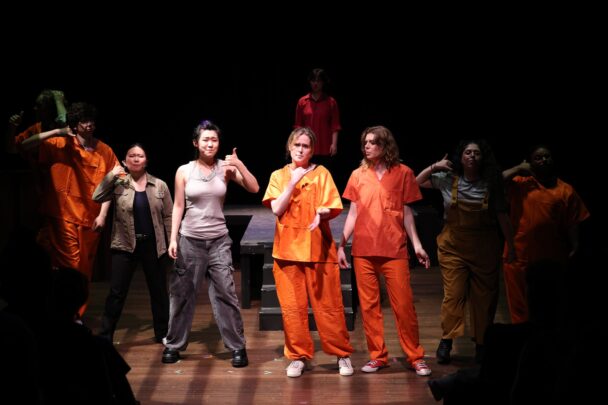
“I was implementing actual moves, just in a way that wouldn’t get anyone hurt,” D’Elia said. “Look closely: There’s a lot of rugby tackles that got aborted.”
A lot of the choreography changed in the rehearsal process. Duan said that her fight scene with Shorter started off “blurry” and then slowly came into focus.
“It got more detailed as we moved on and started to move into the theater, because the stage is different,” Duan said. “And I started to add different stuff to it, like, ‘This part would look better on stage if I did it in a different way.’”
The cast was effusive about their experience working with Cortez and D’Elia.
“They worked as different characters in the crew,” Jin said. “Lucia was more…I won’t say strict, but she kept everything strictly as what it should have been—so very disciplined—and then Lola would try to make people stay relaxed. Them together just made a very nice midpoint.”
The issue of adaptation was one Cortez and D’Elia often confronted in the process of bringing “Banana Fish” to life. From cutting about half of the original story and its famously tragic end to reducing Yut-Lung from Ash’s foil to a relatively basic antagonist, Cortez was forced to deal with the realities of collapsing a 19-volume manga and 24-episode anime into a single production.
One point of pride, however, was the way they handled gender-swapped characters.
“I think one of my biggest issues with ‘Banana Fish’ was the fact that all the characters were guys, and I think if I was going to do it traditionally, that would be okay,” Cortez said. “But I, from the start, wanted to play around with it being gender-bent and kind of being open to all genders…the only caveat of that is that Shorter, Ash, and Eiji had to stay the same gender. It was intentional by Yoshida to make them the same gender, and at the same time, Ash’s story as a male victim of assault was incredibly important. There was that idea of, like, ‘Oh, if you’re going to cast Ash and Eiji as female presenting, then are you gonna switch the pronouns?’ And I was very insistent on not doing that.”
I can confidently say that I felt that connection to the characters of Cortez’s production. From Eiji putting on a brave face in the face of previously unimaginable dangers to Ash fighting tooth and nail to protect those he loved, from Shorter’s struggle between loyalty to his friends and the safety of his family to Skipper’s eternal optimism even after death, I found the show to be a rousing reminder of why we fight against those that keep us invisible. I sincerely hope that the cast album Cortez has been floating comes to be, and if we’re lucky, the musical will continue to grow and develop as an adaptation.
“I got to see the world that we’ve been talking about come to life,” Cortez said. “But I would love to workshop it in the future as well and see where it kind of takes me. It’s this project for the future.”
Zameen Cater can be reached at zcater@wesleyan.edu.
Henry Kaplan can be reached at hkaplan@wesleyan.edu.

While I enjoyed some aspects of the show, I was put off by the mispronunciation of Eiji’s name, the addition of a Confucian backstory to Yut Lung, and Shorter’s relationship with a Christian God…all of these unfortunate details combined for a rather racially insensitive adaptation of the manga
Thank you for taking the time to share your honest response to the production. As both an international student and a Chinese actor in the show, and as the performer of Shorter Wong, I would like to offer a few reflections that may help clarify some of the choices you mentioned.
First, the team and I sincerely apologize for the mispronunciation of Eiji’s name. Throughout the rehearsal process, our team made a consistent effort to engage thoughtfully with the source material and to practice the pronunciation of non-English names. However, as a group of non-native Japanese speakers, we regret that we were not as precise and careful as we should have been in this regard. This is something we take seriously, and it will be an important point of attention in any future development of the production. Thank you for bringing it to our attention.
Regarding the connection you mentioned between Shorter and a Christian God, I wonder if this impression may stem from the song “God Up Above,” in which the word “god” appears. As the actor portraying Shorter, my interpretation of this moment is not tied to any specific religious framework. Rather, it is a deeply emotional and weighty point in the story, occurring after Shorter is forced into betraying his closest friend and as he approaches death. In my reading, the references to “god” or “deity” reflect not a defined belief, but the instinctive turn toward any higher power in a moment of profound helplessness. It is less about religion and more about a human reaching outward when no other options remain.
Finally, your observation about Yut-Lung Lee is accurate. The script does include a detail about his teachings in the Confucian philosophy. I can share that, as one of four Chinese actors in the cast, including the actor portraying Yut-Lung, we have all been actively engaging with the original source, the developing script, and thinking carefully about how to approach our characters with awareness. From our perspective, Confucianism is a form of philosophy that is rooted in Chinese culture, so we didn’t consider it stereotypical. We wanted to bring a story to the stage that we felt comfortable acting in. The community was a safe, collaborative space from the beginning and remains one of my favorite parts of the show.
We truly appreciate you voicing your perspective. Conversations like this are important, and they help us continue to reflect on and improve our work.
I appreciate the apology, response, and insight into the creative process. Adaptations are incredibly tricky to pull off well and insights into decisions made adds to my understanding of the show. Ultimately, intent vs result become complicated when producing an outward facing project such as this one. However, I do think, especially if you consider the greater work of Banana Fish, some of these conversations surrounding the Asian Diaspora in America are difficult to have when the source material is flawed in a mainly Japanese-centric way. I would have and still would appreciate more insight into how the creators will work with the racial dynamics and bias implicated in the production moving forward.