
Now We’re Commodifying…Friendship?
If you ever watched The Lorax or WALL-E growing up, you (hopefully) agreed with the themes of those movies, but felt grateful that the settings in which these ideas were depicted felt ridiculous. I mean, seriously, having to pay for fresh air because all of the trees were harvested, or living on a spaceship with robotic servants after killing the planet?
Part of what made the settings feel ridiculous was the compression. In the films, the loss seems to happen all at once. In practice, however, we’re watching it happen at the pace of ordinary commerce, one small concession at a time, and the absurdity is only visible in retrospect. The question now becomes if we are willing to pay.
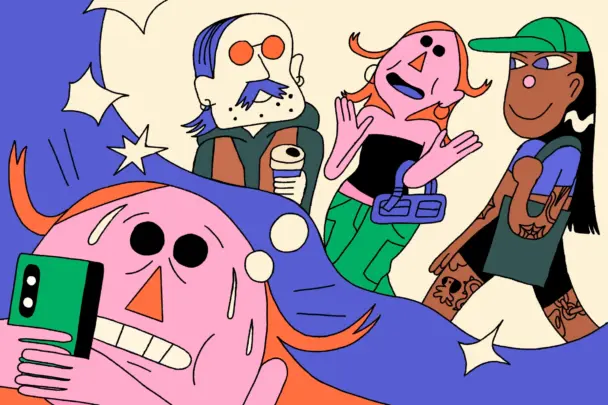
The other day, I came across a LinkedIn post from a startup announcing they were releasing their novel platform for women to make friends. The idea seemed simple enough: You sign up on the app, type in your interests and location, and a moderator picks you and five other women that they think you would get along with and plans events for you until the six of you are a friend group. Naturally, my instinctual reaction was disbelief and a small amount of disgust. People can’t possibly think that’s something worth paying for, right? Wrong. In fact, this idea is apparently so good that I could not even find the LinkedIn post I was talking about for this article because there are 30+ other startups that do the same thing.
It’s worth asking how we even ended up here in the first place. The answer, or at least part of it, largely lies in the individualism so deeply embedded in American culture. Americans have spent the better part of the last century slowly dismantling the infrastructure that used to produce friendships for free. Sociologist Ray Oldenburg called them “third places”: the bars, diners, arcades, bookstores, and movie theaters that were neither home nor work, where people turned up regularly enough to be recognized and stayed long enough to be known. I would say most of them are gone now, or surviving in forms thinned out enough that the original function no longer holds. What replaced them is something closer to a celebration of their absence: the solo era, the main-character arc, the table for one as a statement rather than a circumstance. Needing other people has been reclassified as a character flaw, strongly labeled as “codependency” and “anxious attachment issues,” as independence has been promoted from a phase to a personality.
The market, unsurprisingly, noticed first. Dating apps were early proof of concept: a demonstration that if you took away the organic channels by which people used to meet—the friend-of-a-friend, the coworker, the person from the neighborhood—you could charge a monthly fee to partially reintroduce them. The apps did not cause the loneliness they addressed, but they did prove something. Human connection, it turned out, was something that could be sold. It could be intermediated, tiered, filtered, and paywalled like everything else.
Friendship was the obvious next frontier, and it is striking mostly in how unshocking it feels once you see it. The same generation that had been taught to move for the job, optimize for the career, treat proximity to family as a limitation rather than a resource, arrived in their twenties in cities where they knew no one, with no third places to drift into and no cultural script for admitting they wanted some. A product built for that condition ultimately was not going to be a hard sell. What is striking is what its existence takes for granted: that the erosion is permanent, that the old ways of meeting people are not coming back, and that the reasonable response to a culture that has hollowed out its own social life is to buy the hollow parts back, one subscription at a time.
A community that can be bought is already a seasoned category: Discord servers with subscription tiers, newsletters for a monthly fee, pay-your-way-in dinners in the city, and the entire economy of people selling access to other people under the banner of personal development. AI companions are further along than most people realize, and the companies building them are not shy about the loneliness market they are targeting. Prediction markets now let you place bets on whether a given celebrity will still be alive in six months—quite directly the commodification of other people’s mortality as entertainment.
None of this is an aberration. It is what happens when a culture spends decades teaching its people that needing others is a weakness to be outgrown. The loneliness that follows is not a side effect; it is the designed outcome. And once a country has produced enough of it, the market does what markets do. It finds a price, builds a product, and sells the thing back to the people who were told, not long ago, that they were supposed to be above wanting it in the first place.
Shloka Bhattacharyya is a member of the class of 2028 and can be reached at sbhattachary@wesleyan.edu.




Leave a Reply