
WSA Presidential and Vice Presidential Candidates Debate Policies & Platforms As Voting Begins
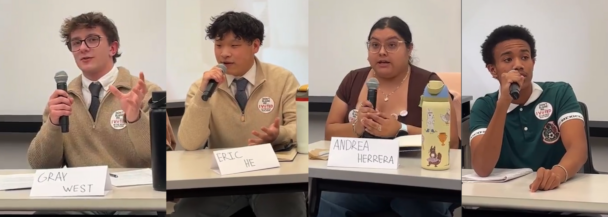
Presidential and vice presidential candidates for the Wesleyan Student Assembly (WSA) discussed their platforms and debated senator pay, University-Middletown relations, and administrative accountability in the Frank Center for Public Affairs on Tuesday, April 7.
Moderated by The Argus, the debate drew a crowd of over 20 students. Three presidential candidates, Noelle Crandell ’27, Andrea Herrera ’27, and Eric He ’28, as well as the two vice presidential candidates UsZee McKoy ’29 and Gray West ’28, answered questions from the audience and the wider student body for approximately an hour. Crandell joined in via Zoom, while the other four candidates attended in person.
Herrera is Chair of the Academic Affairs Committee, Crandell is former Chair of the Community Committee, whereas He is on the Student Budget Committee (SBC). McKoy is on the Community Committee. While West is the only candidate who has not formerly served on the WSA, he noted his community-engagement experience via his involvement with the Center for Prison Education, Wesleyan Institute for Policy, the Wesleyan Business Review, and Student Academic Resources.
WSA Chief of Staff Corinne Dicpinigaitis ’26 opened the debate, asking that candidates engage in thoughtful debate and refrain from attacking each other’s characters. The Wesleyan Argus’ Editors-in-Chief Peyton De Winter ’27 and Janhavi Munde ’27 asked questions on a range of topics from the recent controversy on raising the pay of WSA Senators to the changes enacted last semester to the Alcohol and Other Drugs Policy. After delivering their opening statements, each candidate was given one minute to respond to each question.
The candidates had a diverse range of priorities. Herrera and McKoy staunchly posed themselves as watchdogs of the University’s administration, whereas Crandell and He shared—albeit via differing approaches—that they would pursue greater collaboration between the University, the WSA, and the student body.
“What always happens is that [the University administration] tells us, ‘Here’s what we did, here’s the decision we made,’ and then [the students] are like, ‘This isn’t good,’” Herrera said. “It should be the other way around, where the students tell the administration what is wrong, and they make a decision based on what we say.”
West and He, the only two candidates entering the election as running mates, shared that their main concern is improving communication between the administration, the WSA, and the student body.
“One of the most important issues, in my opinion, is transparency,” He said. “Many people might be too shy or too embarrassed to show up to Boger Hall every Sunday [for WSA General Assembly meetings]. I would like to suggest an anonymous feedback form so people don’t actually have to come to the General Assemblies to express their issues.”
One of the more contentious questions, emailed in anonymously from the student body, was about the candidates’ positions on continuing and raising the semesterly stipend for WSA senators. Some candidates, like West, accused the WSA of corruption.
“It’s one thing to look at the WSA internally and say what we think about each other’s work, but it’s another thing to look at what the student body thinks about the WSA,” West, the only candidate who is not currently on the WSA, said. “If you ask me…the WSA increasing its own pay from within itself with an internal vote sounds like blatant corruption.”
West backtracked on this claim later in the debate, clarifying that although the proposed pay raise does not imply that WSA senators are corrupt, the outlook of the amendment as it stood then did still seem corrupt.
Other candidates like McKoy saw the pay raise as an opportunity to increase the accountability of senators, which earned loud cheers from the audience.
“When I first saw this bill, I was mortified,” McKoy said. “But I personally will support this bill if there are more contingencies that force WSA senators to be in check with their attendance, make them do much more work, and make them engage more with the student body. If I do vote for this raise, and if I am Vice President, the WSA will not be a slacking body. No one will be there just for fun.”
Candidates were asked to speak on how they would advocate for underrepresented groups, including students with disabilities, if elected.
“I kind of speak as the king of underrepresented groups,” McKoy said. “I am a proud, Black, Latino, queer, neurodivergent student…I will work [with] the Office of Academic Affairs to make that process a lot more easier, remove the red tape and make it so that students don’t have to continue to go through that uncomfortable process over and over again.”
West and He stated they would work closely with the Office of Residential Life and the Office of Accessibility Services to advocate for disabled as well as underrepresented student demographics. Herrera and He spoke to their identities representing marginalised demographics.
“I serve as the co-president of [the Latin American Student Organization], the Womxn of Color collective, a bunch of these organizations that work directly with underrepresented communities here at Wesleyan,” Herrera said. “I also came as a student and realized, ‘Hey, there’s not a lot of resources for first-generation women students like myself.’ And I could have sat there and just complained, but I wanted to make change.”
He echoed the sentiment.
“I’m a first generation immigrant from China,” He said. “I lived in Beijing until I was 10 years old, and then I grew up the rest of my way in the U.S. And I feel like a lot of people like me struggle with [their] identity, because we spent half our life at one place and half a life the other place, and then we develop differently. So I feel like this is one of the groups that I really want to speak to and then offer support to.”
Crandell spoke to streamlining informational resources for students as well as improving resource accessibility for identity groups.
“Our identity groups are some of the biggest groups on campus,” Crandell said. “They have most retention. They have the most support. I think that it’s not just funding, though. I think that we can advocate for them to have funding, but it’s a lot of work to run a student group. And right now, I think OSI is lacking in their ability to train these students to then be part of some work and to be effective.”
An audience question regarding the candidates’ stances on the updated Alcohol and Other Drugs Policy proved to be an unexpected commonality. Assistant Dean of Students Kevin Butler banned drinking games, amongst other popular methods of alcohol consumption, at the beginning of the 2025–26 academic year. The candidates all opposed the change to the policy, to varying degrees.
West took an assertive approach to the University’s change to the policy, heavily criticizing the update as an invasion of students’ privacy.
“[President Michael Roth ’78] actually agrees with our stance that pushing underage drinking underground is doing no one a favor,” West said. “But this is an infringement on student social life, where [the University] should never stick their nose in, and there are other ways to educate people about alcohol consumption than severe punishment.”
McKoy also condemned the policy as discriminatory and poorly implemented, stating that the University should focus on harm reduction.
“Excessive drinking is really scary, but we need policies and measures that come from a point of harm reduction and not punitiveness or things that create more shame,” McKoy said.
Other questions covered topics such as ways in which the candidates might improve the experiences of underrepresented students on campus, the University’s divestment from Israeli companies, and the funding mismanagement for the Jewett Center for Community Partnerships (JCCP).
Crandell highlighted her background serving on WSA’s JCCP subcommittee.
“As someone who was on the JCCP subcommittee for almost three years, I think it’s really frustrating, and I think I was really disappointed when [the JCCP funding cuts] happened, because I think there are really good people doing really good work at that administrative level, but they lack the structure and the organization to successfully help students with that transition.” Crandell said.
Herrera spotlit her background as an organizer when speaking on the cuts to JCCP’s funding.
“This is a huge issue,” Herrera said. “It’s not fair that students are doing life-changing work, giving back to the Middletown community, which we are currently technically extracting from. So as an [organizer who’s] really excited, I understand the need to do these jobs and to do the work that the JCCP has.”
At the end of the debate, candidates were given the opportunity to give a final one-minute statement to the audience. A combative moment arose when West commented on the WSA’s reaction to rumors of Pi Cafe’s potential closure.
“I watched the Pi Cafe thing happen,” West said. “No reaction from the WSA…I feel that there could’ve been more proactive reaction on that.”
The Argus calls for a fact-check on that. The Argus reported that the WSA’s Student Dining Committee was engaged in talks with University dining team members soon after rumors of potential closure began circulating on campus.
The debate was recorded by Senator Saul Ferholt-Kahn ’27 and posted on the WSA’s Instagram account, and can be found there in its entirety.
The deadline for voting was extended following an issue with the format of the form, which prevented students from ranked-choice voting. Students of all class years can now vote for both WSA President and Vice President via WesNest until Saturday, April 11 at 5:00 p.m. Students in the class of 2027 can also vote for Senior Class Officers via WesNest. Elected representatives will be announced on Sunday, April 12.
Akari Ikeda can be reached at aikeda@wesleyan.edu.
Leave a Reply