
The Case for the Animal Memorial Plaque: It’s Time for Wesleyan to Consider the Moral Cost of Our Meals and Experiments
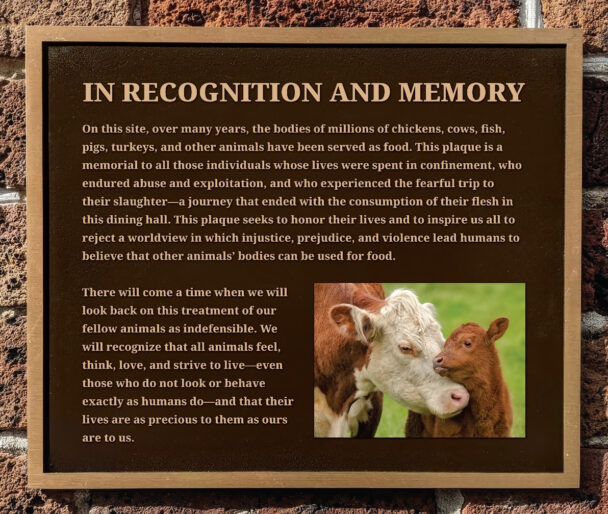
Late last month, two representatives from the People for the Ethical Treatment of Animals (PETA) tabled at Usdan University Center in support of the Wesleyan Animal Recognition Memorial. A group of University students have been behind efforts since the start of the school year to install a plaque in Usdan in memory of animals that have been used for food on campus.
At the table was a sign asking, “How will history view our treatment of animals?” It’s a question we know the answer to, but prefer not to answer. Recent polling finds that between 70% and 80% of Americans disapprove of the way animals are treated in factory farms. More Americans than ever—including among both Democrats and Republicans—say that animal experimentation is unethical.
We savor our hamburgers and bacon, but the cost to animals is clear. More than 80 billion animals end up on our plates every year. As you read this, millions of pigs are trapped in cages so small they cannot move. Cow calves are being separated from their mothers and confined to huts so small their muscles can not properly develop.
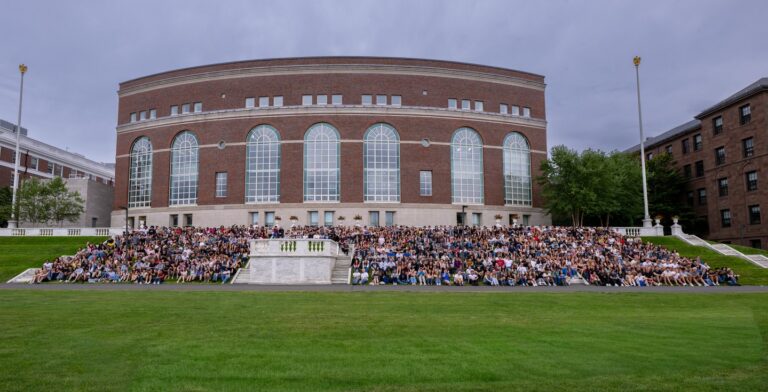
This reality is not abstract. It exists right here at Wesleyan, a school often described as one of the most progressive universities in the nation. Students have been engaged in morality-driven movements ranging from protests against war to rallying in support of academic freedom during the second Trump administration. I support many of these efforts, but we cannot let our own practices escape this same scrutiny.
If we are really looking for a way to reduce worldwide injustice from here at the University, it has to start with ourselves. Millions of animals have been served as meals at Usdan. The University uses mice and rats in scientific experiments, where euthanasia is common. Studies show these experiments are also rarely useful for humans—86% of investigational drugs that were successful in animals failed for humans in clinical trials.
If these animals are giving up their lives for our benefit, we have to at least acknowledge this reality.
One way to do that is through the very commitment of higher education: debate and dialogue.
President Michael Roth ’78 has been one of the loudest voices in defense of academic freedom. At last year’s commencement, Roth argued that free expression means “that many views that might disturb us will get a hearing.” If the administration wants to honor that commitment, it should welcome the proposal to establish the Wesleyan Animal Recognition Memorial.
Critics of the proposal have said that students will walk right past the memorial and then chow down on some pork chops. Sure, some students may do that. But the proposal is not about banning meat from Usdan or ending animal experimentation on campus. Instead, it’s an invitation to get students to think. One less burger a week by a few students could mean one less cow. One teaching assistant who opts not to experiment on mice is a life saved.
This plaque would not have to be up in perpetuity in Usdan. But it would serve an important purpose by making us students discuss and question our treatment of animals from the dining hall to the laboratory. It can be easier to critique others than to look at ourselves critically as a community, but doing so is where change comes from. The sign at the PETA table asked how history will view our actions. We can begin writing a moral answer by looking at ourselves.
Blake Fox is a member of the class of 2026 and can be reached at bfox@wesleyan.edu.
The author is not affiliated with the Wesleyan Animal Recognition Memorial campaign.



Leave a Reply