
Being Online Is So Last Season: Looking at Trends, Media Literacy, and Book Charms
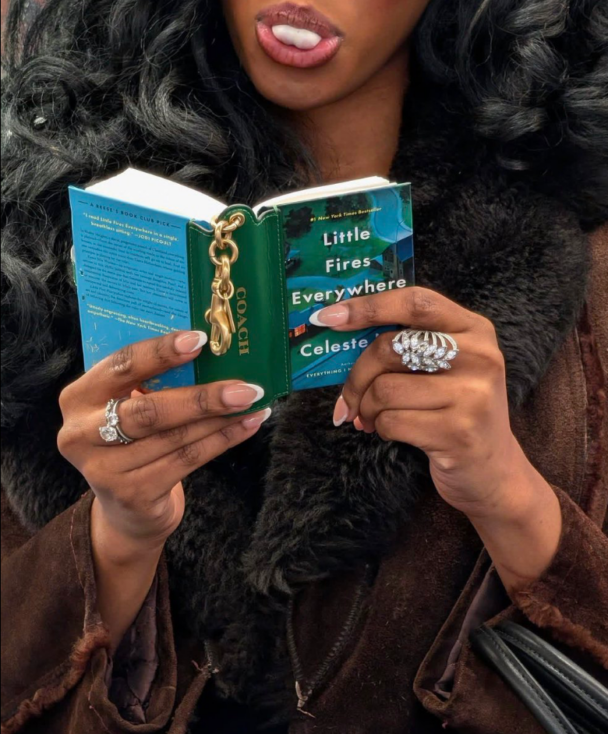
Whatever the reason for its initial appeal may be, the Labubu trend was never going to last. Perhaps it was the juxtaposition of it all; the jarring sight of brightly colored fur, zig-zag teeth, and exaggerated eyes hanging from the handle of a Birkin bag. Or maybe it was the way that it epitomized society at the time, the reign of the microtrend, the invasion of the internet into every aspect of life, the decline of individuality. Now, the power vacuum created by the Labubu’s decline has been filled: enter Coach’s micro book bag charm.
First spotted in September as part of Coach’s Spring 2026 collection, the book charm returned earlier this month at New York Fashion Week. “Sense and Sensibility” dangled from Elle Fanning’s chestnut brown Tabby, while “I Know Why the Caged Bird Sings” swung from Caleb McLaughlin’s black Kisslock Barrel Bag. The novel charms—just longer than an index finger but still fully legible—accompanied the front row attendees of Coach’s Fall/Winter show and were later spread online in staged videos of celebrities reading their novels on the train.
This isn’t Coach’s first foray into the world of literature, nor is it fashion’s. In November 2025, the brand partnered with Reese Witherspoon’s Hello Sunshine, launching Sunnie Reads, a Gen Z–aimed book club. And just months before, Dior reimagined their classic Book Tote to feature actual books, including “Madame Bovary” and “In Cold Blood”.
Is the stark contrast of this shift from the Labubu to the book charm simply a coincidence? Or is it evidence of a new trend taking place, one that places status on being offline? Considering the evidence outside of fashion, one is inclined to say the latter.
Over the past few years, the effort to retreat from online life has reached the cultural zeitgeist, with 2026 being declared the year of analog. Vintage devices for listening to music, such as turntables and CD players, or cameras like Polaroid and digital cameras have re-emerged on the market. Apps like Opal or products like Brick, designed to keep users off their phones, have seen surges in revenue as more people try to separate themselves from their screens. Influencers have started peddling their off-the-grid lifestyles, publishing tips on how to “unrot” your brain, extolling the benefits of reducing their social media use, or showing off their own offline hobbies to their followers, whose addiction to scrolling fuel these videos. The more authentic devotees have even abandoned their smartphones altogether, sacrificing the conveniences of built-in photos, maps, and weather for the allure of interpersonal connection. It seems as though the internet has gone full circle; what was once a symbol of prestige, with mass availability, has become tacky and common. Now, social status can be denoted by one’s offline abilities, such as cultural knowledge and literacy.
While purists may criticize the performative aspect of the trend, on the whole, it seems to be a positive change. If people are investing less time in their phones and more into fulfilling hobbies like reading, how much does it matter if part of their motivation is artificial? Is it really judicious to nitpick a trend that encourages at least some aspect of intellectualism? The issue seems not to be with those taking part in the trend, but with those who are left behind. American literacy rates have steadily declined, with changes in the past decade affecting approximately 6.2 million additional Americans, for whom racial, not to mention class, dynamics play a large part. To elevate reading at a time when many disenfranchised people are losing access to it, when public education is being defunded, and libraries are losing resources poses the question: is this truly an effort to repopularize intellectualism, or is it simply another attempt by the upper class to reinforce hierarchy?
This is the question that one ponders while watching the book-filled New York Fashion Week. Beyond Coach and Dior, Colleen Allen based her spring line on “The Bell Jar,” while Rachel Scott paired her collection with a reading list of feminist theory, and Michael Kors placed copies of “The Sheltering Sky” in woven bags featured on his runway. While waiting for the answer, it seems the best thing to do is catch up on some reading, preferably via a mini designer bag charm.
Alexandra Lee is a member of the class of 2029 and can be reached at ahlee@wesleyan.edu.






Leave a Reply