
From the Closet to the Club: “Heated Rivalry” Parties Bring the Online Phenomenon to Life
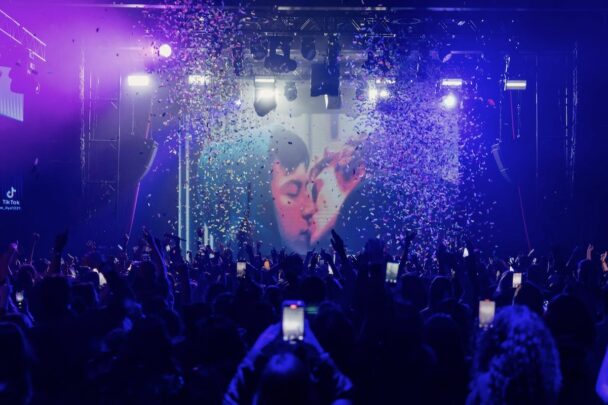
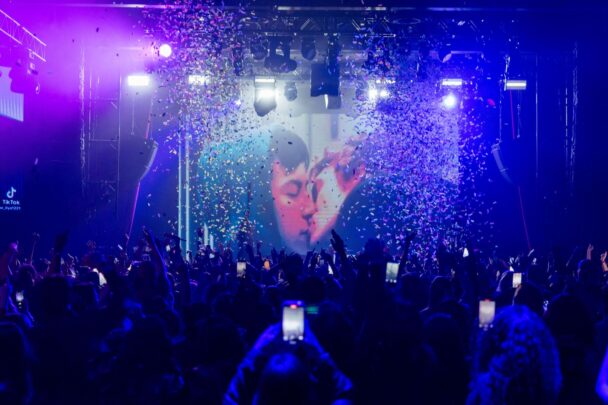
It’s an increasingly common scene: hundreds of partygoers in a club, dancing, singing, and most importantly, watching TikTok edits. The edits, projected as if at a movie theater, are multiplied by the sea of phones recording them. This is a “Heated Rivalry” club night.
“Heated Rivalry” began as an underdog. The show, inspired by the book series “Game Changers” by Rachel Reid, centers the closeted professional hockey players Shane Hollander (Hudson Williams) and Ilya Rozanov (Connor Storrie). The adaptation began as a small production by the Canadian company Crave, before the American rights to the show were picked up by HBO Max, where the first couple of episodes were released to little fanfare.
Week after week, the show gained popularity thanks to word of mouth, social media, and its breakout stars. The first episode initially had a modest 30 million streaming minutes, while the series racked up more than 324 million the week the finale was released. The actors faced a similarly meteoric rise; both Storrie and Williams had been waiters before filming, presenting at the Golden Globes less than a year later.
Online fan culture, from longtime fans of the book series and newcomers alike, buoyed “Heated Rivalry” on its path to success. The weekly releases allowed online anticipation to build throughout the week, as fans made edits, tweets, and fan fiction from the week’s episode, expanding on the burgeoning collection of fan-made media until certain edits, jokes, and pictures had lives of their own.
This extra-textual language includes songs like “Rock Me” by One Direction (which has been used in popular edits of the show), a video of Storrie dancing to Madonna’s “Like a Prayer,” and many comparisons to the fellow homoerotic athletes of Luca Guadagnino’s “Challengers” (2024). While these examples of online culture are not unique to “Heated Rivalry,” what followed is.
On Friday, Jan. 2, the Los Angeles-based event company Club 90s threw a “Heated Rivalry” rave in Los Angeles, Calif., and videos from the party amassed millions of views. Fans screamed, cried, and sang as their favorite edits played. Those watching online demanded their chance to watch edits, such as an infamous one set to Megan Thee Stallion’s “Big Ole Freak” that was deemed too sexy for TikTok. Club 90s swept in, hosting “Heated Rivalry” club nights across the country. These events were instantly met with high demand, with tickets selling out quickly. Venues for upcoming shows are increasingly large. One event is being hosted at Washington, D.C.’s The Anthem, and 5,000 of 6,000 available tickets have already been sold.
Clubs are not the only place fans are flocking to. The NHL has seen a 20% jump in ticket sales since the show’s first episode aired, and searches for hockey tickets increased by over 75% on StubHub. This includes many first-timers, who then post their experience at what hockey romance enthusiasts call the boy aquarium, inspiring more fans to go. Viral mania has manifested in the physical world.
The phenomenon made it to the University on Friday, Jan. 23 when Psi Upsilon hosted Heated Xi-valry. The social chairs of Psi U, Hanyue Wang ’28, Ry De Guzman Jr. ’28, and Alex Khalil ’28, chose the theme because, as Wang explained: “Heated Rivalry is already widely recognizable and playful, which made it an easy way to bring different groups together.” That night, piles of thick winter jackets sat discarded on couches as hundreds danced for hours in the ballroom.
Though it did not feature the same explicit theming or screens that characterize a “Heated Rivalry” club night, the show’s presence was felt. Many attendees wore hockey jerseys, and songs both explicitly and implicitly part of the “Heated Rivalry” canon were played, from t.A.T.u.’s “All The Things She Said” to “Challengers: Matchpoint” by Trent Reznor and Atticus Ross from the “Challengers” score.
DJ Miguel Estrada ’27 went in a different direction with his set, choosing to focus on the mood of the series rather than explicit references. Estrada, who has not seen the show, said, “I tried to imitate a high-energy ambient from the few clips I watched. While at the same time, by layering provocative lyrics and culturally charged tracks into the high energy, I wanted the crowd to feel both radical hype and some discomfort. Some may call it ‘freakiness.’”
“Heated Rivalry” began as an individual experience. TV viewing has become an increasingly solitary activity with the rise of streaming, and the front lines of fan culture on X, TikTok, and Tumblr provide little in-person connection beyond the common inside jokes and theories that spread online. That Friday night, people yelled in unison for the DJ to play “Rock Me,” clutched hands as they danced, and felt the combined body heat of fans, casual viewers, and people who weren’t completely sure what “Heated Rivalry” was but wanted to party.
“‘Heated Rivalry’ is usually read as something very explicit and private, but when it’s brought into a public, social setting like a party, that contrast creates humor,” Wang said. “The inversion makes people more aware of the tropes and intensity of the original context, and exaggerating them in a collective space turns them into something very playful.”
Estrada said that “a theme that is raw and genuine is attractive,” and Heated Rivalry’s celebration of authenticity is just that. Much of the show’s tension is borne from Shane and Ilya’s need to stay closeted; their affection exists largely in hotel rooms, empty spaces, and a remote cottage. The touch of feet under a desk during a press conference or a kiss on the cheek under the guise of a post-goal celebration are the closest they come to a public declaration. However, in the dark, under pulsing lights, public declarations abound.
Abby Slap can be reached at aslap@wesleyan.edu.
Leave a Reply