
Eastern European Activists Bring Stories of LGBTQ Advocacy Under Autocracy to Wesleyan’s Campus
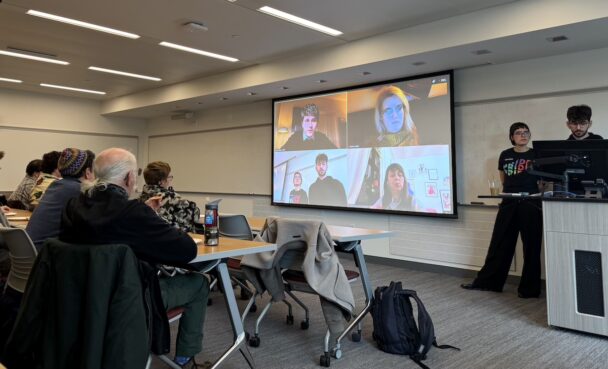
LGBTQ activists from Hungary and Romania spoke about their challenges and motivations in fostering queer community in Eastern Europe on Thursday, Dec. 4, in a Zoom conversation organized by the Adelphic Educational Fund (AEF). Moderated by Dragoș Geică ’28 and Cecilia Földessy-Stiegemeier ’26, the event featured speakers Hella Zsirka, Iulian Dițiu, and Alina Dumitriu and was held at the Frank Center for Public Affairs. Over 20 students and faculty members attended.
AEF was founded in 1944 to assist educational activities by alumni of both the Middletown Chapter of the Alpha Delta Phi (ADP) fraternity and the University. The chapter has continued to conduct an independent program of lectures, concerts, and other educational activities, supported by the AEF, since the fraternity’s early days.
Geică and Földessy-Stiegemeier began developing the idea during the summer break after they bonded over their shared Eastern European heritage and queer identity.
“Both of us are queer, so this cause was really relevant to us,” Földessy-Stiegemeier said. “Over the summer, we just had a phone call and we were like, we should organize something [at the University.] At first, it was going to be an exhibition of posters, but then we said, ‘Why don’t we bring in an activist to speak?’”
The speakers were chosen to reflect a wide age range, as well as different professional backgrounds, genders, and sexual orientations.
“We were thinking of people who were very visible in their advocacy for LGBTQIA+ rights,” Földessy-Stiegemeier said. “We wanted people who knew about the very conservative environment [in Eastern Europe], which the United States is starting to look more like now. I’m really glad that we had speakers from different backgrounds: Iulian Dițiu is a Pride organizer, Alina Dumitriu is in healthcare, and Hella Zsirka provides public services.”
Dițiu is the President of ARK Oradea, the first non-governmental organization (NGO) in Oradea, Romania that supports the rights of LGBTQ people and promotes their social inclusion. They organized the first Oradea Pride march in July.
Dumitriu is the founder of Sens Pozitiv, Romania’s only NGO supporting people living with HIV. Its services include an ambulatory pharmacy, counseling, provision of the post-HIV exposure treatment PEP, accompaniment to hospitals, and HIV testing.
Zsirka is the COO of Háttér Society, an NGO that has represented the LGBTQ population in Hungary since 1995, and is a founding member of the Hungarian LGBT Alliance. It operates a telephone hotline, a legal aid service, and an HIV/AIDS prevention program.
The event took place over an hour, with the two moderators highlighting the struggle of Hungarian and Romanian activists in light of political suppression by their respective governments. Drawing parallels between the United States and their respective countries, the moderators spoke about the harsh measures imposed by their governments on such activist initiatives.
“While our focus today is not on the United States, we believe that conversations like these are increasingly important here,” Földessy-Stiegemeier said. “Many of these tactics that we’ve mentioned in Hungary and Romania use LGBTQIA+ people as a political strategy, intentionally spreading misinformation about gender identity and censorship in schools. This echoes debates that have reemerged in the US, especially under President Trump[’s] administration. These cross-national dialogues help us recognize shared patterns and learn from activists who have long navigated these patterns.”
Geică also shared his views on the clash between Romania’s LGBTQ community and the Orthodox Christian majority of the nation, stating that queer people continue to face discrimination in their day-to-day lives.
“Romania also faces its own set of challenges,” Geică said. “There is still no legal recognition whatsoever for same-sex couples, whether that be marriage or legal partnerships. Social aptitudes remain conservative, influenced by religious institutions. Romania is a very Orthodox Christian country, and LGBTQIA+ people continue to face stigma, whether it’s in schools, at their workplaces, or even while accessing medical services. Politicians don’t hesitate to use homophobia and the traditional family as a tool in their political campaigns.”
During the event, the speakers answered questions from the moderators ranging from the importance of their activism and its impacts to tips on resilience in the face of continued hardship.
“For example, when we started to organize the first local Pride Week back in 2023, it was virtually the first big event of the community in the history of our city,” Dițiu said. “We were expecting some negative responses coming from other people in Romania, but we didn’t expect the level of mobilization we saw from the anti-LGBT church leaders. Some of them were funded by international lobbying groups like the Heritage Foundation. They petitioned the local municipality to ban Pride. So even though we were left without a venue for around 20 events 5 days before they were planned to happen, the local LGBTQIA+ community mobilized, and they helped us to find an alternative venue.”
The speakers also gave advice on taking care of the community and on self-care, emphasizing the need for balance between perseverance and taking breaks.
“I burn out about three times a year,” Dumitriu said. “In the beginning, I was afraid I would not be able to get out of bad situations. Now I know when I have to stop and when I have to sleep. It is helping me to take breaks, and I’m better now after 20 years of doing this work.”
Földessy-Stiegemeier also shared her observations on the United States’ relationship with Hungary with regard to both of their trends towards conservatism. Since taking office in 2010, Hungarian Prime Minister Viktor Orbán has increasingly mobilized his supporters around the concept of “Christian democracy,” embracing anti-LGBTQ policies in the name of what his administration promotes as traditional Christian values. Földessy-Stiegemeier drew parallels between Orbán and Trump, who has a history of homophobia and has repeatedly made false statements about transgender people as president.
“This [trend] has accelerated starting around 2016, 2017,” Földessy-Stiegemeier said. “Because Orbán and Trump are close, the United States sees Orbán as someone who created a conservative tutorial. The strategies that [the LGBTQIA+ community] in Hungary have been struggling with are increasingly affecting the U.S. right now.”
Finally, the speakers drew on their personal experiences to reflect on the process of building community in an increasingly polarized environment.
“Sometimes I am angry, and sometimes I am even fuming, and sometimes I cry myself to sleep,” Zsirka said. “But the next day, I’m still [engaging in activism], because I think small wins matter. Activism is not just about the big things. There is a spectrum from hate to pride, and you should not separate everybody into just friends and enemies. Sometimes a nice talk with your conservative grandmother can make a difference, and you just have to show them that you’re a human being. Even if they don’t understand you fully, sometimes basic acceptance is just enough. And one more piece of advice, never read the comments.”
Akari Ikeda can be reached at aikeda@wesleyan.edu.
Daniel Chehimi can be reached at dchehimi@wesleyan.edu.

Leave a Reply