
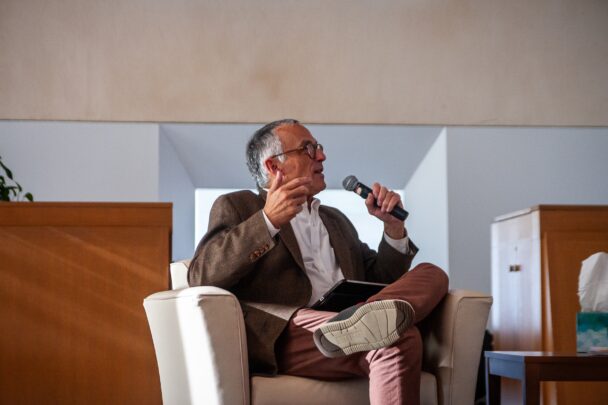
Wesleyan Student Assembly Hosts President Michael Roth ’78 for Open Q&A Session
On Sunday, Nov. 23, the Wesleyan Student Assembly (WSA) held its weekly General Assembly session at the Frank Center for Public Affairs (PAC). President Michael Roth ’78 attended the General Assembly session to answer questions and provide updates on topics ranging from University fundraising and the impact of rising tuition costs on financial aid to recent controversial changes in the the Jewett Center for Community Partnerships’ (JCCP) budget policy.
Roth began by providing information on his recent meeting with the Campus Affairs Committee (CAC), a group of trustees, faculty representatives, and student representatives that discusses the University’s educational programs and student affairs. He gave an update on the University’s “This Is Not A Campaign” fundraising campaign.
“The University Relations Committee had an update on the fundraising campaign from Frantz Williams [’99], who is in charge of the Office of Advancement, and we are a couple of years ahead of schedule,” Roth said. “I think over $490 million has been raised now, so people were pleased to hear that.”
He also reported on the University Audit Committee’s updates on admissions, following the receipt of first-round Early Decision applications on Sunday, Nov. 15.
“On the admissions side, we looked at changes in the nature of the applicant pool and how the University depends on roughly 55% to 60% of students attending being able to pay,” Roth said. “The number of people applying who are able to pay has been decreasing, so we think of the cost [of tuition] as going up, which it does, while the demographics of who might be able to attend are going the other direction. That’s a cause for concern for the University in the long run. But in the short run, applications are up.”
Other updates included the communications initiatives underway to better engage prospective students, alumni, and the broader public; the Finance Committee’s short and long-term budget planning vis-à-vis rising health insurance costs; and the optimality of the Investment Committee’s traditional investment strategy.
Following this, the floor opened for Q&A to both WSA Senators and other students in attendance. The conversation began with a question by WSA Senator Asper Cisse ’28 on the implications of rising tuition on financial aid.
“Financial aid is not going down, it’s going up,” Roth said. “The discount rate, which is the amount we don’t collect, that is, financial aid as a percentage of the budget, goes up every year, as it has over the last several years. And so we will continue to meet the full financial need of the people who we admit and enroll. Whenever we increase tuition, as we have done somewhere between 3.5% and 5% each year, the amount of financial aid given goes up too, so there’s not a gap.”
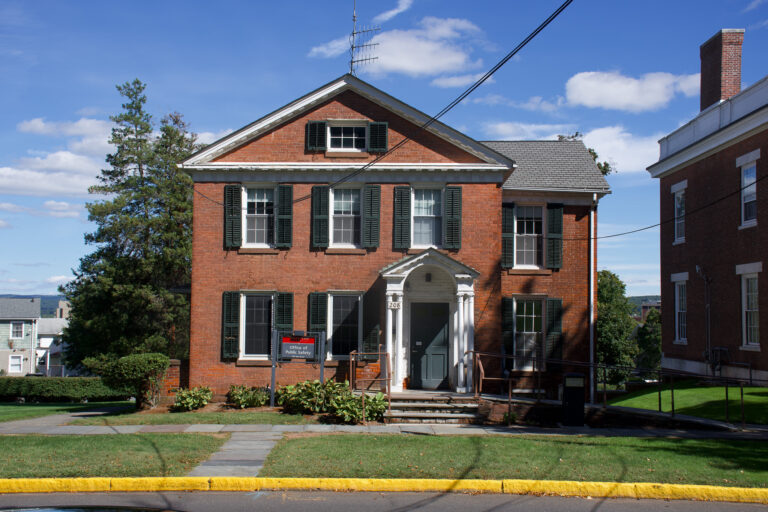
Roth was also asked about the University’s new alcohol and drug policy, which banned drinking games on campus. In particular, WSA Senator Eric He ’28 raised the hypothetical that students might refuse to call Public Safety after an accident resulting from a drinking game, in fear of the heightened punishment.
“I don’t think there’s an increased punishment for calling for Public Safety,’’ Roth said. “As far as that goes, that would be a surprise to me. But we’ve been working with WesWell to review if the policy represents an onerous regulation or one that’s likely to result in unintended consequences that are even less healthy than, for instance, beer pong.”
WSA Senator Casey Dunning-Sorey ’28 asked Roth whether Public Safety would intervene if someone who appears to be federal law enforcement tried to arrest a student or non-student on University property without a judicial warrant.
“I think yes, but that’s not a very helpful answer, because then you want to know the nature of the intervention,” Roth said. “And so it’s a question I’ve been asking myself a lot these days, because it’s one thing to say to students and faculty that if somebody comes to your door and they don’t have a warrant, you don’t have to open it. We don’t want you to actually get into fistfights with people who are going to beat the hell out of you, which is what ICE will do. Public Safety won’t do that either. If they break the law, we will seek appropriate legal remedies in court.”
Brendan Barry ’28 also asked Roth about recent changes to the JCCP budget policy, and the opposition of some student workers and members of the Middletown community to what they perceive to be large-scale cuts to JCCP-associated student groups. Roth asserted, as he has in the past, that the University is “fully funding the JCCP” and doing its share to support the local community.
WSA Senator Raiza Goel ’28 asked Roth whether the University had noticed a decline in international applicants following the Trump administration’s crackdown on student visas.
“We have not seen the declines in applications from international students that we expected,” Roth said. “However, we had a dramatic increase in the number of applicants from Africa. I do know two students who were unable to come because they’re from countries in Africa on the administration’s list of countries prohibited from sending people to the United States. However, we continue to advocate for the African Scholars Program and for the support of the students in it, and we have been active and continue to promote the University in markets that usually send us the most people, particularly China, India, and London.”
After several more questions from senators, Roth’s schedule obliged his departure. The WSA plans to host Roth in the future to address additional questions following the next Board of Trustees meeting.
Raiza Goel is a News Editor at The Argus.
Daniel Chehimi can be reached at dchehimi@wesleyan.edu.
Brendan Kelso can be reached at bkelso@wesleyan.edu.
Leave a Reply