
Colorful Pages and Exciting New Stages for Wesleyan’s Poetry and Prose Magazine
If you hang around Wesleyan’s more literary crowd, you’ve probably heard of The Lavender, a student-run publication for poetry and prose. Published twice a semester and produced by Route 9, The Lavender accepts dozens of student submissions per edition. The magazine is a crucial outlet for students to share their artistic work and collaborate with other artists, and you might be surprised to find out that it hatched only a few years ago: The Lavender’s inaugural edition was published in Fall 2021.
“My hope is that Route 9 Literary Collective is a space where anyone can share what they’re passionate about here at Wesleyan,” Oliver Egger ’23, who founded Route 9, wrote in his first editor’s note. “The Lavender is hopefully the first consistent publication of many that will fulfill the goals of this mission.”
Four years later, editors-in-chief Mel Cort ’27 and Mia Alexander ’26 are working to continue Egger’s mission with a committed crew of artists and writers. Cort first met Alexander at the club fair their freshman year. The two immediately clicked.
“I came to Wesleyan straight off of my high school lit mag, and I went to the club fair and I said, ‘I need a lit mag,’ and I found The Lavender,” Cort said. “At the second meeting, Mia, who was the poetry editor at the time and was so welcoming and caring and sweet about the whole thing, said, ‘I’m looking for an assistant if anyone wants to be an assistant poetry editor.’ And I said, ‘Yeah, me. This freshman who you met two weeks ago.’ And she said, ‘Good deal.’ And the rest is history.”
Like Cort, Alexander discovered The Lavender at the beginning of her freshman year.
“At first I just submitted because I was too terrified to go to any of the meetings,” she said. “I was like, ‘These guys are so cool. They know exactly what they’re doing, and they’re all English majors.’ But then I went to one of the readings, which was really cool, then I went to one of the meetings.”
Each edition of The Lavender begins with small paragraphs on “Why The Lavender?” and “Why Route 9?”
Before the school transitioned to its iconic red and black cardinal mascot, Wesleyan’s school color was lavender. It was changed following the publication of an article in The Wesleyan Argus that claimed lavender was not a “striking color” and therefore not fit to represent the school’s athletic teams.
The magazine’s name thus pays tribute to what was once an essential part of Wesleyan’s culture.
“We think it is a striking color and want to bring it back. We don’t need to be fierce. We can just be purple,” Cort said.
Since Egger’s inception of Route 9, the collective has grown, now publishing three consistent magazines: The Lavender, Pre-Owned Good Condition, and The John. They also publish single-edition zines and other anthologies. Cort said Route 9 is always looking to feature more voices and experiences and encourages interested writers and artists to take part.
“There’s a form on our website where people can suggest new magazine ideas,” Cort said. “People here have a lot of cool things to say, but don’t necessarily know how to go about printing or budget requests or anything, so we just want to help people get their projects out.”
When asked about her favorite poem from The Lavender, Alexander named “Shoresh Means Root” by Yael Ezry ’26 as the one that stood out. Originally published in the Fall 2024 edition, “Hauntings,” the poem touches on the author’s childhood and her memories of studying Hebrew.
“It really sticks with me,” Alexander said. “It’s a really great poem. It’s just so tight and well-written. As someone coming from a multi-cultural background, my mom is Hungarian and I spent my summers in Hungary, there is something about that [appreciation of] multi-culturalism.”
A Renaissance?
Though there are usually a number of returning writers, Cort says this semester has seen a huge influx of submissions. They attribute this new wealth of writers to their social media expansion under Sarann Spiegel ’27.
“There’s also a bunch of people who submit under pen names, and it’s always fun to see when people come back and publish again because we have no idea who they are, but their work is there,” Alexander added.
The most exciting thing about The Lavender, Alexander said, is the release parties. The release party celebrates accepted writers and gives them the chance to read their work aloud.
“I feel like it brings me back to freshman year when I was too scared to read my own work even though it was published,” Alexander said. “There was one person at our last release party who said, ‘This is the only poem I’ve ever written, and I’m never going to write another poem, but I’m going to read it now.’ It’s a really special experience.”
Cort lives for seeing and feeling the physical product. They say it gives the magazine more sentimental value than a solely digital publication would.
“When it’s an object, it’s an object, something you can hold, and you think, ‘This is the work that so many compiled that I can put on my shelf,’” Cort said. “There’s something special about having it, being able to give it to people, being able to flip to your page and say, ‘This is where I was published.’ You can’t replicate that.”
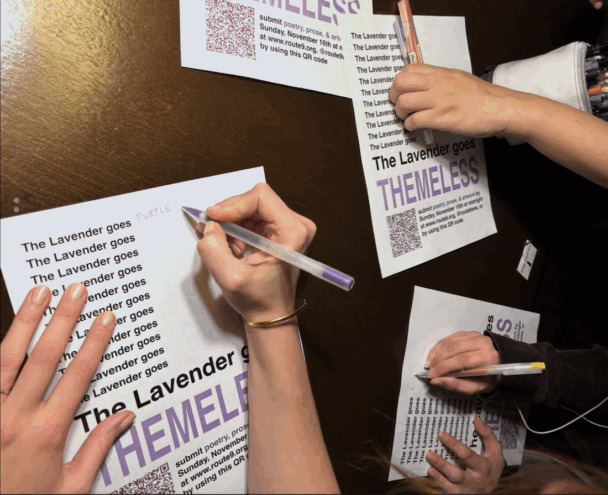
The Lavender has long published themed editions: Writers have been asked to submit pieces related to words like “Perishables,” “Ritual,” and most recently, “On Air.” But for their upcoming edition, The Lavender is taking a huge left turn and going themeless. Alexander hopes it can be a huge step forward and expand writership.
“There’s a running joke at The Lavender that [the] theme doesn’t matter when we are considering submissions,” Alexander said. “We just want the best work possible. So it’s really fun that we’re moving to themeless. We just want the best work, even if it doesn’t adhere to the theme.”
Cort said the group is still considering whether it will go themeless again, or even permanently. It seems it’s not out of the question.
“Some submitters really thrive in having some sort of direction or something to work towards, but the variety of stuff we’re getting from themeless is so fun,” Cort said. “It remains to be seen.”
Cort and Alexander again encourage interested writers to visit the Route 9 website (route9.org) and pitch an idea for a magazine or write to Cort (mcort@wesleyan.edu) and Alexander (mealexander@wesleyan.edu) for more information.
Eliza Lampert can be reached at elampert@wesleyan.edu.
Conrad Lewis can be reached at cglewis@wesleyan.edu.

Leave a Reply