
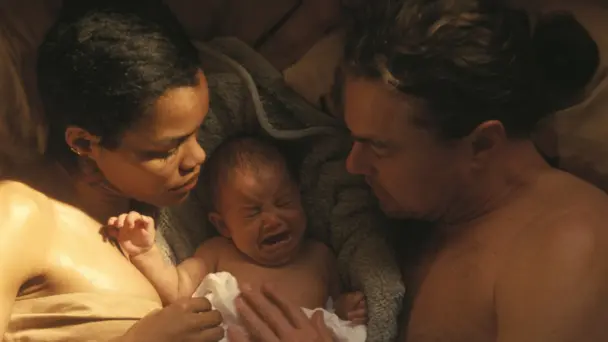
Review: “One Battle After Another” is a Triumph of Juxtaposition
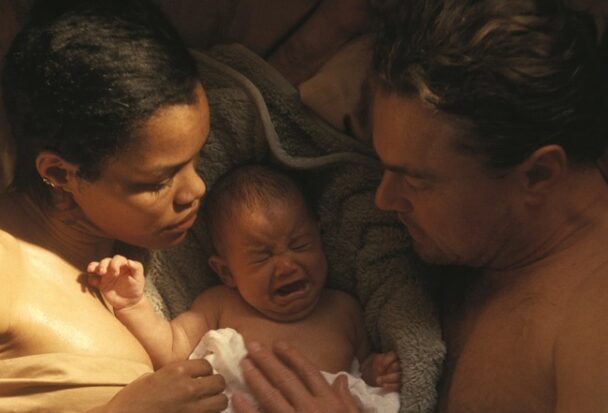
This review contains mild spoilers for “One Battle After Another.”
When a Paul Thomas Anderson film starts, more likely than not, the director’s cards are held close to his chest. In much of the legendary filmmaker’s work, the world we are introduced to strikes us from the first frame as disorienting.
In “The Master” (2012), fragments of scenes in radically different locations bombard us one after the other. A string of music cues accompanies, ranging from seductive to nerve-wracking, and insofar as there is dialogue, it too is used expressively, such as when Joaquin Phoenix slurs advice out of the left side of his mouth about getting rid of crabs by burning his testicle hair.
Another Anderson film, “Magnolia” (1999), follows its opening prologue about coincidences (a non sequitur to the film proper) with a montage that introduces us to the film’s 12 main characters through frenzied fragments. Songs overlap, language is used to punctuate, and as soon as you clock the gist of a single character, it’s on to the next. Of course, “Magnolia” is a three-hour film; you will have the remaining two hours and 45 minutes to understand who these people are, so any discombobulation is mere mood setting. Then, there is a moment where you get a sense of the film starting in earnest, shifting its priorities from sensation to character. Never has this shift been as complicated, or as keenly felt, than in Anderson’s latest film, “One Battle After Another.”
The first 45 minutes of this film plunge us headlong into the exploits of a radical leftist group called the French 75 as they run around and do some real bad shit: liberating an immigration detainment center, bombing courthouses, and robbing banks. If they have a leader, it’s Perfidia Beverly Hills (an astounding Teyana Taylor), and she sets the group’s energy—the film’s energy—at her own boiling temperature. The opening is a masterwork of economy in that, much like in “The Master,” huge shifts in character happen in the space of very few quick shots. This fact has spurred charges that the film lacks specificity as to what exactly this leftist group believes—something to take very seriously—but the film’s specific language tells me all I need to know to believe in their cause. There is no scene in which this group sits around a table and talks theory, but the way moments accumulate, each scene colliding against the surrounding ones, is vital. The prologue is, to borrow a phrase from Thomas Pynchon’s “Gravity’s Rainbow,” “an aggregate of last moments.”
Pynchon’s own novel “Vineland” (1990), set in year 1984 and haunted by the specter of Ronald Reagan’s re-election, forms the spine of “One Battle After Another,” offering Anderson certain characters and relationships that he and the actors reshape to fit the form of a blockbuster extravaganza. At the start of his career, Anderson was accused of being a collage artist, and though those accusations have largely gone away, I still see that instinct in him in an extremely satisfying, mature form. “Boogie Nights” (1997) and “Magnolia” are film literate—the pulls from Altman and Scorsese are relatively shameless—but his more recent work is culturally literate.
Though “One Battle After Another” certainly has many cinematic antecedents, his collage spans mediums and moments. A little bit of RFK, Jr., a little bit of Gil Scott-Heron, a not-so-little bit of the average WESU radio show’s programming (thanks to the presence of Dijon, Alana Haim, and Junglepussy). Particularly moving is the fact that lines from the letter Perfidia delivers to her daughter in a voice-over at the end of the film can be traced to a 2002 documentary about the Weather Underground, originally written by an AWOL daughter to her father. This approach to storytelling works particularly well in this film, as it is also the mode Pynchon operates in: arguably the factor that makes him the indelible writer that he is. Read the first 20 or so pages of “Vineland” and you’ll find yourself bombarded with allusions to psychedelic rock, “Friday the 13th,” and long forgotten TV movies. In both film and book, our characters exist in a world of ephemera—of rabbit holes we’d like to go down if not for the urgent matters at hand.
A crucial difference between Pynchon’s and Anderson’s approaches is that the film keeps a relatively narrow focus on its central characters, whereas the book essentially evolves from a linear story to a tangle of nested asides, a flood of memories about a particularly painful revolutionary failure. This change in ambition is not to Anderson’s detriment; on the contrary, it loads the margins of his film with worlds of profound detail. In one series of shots, for instance, we see a file cabinet that collects magnets saying “FEMALE JUVENILE,” “KEEP SEPARATED,” and “FAMILY” and immigrant children in cages playing soccer with tinfoil as soldiers stride by them. The entire film is contained therein. It is these details, finely observed and surprising images that reflect the heartache of our present moment, that anchor the film’s antics and keep the often comedic tone far away from parody. The absurdity of Sean Penn’s character Col. Lockjaw is in fact heightened by the fact that he operates seamlessly in a world which looks so close to our own.
Lockjaw is a military man on a mission to kill his biracial child and prove his commitment to racial purification to a cabal of white supremacists called the Christmas Adventurers. The terror of his character is how his (at times) cartoonish performance differentiates him from the fascists beneath him on the food chain, the hyper-competent just-following-orders types. There’s a lesson here that I find convincing: Those with the power to make decisions are obsessives and borderline mystics, with their own batch of psychosexual preoccupations that seem completely at odds with normal human behavior, but the functionaries of those decisions are rational and extremely good at their jobs.
The scene from “One Battle After Another” that I cannot stop thinking about comes when a military interrogator sits down with a series of high schoolers in an attempt to find Willa, the biracial child in question. He talks with an eerie lack of affect punctuated by disconcerting beats of faux-geniality, and he gets exactly what he wants. There is little recourse for the kids interacting with him besides “Yes, sir” and “No, sir.” American citizens will likely never meet a Lockjaw in our lives, but we will meet this man. The barely masked disdain that emanates from this man who is ostensibly doing his job is only one 911 call away; the actor who plays the interrogator, James Raterman, was a military interrogator in real life.
The film is supremely incisive in much the same way Pynchon’s book is, but Anderson has a completely different set of tools. Pynchon is no diagnostician, but he allows for ample room to mine his characters’ psychic spaces for conclusions about the totalizing damage inflicted by systems of power on our beings. For a filmmaker, that type of access is difficult to achieve without didacticism, but Anderson approaches it through juxtaposition. The difficulty of Perfidia’s character lies in the fact that she exists in the spaces between what we are shown; she seemingly contradicts herself, and it’s up to Taylor and the audience to thread those contradictions together to form an embodied character.
Since the initial wave of glowing reviews of “One Battle After Another” came from a critical body that is predominantly white and male, frustrations about Taylor’s character—a Black woman who sabotages her revolutionary comrades for what could be read as an insatiable sex drive for a white supremacist—have been slow to come to the fore, but the dissenting takes have begun. Bad faith or not, the question of what this character’s actions mean as an image of Black motherhood is to be taken seriously. Accepting that mileage may vary, however, I believe that the judgement that Perfidia could incur as a poor role model for revolution is our culture’s; it is not Anderson’s or Pynchon’s.
It may be hard for some to see the essential empathy Anderson has for Perfidia behind the legion of judgements other characters make about her, but I think he recognizes that. This is a character whose actions are almost exclusively received in bad faith, whether by fascist state actors or by the father of her child. A shot of Perfidia full of mirth at a bonfire with her comrades is met with disapproval from Leonardo DiCaprio’s Bob Ferguson: “It’s like she doesn’t even know she’s pregnant.” Even the film’s lens makes attempts to constrain her, like when the camera leers at her ass before revealing the shot to be a view through Lockjaw’s binoculars. White America fears, hates, and lusts after her; in voiceover, she says she “feels like a piece of meat.”
It is an act of utter grace, then, for Anderson to amend the source material and let Perfidia walk out of the film whole, to remain untroubled by all the acts of force that follow her exit. The start of the film shows us all the different ways she is misread, challenges us to see the real person elided by the misreadings, but ultimately acknowledges that perhaps she is unknowable to the camera. What we’re left with are the people who did know her, and how their assumptions about her reformulate over 16 years, still animating action in her absence.
For films that seem to me infinitely more complex and intellectually rewarding on every rewatch, Anderson’s body of work often boils down to simple questions. He is not someone who sets forth an intricate systemic analysis; insofar as can be gleaned from this film and from “Inherent Vice” (2014), it comes from Pynchon’s source material.
On his episode of “WTF with Marc Maron,” Anderson said something about how he writes characters that has always stuck with me: “Anytime you can narrow it down to something akin to ‘Tom and Jerry’ or ‘Spy vs. Spy,’ that’s always when it seems to be good.” Not only is this true about most of Anderson’s films, his latest perhaps most of all, it speaks to how much more they are than the sum of their parts. A lion’s share of nuance comes from how the actors and camera riff on foundations that can be reduced down to basic human dramas.
After my second viewing of “One Battle After Another,” still reeling, my girlfriend commented that above all else, it is incredibly moving for Anderson to make a film about a family being separated. That this was her takeaway says everything to me about why I love Anderson’s work: if you strip away all the bells and whistles, you see a filmmaker unwaveringly committed to righteous, painful truths. For the moviegoing public in 2025, there’s no greater gift.
Louis Chiasson can be reached at lchiasson@wesleyan.edu.



Leave a Reply