
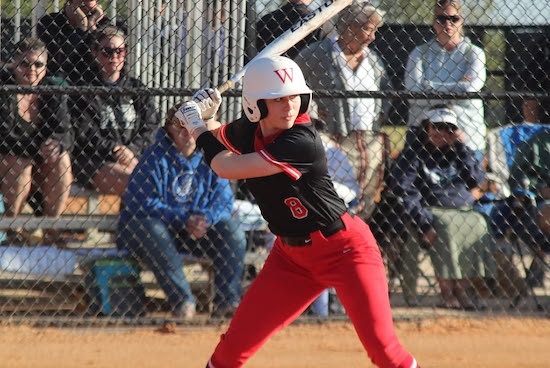
Play(er) of the Week: Abby Orso MA ’26 Talks Grad Transferring, Season Expectations, and Being Managed by Her Brother
In Play(er) of the Week, our goal is to highlight outstanding athletes or moments from games that deserve extra attention.
Abby Orso MA ’26 is a graduate student from York, Maine pursuing her master’s degree in education and human development. She is also a pitcher for the Wesleyan softball team. Recently, Orso was named NESCAC Player of the Week, which is the first time that a Cardinal has been recognized with that honor since 2018.
Orso sat down with The Argus to discuss this recent accolade, her unique athletic journey, and the team’s hot start to the season.
The Argus: When did you first start playing softball?
Abby Orso: Back when I was 10. I didn’t do the T-ball phase or anything. My parents threw me in Little League, and I started playing travel the year after.
A: Have you always been a pitcher?
AO: I picked that up around that age, too. My parents didn’t really know anything about it, because my mom played softball in college, but she didn’t pitch. She was an outfielder, so, a very different position. So ever since then, I just stuck with it.
A: What would you say is your favorite part of softball, and what would you say the hardest part is?
AO: My favorite part is probably the teammates I’ve met along the way. Some of my best friends are from the sport. But I also think it’s been so applicable to so many things. Whenever I’m in a job interview or I’m doing something outside of the sport, I reference it. The most challenging part is how many times you have to fail, but you’re still doing well. It always blows my mind that a good batting average is .300. You fail 7 times, and you succeed 3 out of those 10 times and [are] considered really good. So being okay with failing is just a challenging thing. And then also being a pitcher. You’re literally in the middle of the field—in the circle. It just feels very isolating at times. So I think that can be challenging, but it’s rewarding.
A: How did you decide you were interested in playing at the collegiate level?
AO: I just wanted to play as long as possible and to get to a competitive level where everyone around me loved playing the sport as well. A lot of times I feel like in high school, you play a sport because you’re supposed to and just keep going with it. But in college, you have to really put the time in, so I think being surrounded by people that also love the sport was inspiring.
A: How did you decide you wanted to do a graduate year, and also how did you end up picking Wesleyan?
AO: I solidified the fact that I did want to do it [during] my last season at Colby. It just didn’t feel complete yet. I think a lot of that had to do with the fact that I started in COVID, so I didn’t really have my freshman season. I just didn’t feel ready to be done yet. And then I also didn’t have a senior season for high school, so there were just a lot of years in there that I missed, and I wanted to ride it out for as long as possible. And also my parents both played sports in college, and they have always said, “If I could just play one more game, that would be so much fun.” I think I wanted to get to a point where I’ll look back at this now and think like, “Okay, I did play that last year that I had the opportunity to play, and I rode it out for as long as possible.” Wesleyan, specifically—my brother [football player and wrestler Will Orso ’26] is a student here, and I have visited many times and have really enjoyed the people I’ve met. I met a lot of the softball girls before considering coming here, and they were also welcoming, and the coaching staff was super welcoming. They had a program that aligned with what I want to do after I graduate from here. And it just all aligned perfectly.
A: Is it different balancing sports and school as a grad student versus an undergrad?
AO: Yeah, definitely. I think now it’s more so work. Like I work during the day, I have class at night, and then softball in the middle. So with my teammates, it’s just a funny dynamic, because they’re at class, and [I’m] at my—what feels like [a]—big adult job during the day, and then we all come back together at the field. And this is the part of the day that I look forward to the most. So I think that the difference now is looking forward to practice so much more than I did prior to now. And this is my outlet, and this is my fun throughout the day, so it’s honestly made me enjoy it more while being here.
A: What’s it been like going to school with your brother, because he manages the team and he’s an athlete as well?
AO: Well, this fall was so much fun because I usually don’t get to see many of his games, and this year I got to go to almost all of them. But that was so much fun, and they had such a good season. And my parents come to every single one of our games, so being able to see them even more this year has been awesome. My brother—I wasn’t really sure what to expect, because we’ve never been on the same team together. It’s weird, but it almost feels very normal at this point, because we’re at an age where we get along much better. When I go in from an inning that I was struggling in, he makes a joke, and he’ll be, like, “Nice job out there,” sarcastically, when I do poorly. I think he brings me down [to earth] sometimes when I’m existential and thinking it’s the end of the world. So it’s nice to have him in there. I know that he hasn’t been able to come to really any of my softball games, so it’s been nice to see us supporting each other in the seasons and having him here as a support system transitioning to grad school.
A: Coming into this year, did you have any particular expectations for yourself and the team as a whole?
AO: I think team-wise, I definitely had the expectation that we’re gonna compete this year in our conference. I had already known from playing them for three years what talent they had on the team, so I was excited. They were a tough team [in] prior years. But also the expectation I had for myself coming onto this team was to bring a competitive edge. We can do the hard things, we can beat the teams that are really good in this conference, and we can [go] up a notch in terms of competitiveness. So I had that expectation that I really wanted to bring in energy that showed us that we could do great things and then just enhance the skills that [my teammates] already had, because I knew that they were really talented already.
A: You were recently awarded NESCAC Player of the Week. How does it feel to have gotten that for the first time being a part of this program?
AO: It was awesome. I think the best part of that was just seeing how many people supported me and then also sharing it [with] another player on our team [NESCAC Pitcher of the Week Jacelyn Lees ’28]. That was really fun, to see softball sweep the award. So I think it solidified the fact that we’re on the right track and we’re doing great things.
A: You guys have another NESCAC series coming up at home this weekend. How are you feeling about this next chunk of games?
AO: Going into this weekend, we are just trying to make our mark in the NESCAC. We have something to prove and each game is an opportunity to do that. So going into Amherst, our goal is to sweep them. But regardless of what happens, we want to prove that we’re competitive and that we have the talent on the team to beat whoever we come across. So continuing to make a mark in the NESCAC and take it one game at a time. But also we’ve had so much fun with it, so we’re just trying to capitalize on the fun that we have while we win.
A: As a grad student, if you could give advice to yourself as a freshman, what would you say?
AO: I feel like I’m still giving myself advice because I feel like a freshman in many ways. But I think just to not take everything so seriously is one of them. My coaches here have definitely reminded me of that, and that I chose another year to play for fun. So I think reminding myself that it’s a sport I went into because I thought it was fun and continued it because of the same reason. So I think just thinking, “It’s not that serious,” and then just enjoying it because it really does fly by.
This interview has been edited for length and clarity.
Erin Byerly can be reached at ebyerly@wesleyan.edu.

Leave a Reply