
Living Theater hits MoCon
Salad and anarchy are not ordinary bedfellows, but Sunday night at Mocon they came together as the culmination of a weekend-long workshop put on by the Living Theater.
The Living Theater, a collective founded in 1947 by Judith Malina and Julian Beck, was advertised by e-mail as a “form of radical, participatory theater based on the ideas of Julian Beck and Antonin Artaud.” During the 1960’s the theater explored the works of Gertrude Stein, William Carlos Williams and John Ashbery, but later shifted focus in order to convey their political message.
“Their ultimate goal has always been what they call ‘beautiful, nonviolent anarchism,’” said Will Swofford ’05. “They try to incarnate human emotion on stage.”
Swofford, whose group Silence is responsible for bringing the Living Theater to Wesleyan, said that he had heard about their methods before and he thought that The Living Theater would be a great opportunity for Wesleyan for a variety of reasons.
“We started Silence to bring nationally and internationally renowned performances and workshops, specifically poetry and experimental music, to campus,” Swofford said. “Last November we put on the Music Maverick Series, for instance, that brought free [improvisational] jazz to the Chapel.”
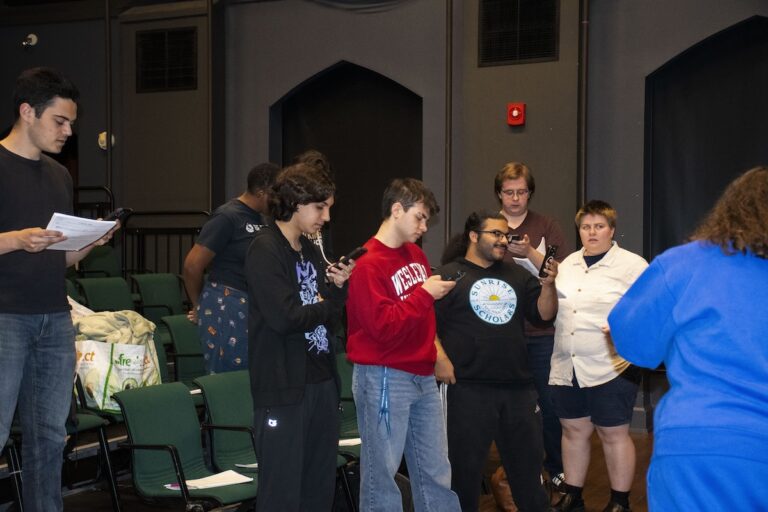
The full Living Theater program began with a two-day workshop at Oddfellow’s Playhouse, attended by sixteen students each day. The workshops involved theater exercises to open perception to listening and to build community, as well as more political exercises to promote what Living Theater calls its “political model for communication.” Students also worked to identify issues that they wanted to convey in a final piece. For example, solidarity with Mocon workers struggling for better benefit packages was one focus. The performance was brought to Mocon on Sunday night at 6 p.m. in front of the salad bar and was accompanied by choreographed movement and sound.
The reaction from the crowd was mixed.
“A few people were jerks and dropped cups during the entire thing to disrupt it, and one kid threw a brownie at [workshop participant] B Lake [’06], but most people really liked it,” said Brendan O’Connell ’08, who attended the workshops. “A few seemed in awe and completely transfixed, which was amazing.”
“They were definitely shocked, ”Swofford said. “We were creating a spectacle. But the energy of the performance was really good.”
In the audience, confusion seemed to be the prevailing emotion.
“It was very strange,” said Julia Cheng ’08. “I couldn’t hear the guy very well so I had no idea what they were trying to do, but it looked cool.”
“I had no idea what their message was… was it about the workers?” said Asli Sonceley ’08. “I’m not sure.”
Swofford is also running a student forum this semester called “Deep Listening Ritual and Improvisation,” which involves students studying the give-and-take of improvisational music. Both of these groups were tangentially connected to the Living Theater’s cause. What convinced Swofford that there was a need for an on-campus workshop was the burst of student activism and outcry at the end of last fall.
“There was really a rally in student voice last semester, but my feeling was that as much as the Administration wasn’t listening to students, the approach on our side was not very focused on communicating, more on venting, trying to make a statement,” he said. “The Living Theater perspective is a two-way lane of expression, there is a lot of focus on silence, and with the give-and-take we studied in the Forum the concept seemed like a perspective we could have in activism here.”
To bring the Living Theater to Wesleyan, Swofford first went to the Community Development Fund and the WSA, both of whom gave him funding but not quite enough. On a whim, Swofford e-mailed North College.
“It’s really notable that I was able to get [President Doug] Bennet to find some funding for this,” Swofford said, “He e-mailed me back, essentially saying ‘This was a good perspective on activism, we all think there is a need for this, the money you got isn’t enough’, and he matched my WSA funding. There was a lot of hostility toward him during the protesting, so that’s pretty significant.”
“I hope we at least put forth a vision of what Mocon could be instead of the alienating monotonous place it is most of the time for me.” O’Connell said.
“We just wanted to take people out of their everyday for a bit and make them think,” Swofford said.
“People’s reactions were really different, some people even booed, but I do think it was appreciated,” said Asli Sonceley ’08. “It is true, people in Mocon deserve to be treated more like humans.”


Leave a Reply