
Paper Day 2026: University Event Celebrates A Ubiquitous Medium Through Installations at Olin, Pruzan, and PAC
Both seemingly insignificant and endlessly versatile, paper shapes nearly every part of daily life, including this newspaper’s print medium. On Friday, Feb. 20, the University’s 2026 Paper Day installation brought visitors into the world of this dynamic material and medium. Through the work of visual artists, musicians, conservationists, and writers, the event showcased paper’s creative range. Visitors walked out of the day’s events with a newfound appreciation for the ubiquitous material and its many uses.
Like the process of making a sheet of paper, the day was carefully organized, with meetings beginning as early as August 2025. Last spring, the Archaeology Department hosted a Bronze Day, which similarly centered on a single material through interactive programming.
The organizers of Paper Day were inspired to translate that model into a different medium. Head of Special Collections at Olin Library Tess Goodman said the original idea was either hers or that of Dietrich Family Associate University Librarian for Unique Collections and University Archivist Amanda Nelson.
Goodman explained that they envisioned Paper Day as part of a possible series of annual events celebrating different materials. Once word spread throughout Olin and Art & Art History Department, interest quickly grew.
“There were so many different people who had ideas and contributed different kinds of labor and activity,” Goodman said. “It was truly a community effort.”
Faculty and staff suggested ways their students could contribute and what they could add from departmental collections. Nelson also brought funding through the Rare Book School M. C. Lang Fellowship, with additional support from Special Collections and Archives and other departments.
The day came together to transform Olin, with help from sources including the Davison Art Center, the IDEAS Lab, the Art & Art History Department, the Music Department, and more. Organizers were initially unsure what turnout would look like, but it quickly became clear that the event struck a positive chord with the community. Olin’s central location and high level of student involvement created an especially lively atmosphere while also opening opportunities for new cross-disciplinary connections.
One of the first visible examples of this cross-campus collaboration was the “On/Of Paper” exhibition in Usdan. Art Studio Assistant Dalton Newbend organized the show, which featured works by University faculty, staff, and alumni alongside short texts about their paper relationships. Adjunct Assistant Professor of Art and Art Studio Technician Kate TenEyck curated the display case as a way to advertise the event.
Additionally, the Alternative Printmaking: Beginning Japanese Woodblock Technique (ARST261) class was involved. This was especially exciting because students were able to interact with this art in a public exhibition. “[That] doesn’t necessarily happen under normal circumstances, because the printmakers are often in the printshops without people knowing what they’re doing,” TenEyck said.
The day commenced with a series of talks in Olin’s Smith Reading Room. Keynote speaker and alum Josephine Jenks ’18 spoke on her work as a paper conservator in New York. Then, archaeology and studio art double major Hank Schwabacher ’26 presented his thesis project on Amate paper, an ancient Mesoamerican craft used by Mayans and Aztecs, describing both its history and his own recreation of it. Local book artist and publisher Robin Price displayed her multidisciplinary pursuits, with paper at the forefront of her work.
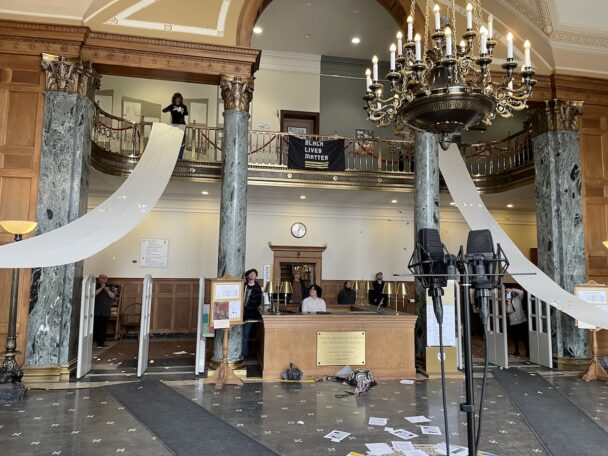
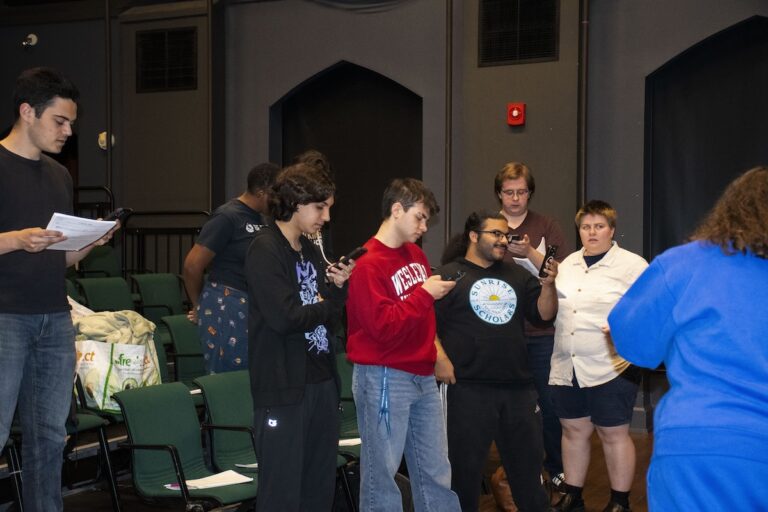
After the talks, attendees gathered near the library’s main entrance, where “Paper Piece” by Benjamin Patterson was performed by students from Live-Electronics for Composition, Improvisation, and Sound Art (MUSC221). The usually quiet lobby library was suddenly animated. Large rolls of paper were unraveled from the second floor, then pulled, torn, and manipulated to create a visual and sonic landscape.
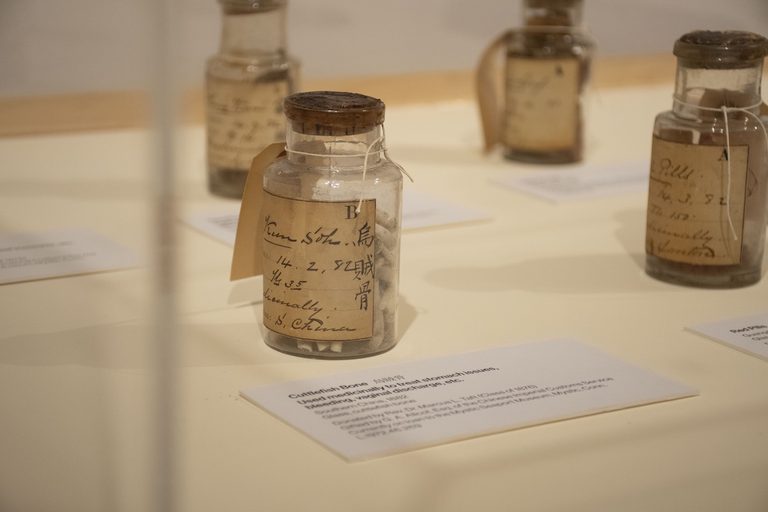
From 1:30 to 3 p.m., the Paper and Book Arts Fair filled the Pruzan Art Center lobby, where students, faculty, staff, and curators set up displays and demonstrations of various paper-art techniques. Visitors encountered paper-based photographic processes like cyanotypes, bromoil, collotypes, and photogravures; handled Robin Price’s original artist books; printed bookmarks and postcards on a BookBeetle miniature press; made zines; examined pith paper used in 19th-century Chinese watercolor paintings; and explored decorative papers from the Special Collections and Archives, including examples of watermarks, marbling, and paste paper.
Each aspect of the celebration emphasized the chameleon-like nature of paper. “We take for granted that paper is everywhere,” TenEyck said. “We recycle it and throw it away and don’t often think about where it comes from.”
The last part of the day was devoted to answering this very question through hands-on demos. Preservation and Book Arts Librarian Krista Narciso demonstrated European-style hand papermaking using cotton linter fiber in the Book Arts Lab, and participants made their own sheets. In the Exley Science Center IDEAS Lab, Makerspace Coordinator Ben Parker led a laser cutting demonstration featuring the University’s modern machines.
In the Goldrach Gallery in the Pruzan Art Center, Davison Art Collection Curator Miya Tokumitsu led tours of the Davison Art Collection’s spring exhibition, “Looking Inward: The Interior As Subject,” which features prints and photographs by artists including Édouard Manet, Sylvia Plimack Mangold, Carrie Mae Weems, Joel Meyerowitz, and Giovanni Battista Piranesi.
As the day drew to a close, it became clear that Paper Day was not simply a celebration of a material but a testament to how a shared fascination can draw a community together. Reflecting on paper’s importance to her own work, TenEyck said that “the paper and the ink come together so tightly; the artwork becomes the paper, in a way.” This understanding echoed across Olin, Usdan, Exley, and Pruzan, as students, faculty, librarians, and visitors moved between spaces and disciplines. Printmakers stepped out of their studios, conservators shared their processes, and attendees made, handled, and listened to paper in ways they likely never had before. The incredible turnout showed that interest in these types of collaborative celebrations is high: This was the first, but definitely not the last.
Molly Wynne can be reached at mwynne@wesleyan.edu.

Leave a Reply