
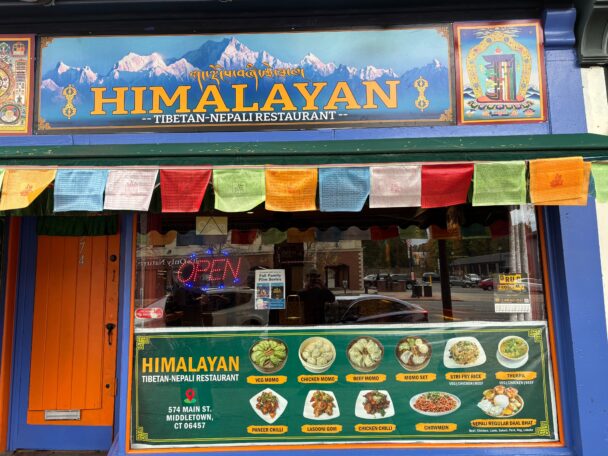
Eli Eats Himalayan Restaurant, a Trip Through Tibetan-Nepali Nourishment
Sick food is a fascinating conundrum to me. Normally, one’s appetite is adversely affected by all forms of blights and pestilence. On the other hand, some foods are exceptional when sick. As an Ashkenazi Jew with a weak immune system, I’m proud to say that my people’s food falls into the second camp. I mean, chicken noodle soup is kind of our thing, and matzo ball soup is excellent for indigestion. Tragically, there are no Jewish delis to speak of in a 20-mile radius from campus, which makes the already-miserable experience of being ill in college even more despondent. However, I recently had a revelation: Tibetan food is a more-than-sufficient analogue to Jewish food, and (close your ears, Grandma) might be, when sick, a bit of an improvement. Let me explain.
Last Tuesday, I was in the mood for Tibetan-Nepali food that was served at a restaurant named for the tallest mountain range in the world. Luckily, Middletown houses Himalayan Tibetan-Nepali Restaurant, a Main Street locale with a blue-and-orange painted exterior. I’d never had Tibetan or Nepali food before, but had the good fortune of being joined by a Tibetan friend who happened to be hungry.
We reached the restaurant at 5:00 p.m., escaping the burgeoning cold of a day on the border of fall. The doorknob was an elephant, shaped after the Hindu deity of Ganesha. We entered into the wood-paneled dining room, greeted by Tibetan prayer wheels, a shrine to the Dalai Lama, and posters of the Ashtamangala, the eight auspicious symbols of Buddhism. Tibetan incense, more subtle than its Indian counterpart, wafted above. The top half of the menu featured staples you’d see at any Indian or Chinese restaurant, like aloo dam and beef chow mein. As Tibet is geographically located between the two countries, it’s not shocking to see some culinary overlap. But we didn’t opt for either of the aforementioned dishes, instead starting our meal with chicken momos and beef thukpa.
For the uninitiated, the easiest analogue to the momo is the dumpling. And, these momos were…well…pretty hard to distinguish from dumplings. Arriving in a wood steamer, the fillings were a bit mintier than what you’d find at a Chinese restaurant, but besides that were not too different from the dumpling. I appreciated how chive-forward the minced situation was, and the spicy tomato sauce scintillated the senses. However, in sum, the momos were solid, if not unspectacular. Disappointingly, there was a substantial bit of grease within each momo, which made the dish resemble an accidental soup dumpling. I quickly assumed this was a defect in cooking, not the dish itself. But still, not an auspicious start.
However, things quickly looked up with the beef thukpa, a soup that harkened back to the aforementioned chicken noodle situation. Thin egg noodles were draped over shreds of beef, carrot, and bok choy, all served in a meaty broth. Best three hyphenated words to describe the soup: to-the-point. This umami experience had no qualms with what it was, delightfully warming the kishkas (shoutout to all my Yiddish speakers out there). When paired with a spicy orange sauce that I presumed contained turmeric, the soup added a second dimension that quickly elevated it above chicken noodle. Spicy but not overpowering, this was a lovely time for all involved.
Still, my friend and I were left wanting more. Enter Nepali dal bhat. We ordered, watched a soap opera or two on the restaurant’s television, and then were greeted with a menagerie of yum. Black dal. Lamb stew. Potatoes with fennel. Garlic bok choy. Basmati rice. Rice pudding. One really spicy pickle. Like, so spicy. Obscenely, unhealthily spicy. What is wrong with this pickle? I haven’t gotten the hiccups since third grade; what’s going on? Why did I eat this? What’s wrong with me? Sorry. As I was saying, the dal bhat was the star of the show. I’m a huge fan of lentils, which allowed me to emotionally ingratiate myself with the darkened stew. Piquant, pungent, and a little bit bitter (thank you green onions), this was a triumph when draped over rice. And, I soon realized, would be excellent whilst ailing.
The lamb stew was of a similar vein. Full-bodied chunks of meat stewed with a mishmash of spices (coriander and garam masala stood out), this could save even the most brutal case of consumption. The trimmings were equally satisfying. The sweet potatoes garnished in fennel seeds possessed a lovely color and an agreeable aftertaste. The bok choy was, in the words of me right now, “bok-awesome.” And the rice pudding again harkened back to my Ashkenazi roots, but this time featuring more cardamom. The momos almost undid the meal, but the dal bhat revived it.
We left the restaurant at 6:30 p.m., with clearly no capacity to begin our homework. After bidding my friend adieu, I walked back up the hill to my Lox Rise, adjusting my Richard Nixon–themed hat (not an endorsement) to protect against the setting sun. I found myself yawning and ready for an excellent night nap that would completely ruin my sleep schedule. My stomach hurt in a good way. The crick in my neck had gone away. The thukpa and dal bhat had functioned like a great pastrami sandwich with a side soup; all problems, real or imaginary, had been ameliorated. In that moment, I realized something glorious. I couldn’t replace the deli, but like Billy Beane in “Moneyball,” I could recreate it on the aggregate. And that’s good enough for me.
Eli Pearl is a member of the class of 2028 and can be reached at epearl@wesleyan.edu.




Leave a Reply