
Local Groups Respond to Immigration and Customs Enforcement Activity in Connecticut
After a record high summer of U.S. Immigration and Customs Enforcement (ICE) arrests across the nation, visible ICE activity in Connecticut throughout September continues to rattle the community.
Local organizations like the Middlesex Immigrant Rights Association (MIRA) and Indivisible Middlesex have been working to respond to reports of ICE arrests in the area.
Arrests at Local Courthouses
On Thursday, Sept. 17, 2026, MIRA was notified of ICE activity at a courthouse in New Britain at roughly 11 a.m. and mobilized several members of its rapid response team to the area. The Argus spoke with two members of MIRA who were present at the incident.
“When I arrived, there were several ICE vehicles, one directly outside the courthouse and one parked in a parking lot across the street,” an anonymous alum of the University, who has remained in the area, said. “I went to watch the ICE vehicle that was across the street…keeping an eye on the ICE vehicle in the parking lot, and to see if more ICE vehicles arrived. [I was] also warning people in the area that were walking towards the ICE vehicles [to] watch out.”
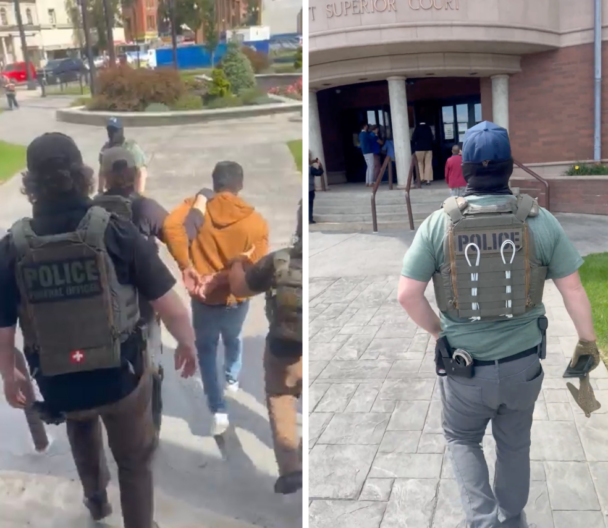
According to MIRA members interviewed by The Argus, at least five additional unmarked ICE vehicles arrived in New Britain at 12:40 p.m. in pursuit of someone walking to their car from the courthouse. The ICE agents were clad in balaclavas and tactical gear labeling them as “police,” captured in video verified by The Argus. Observers also noted that the ICE agents did not respond to requests to provide a warrant or identification, as required by Connecticut law.
“I just remember standing there, just the anger I felt was so intense, and the fact that this is something that’s deemed as okay,” the anonymous alum said. “I don’t think people are aware of how much this is happening in Connecticut and also just how much they can help. This is twenty minutes from Wesleyan campus, you can get into your car, drive over, and be there to help protect your community, and be there to stand between these neighbors.”
The following week, on Wednesday, Sept. 23, ICE activity at the Meriden Superior Court sparked a confrontation between activists and ICE agents. The Argus spoke with three activists who were present at the incident. According to Ed McKeon, a founding member of Indivisible Middlesex, ICE agents were spotted entering the courthouse three separate times that day.
“In the morning, they entered and detained an individual who, it turned out, was not the individual they were looking for,” McKeon wrote in a message to The Argus. “When I arrived ICE vehicles were idling outside the courthouse. After several minutes, they moved toward the courthouse and agents moved towards the building. Observers began filming with cell phones and yelling that ICE was not permitted in the courthouse without a judicial warrant.”
Protesters followed the agents into the foyer of the courthouse and spotted them entering the main hall without going through security. According to two observers, Connecticut marshals did not check the agents’ weapons or ask them to remove their masks as they entered, which violates Connecticut’s Trust Act. The U.S. Department of Justice has sued the state over the law, which prohibits law enforcement from wearing masks on duty and requires them to display identification.
As members of MIRA crossed into the courthouse, marshals blocked their path, citing their cameras.
“[The marshals] ask us to start leaving, and I start backing up to try to leave,” the anonymous alum said. “There’s people behind me, so I can’t just turn around and leave, I don’t have a clear exit.… About maybe a second after he asks me to leave…he puts his hand on my chest and he starts pushing me back. He’s not lightly pushing me, he is shoving me…So, I look up at him and I say, ‘I am complying.’ Like I just tell him. I don’t remember if he stopped shoving me, but he shoved me for a while, and then at a certain point, I was able to get out.”
As the protesters exited the building, one woman was pushed to the ground by courthouse security, hitting her head on the ground and was briefly unresponsive, according to a video obtained by The Argus. She was taken to a nearby hospital via ambulance.
“Right as I get out, I see this elderly woman that had been protesting with us, and I just see her [as] she just tips over,” the anonymous alum said. “Her whole body is straight and she just tips over onto her back.… So, I [called] 911 to the court. Emergency services came, the woman woke up after a few seconds, [and] she got a CT scan. She’s okay.”
Another member of the rapid response team was pepper sprayed by an agent as they exited the courthouse, despite having already begun to back away, as reported by the CT Mirror.
“ICE left the building empty-handed and got in their cars and left,” McKeon wrote. “They returned several minutes later, re-entered the courthouse and returned [to their vehicles] with a detainee.”
According to McKeon, the incident in Meriden is being investigated by the Connecticut Attorney General’s office and the state police.
An anonymous University student, who is affiliated with MIRA, was not surprised at the location of the arrest. The student had recently been at the Meriden courthouse accompanying a person who had requested MIRA’s aid in the legal immigration process.
“I did a court accompaniment at that exact courthouse less than a month ago, and I am terrified to think about what would have happened to the kind man I met if he was taken to one of those hellish detention sites, and what the person who was taken is now experiencing,” the student wrote in a message to The Argus. “They target courthouses intentionally, trying to make people too scared to appear in court. If someone misses a court date out of fear, ICE can much more easily obtain an order for removal.”
This incident has not been the only one of its kind in Meriden; 32 people were detained from January to the beginning of August, according to the CT Mirror. Approximately 450 people have been detained in Connecticut in the same period.
“Rapid response groups report 110 detentions in August, with 94 in the last week,” McKeon wrote. “ICE is definitely changing tactics, with fewer mass public abductions, and more targeted individual arrests where people are snatched quickly.”
University and Community Response
Both students and the administration have reacted to these incidents with shock and outrage. The Argus asked President Michael Roth ’78 how he thought the University could respond to ICE activity nearby.
“There’s not much we can do at Wesleyan except to raise our voices against what is just an extraordinary abuse of power,” Roth said. “I’ll continue to do that. But, it is really alarming because they’re using extra-legal mechanisms to destroy families, detain law-abiding residents of the country, all in the name of fulfilling the leaders’ announced quotas. It’s horrific and I think it should alarm all of us.”
Following ICE abductions around the country during the beginning of the second Trump administration, student groups at the University formed the ICE Out Coalition in January 2026. The coalition is made up of student organizations on campus including Wesleyan Democrats, Wesleyan Young Socialists, Sunrise Movement Wesleyan (Sunrise), Wesleyan American Civil Liberties Union, Wesleyan Refugee Project (WRP), and the United Student Labor Action Coalition. Representatives from each group form a steering committee that gathers to organize events and plan actions on and off campus.
University groups like the WRP and Sunrise work closely with MIRA and Integrated Refugee & Immigrant Services to help fundraise for the outside organizations, according to WRP Fundraising and Financial Manager Helen Xie ’27. The relationship is often symbiotic, with student groups benefitting from the guidance and community that local organizations offer.
“These collaborations allow us to stay in touch, cross-promote, and avoid [duplication] in events or volunteer bases of the people who are involved,” Sunrise leader Kiran Schatz ’29 said. “It has been incredibly helpful to have these local connections, especially with groups like MIRA who seek to provide a range of resources to the community and have existing infrastructure and connections off campus.”
Students interested in joining the rapid response team or learning about court accompaniments can be trained by MIRA and Indivisible. MIRA organizers told The Argus that the group is planning on-campus trainings this semester in addition to their community trainings in Middletown.
“Organizations like MIRA will continue to support affected communities during these unpredictable times,” MIRA spokesperson Alex Cruz wrote in a message to The Argus. “We will do this by educating people about their rights, providing resources to families, and by pushing for the Trust Act to be both enforced in the short-term and strengthened in the future.”
Peyton De Winter can be reached at pdewinter@wesleyan.edu.
Anabel Goode can be reached at agoode@wesleyan.edu.

Leave a Reply