
At the Emmys, Unexpected Wins and Low Viewership Define the TV Landscape
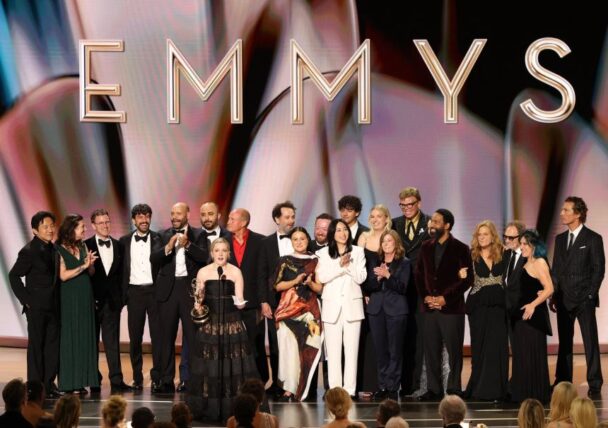
The 78th Emmy Awards proved eventful, crowning underdog shows like “Widow’s Bay” and saying farewell to old favorites, with Jean Smart winning her fifth award for “Hacks.” However, the telecast, hosted by cable TV icon Mariska Hargitay of “Law & Order: Special Victims Unit,” saw a nine percent decrease in viewership from last year despite the night’s record-breaking wins, star power, and a pre-recorded sketch featuring Taylor Swift that aired the evening of Monday, Sept. 14.
The night’s biggest winner, Apple TV’s offbeat horror-comedy “Widow’s Bay,” felt dominant as just about everyone involved in the show, from its kooky ensemble of town hall employees (Matthew Rhys, Stephen Root, and Kate O’Flynn) to the creator Katie Dippold, won, setting a record with 14 wins for a comedy series. However, it was also the category’s least-watched nominee, released on a streaming service that only accounted for point five percent of all U.S. TV viewing time during the show’s release this summer (in comparison, Netflix accounted for eight percent).
“Widow’s Bay” is not alone, as Apple TV’s seldom-watched slate of dramas, “Pluribus,” “Your Friends & Neighbors,” and “Slow Horses” competed against HBO Max’s hit “The Pitt,” which won the Outstanding Drama Series for the second year in a row. Throughout the show, my phone buzzed as my TV-obsessed friend continuously wondered what the HBO Max miniseries “DTF St. Louis” was (and why it was named that). The show went on to win seven Emmys. I learned about Netflix’s serial killer miniseries “The Beast In Me” when Matthew Rhys walked up to accept an award for his role, and Allison Janney’s win for the Netflix political drama “The Diplomat,” which shocked even her and merely left me wondering who, besides my parents, was tuning in.
During the Peak TV era, which began in the 2000s with the rise of prestigious HBO shows like “The Sopranos” and exploded in the 2010s due to streaming, many complained there were too many shows to watch them all. These days, the market has shifted drastically, with a 39% decline in the number of Emmy-eligible comedies, dramas, and limited series over the past four years. In the aftermath of COVID-19, the Writers Guild of America and Screen Actors Guild strikes, and streaming service consolidations, viewers are wondering whether there is anything worth watching.
The telecast projected confidence, as Hargitay opened with a bold reimagining of Joan Jett’s “I Love Rock ‘n’ Roll.” As she sang “I love TV screens” surrounded by dancers wearing cardboard-cutout box TV sets on their heads, I could not help but think of the laptop I was watching it on, and the nights I’ve spent curled around it laughing to the much-nominated “Hacks” or anxiously peeking through my fingers as the doctors of “The Pitt” dress a wound, let alone the times I’ve succumbed to watching Hargitay on “SVU” in twenty-part episodes via TikTok.
Hargitay later gestured to another kind of screen during her monologue, reciting, “At the end of the day, we come to TV for magic, to laugh, to cry, to care, because we need that…” as the lights dimmed and the camera shifted to Nicole Kidman in the front row. Kidman’s much-memed AMC ad was a staple for many Americans this summer, as the summer box office grossed a record $4.76 billion, with individual admissions also up from last year as people flocked to the theaters for “The Odyssey,” “Obsession,” and “Spider-Man: Brand New Day,” among others.
Perhaps the ultimate sign of television’s declining cultural relevance came from the pre-recorded Taylor Swift skit, a riff on Hargitay’s role as Olivia Benson in “SVU” in which she investigates whether or not Swift will make an appearance (Swift spent Monday night at a football game instead). Lost in a sea of red string and Easter eggs, she barely notices when the singer sits down and recites a series of code words: “Saccharide. Aries. From the vineyard. North or South.” As I scrolled through social media late that night, I was confused. I wasn’t inundated with the barrage of jokes, theories, and mania that tend to ensue when she so much as breathes. Maybe no one had seen it.
Abby Slap can be reached at aslap@wesleyan.edu.

Leave a Reply