
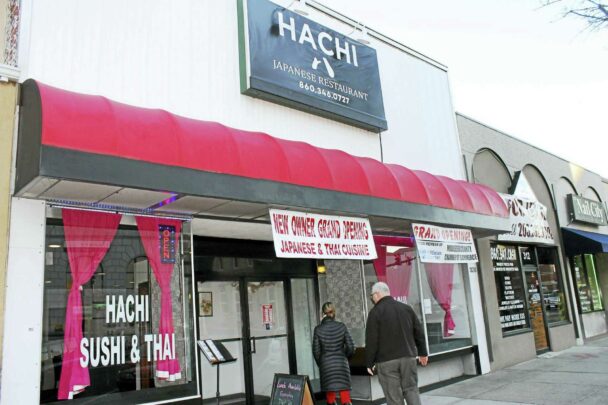
Eli Eats: Hachi and a Vigorous Defense of American Sushi
The other week I watched “Jiro Dreams of Sushi,” David Gelb’s impressively uncritical 2011 documentary of Jiro Ono, a nonagenarian Tokyo sushi savant. As a tasteful piano score plays, the film depicts Jiro perfectly scoring akamutsu, carefully massaging octopus, and elegantly crushing his son’s dreams of leaving the family business. The documentary is a visually stunning example of hero worship, a joy for any self-described gourmand. However, it still left me with one question: Is any of this better than Hachi? Frankly, I’m not sure.
I entered Hachi on the tail-end of a sunny Saturday with a hankering for rock shrimp tempura. My group and I sat down at the table and immediately got to work, scouring the menu’s speciality rolls section. There’s something brilliantly American about Hachi’s maximalist rolls. And that’s because they, like many sushi rolls you know and love, are American. While the roll itself was invented in Japan, a cursory Google search will reveal that it was Japanese immigrant chefs in 1960s Los Angeles who invented the California roll, playing to American palates that were less comfortable with raw fish. As the ’80s sushi phase swept the nation, rolls became more and more ludicrous, with chefs adding tempura flakes, spicy mayo, and even cream cheese (a step too far), creating the panoply we consider American sushi today. To a sushi purist, these innovations are an abomination. And from a pure fish lover’s perspective, they might be right, as too much sauce can overcomplicate more delicate flavors. But, by that same token, the American sushi roll also typifies what makes American cuisine so special: two different cultures coming together to make an entirely new third thing. The good news is that, for those of us unwilling to fork over an entire paycheck on a singular piece of abalone, that third thing tastes pretty good. And, in even better news for us Middletown residents, Hachi is American sushi at its peak.
Returning to the meal itself, my group opted for edamame, the aforementioned rock shrimp tempura, four rolls, and a bit of toro nigiri. The edamame came out first, and was eternally solid. Cooked “al dente,” as one of my dining companions remarked, the green soybeans were perfectly salted, prepping the palate for what was to come. Next was the rock shrimp tempura, slathered in spicy mayo. Bites burst in the mouth, and the mayo stayed in the sinuses for an extra beat. There was a sort of rhythm to consuming the tempura, a snap, crackle, and pop. Two delightful appetizers provided for an auspicious start.
Then, delivered on a plate that resembled an ancient Greek discus, came the main course: the rolls and the nigiri. The toro was probably the nadir of the night; too chewy. But everything else was sublime. The star of the show was unquestionably the Wasabi Roll, featuring spicy (and crunchy) tuna, yellowtail, jalapeños, “Japanese Dressing” (yuzu ponzu, I discerned), and dollops of red tobiko. Holy cow. The ponzu and the side oranges (since why not), gave the roll a citrusy, vaguely tropical sensibility. The tobiko provided a pop-in-your-mouth sensation most similar to a really good cherry tomato. The jalapeño, while not perfectly piquant, was another excellent textural element. And the spicy tuna? Come on. Crunchy and spicy, it was the cornerstone upon which everything stood. There were about seven different flavors in the Wasabi Roll, and each of them worked. It was a phenomenal bit of cookery, an example of a restaurant firing on all cylinders.
My other personal favorite roll was the more understated (and traditional) option, the Yellowtail Scallion roll. Fresh fish, sharp aromatics, the roll functioned as the “glue guy” of the meal; the player who brings everything together. If the Wasabi Roll was the Jalen Brunson of the meal, the Yellowtail Scallion roll was Josh Hart. And there’s no Larry O’Brien trophy in New York without Josh Hart.
Our other speciality roll, the Mojito Rainbow roll, was a bit more of a rocky road. Made up of salmon, avocado, tuna, miso, wasabi tobiko, shrimp, and a “rainbow” mango salsa, the flavors put together were a bit of a bridge too far, with the salsa not allowing us to taste the rainbow. Featuring shrimp and cranberries, the remoulade was cloyingly sweet, and took away from the fish. However, while disappointing, the roll was also quintessentially American. A big swing, an attempted show-stopper, inherently anti-tradition, it forged a path towards something new. Maybe that swing, like the establishment of Williams College, wasn’t a great idea. But we’re glad it was tried.
The final roll, the Spicy Crunchy Salmon Roll, was almost a joke. A deep-fried behemoth, this brilliantly ahistorical approach to sushi would probably make Jiro faint. Dunked in three separate sauces, coated in tempura flakes, featuring a singular slice of avocado (for health)—I laughed the second it hit the table. From the first bite, the roll had my head spinning. The lights were almost too bright. Was I sensing a crab in there? What was going on? However, gladly, I stayed on the mechanical bull. Fried, sauced, and fried again, the dish had no qualms with what it was, no pretensions of what it wanted to be. There was no attempt at a tempestuous arrangement of kanpachi, an arresting look at the intricacies of uni. It was just damn good. And isn’t that what it’s all about?
Your cousin from Bushwick who’s been raving about “real wasabi” since returning from Japan might not like Hachi. But you don’t like that cousin anyway. Get a big group together, order some sake, and get to work. Pair spicy tuna with asparagus. Enjoy a lobster salad roll named “The Boston Monster.” Order more sake. The table needs fried gyoza? Let’s get fried gyoza. Get out of control; there’s literally an Out of Control roll. Red tobiko. Green tobiko. Orange tobiko? Who cares? It’s Hachi. The flavors are ludicrous. Asinine. Awesome. God bless Japan. And God Bless America. L’chaim.
Final Review: I’m such a fan/10.
Eli Pearl can be reached at can be reached at epearl@wesleyan.edu.




Leave a Reply