
The Cost of Convenience: How Ease Undermines Sustainability
The University’s obsession with convenience has embedded itself into everything we do. Take me, for example: I couldn’t think of a synonym for “embedded” within just a few seconds. I hated sitting in even those moments of discomfort, so I didn’t. I jumped to Google Gemini. The A.I. overview handed me a list. I’ve been a student here for four years, and lately I’ve started to wonder how many times I’ve made that same trade—the small, almost invisible exchange of struggle for ease. And how many times the University has made it too.
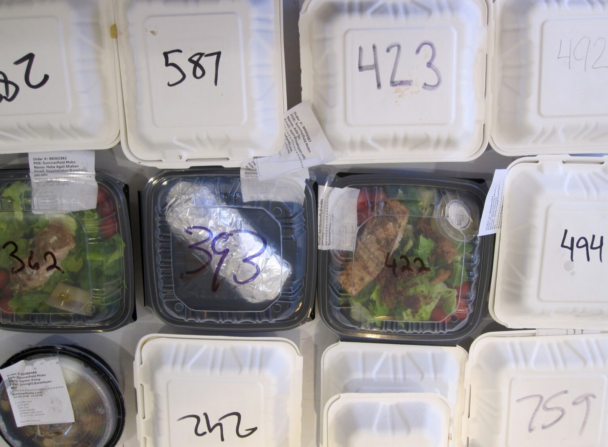
Last year, the reUser container program that students had utilized for years was abandoned when the vendor went out of business. What followed was a series of meetings with administrators, the Wesleyan Student Assembly, and the Sustainability Office, where the University landed on compostable disposable containers as a replacement. These containers have their own issues: As Bon Appétit Dining Manager Michelle Myers-Brown observed, the lack of composting and recycling bins near the dorms means the majority of these containers end up in the courtyard trash.
But what I remember the most from those conversations wasn’t any particular argument against reusability. It’s how many times the word “inconvenient” functioned as a conclusion.
In “Reflections on the Cloak of Convenience,” Emma Felman and others argue that convenience is not inherently good. Both producers and consumers often accept convenience as an unstated advantage, leading to an uncritical endorsement of technologies that simplify tasks without considering the values that may be sacrificed in the process. The paper cites fast food, TV dinners, and delivery services as examples of goods that save effort and time but weaken the broader value of cooking, such as family connection, food culture, and culinary skills.
Several other articles also highlight the social costs associated with convenience culture. In The Week, Deeya Sonalkar argues that modern life has eliminated many of the inconveniences that foster true independence. Zahira Vasquez takes this a step further, stating that convenience has replaced empathy and patience as the core values of contemporary life. She emphasizes that the continual decline of face-to-face interactions has diminished people’s practice of essential social skills, such as respect, attentiveness, and the ability to tolerate the presence of others, all of which are necessary for a functioning community.
This same underlying culture can be applied to the University’s handling of reUser. Yes, it is inconvenient to spend a few minutes checking a container in and out, but not doing so risks sacrificing our commitment to sustainability.
In light of this, an alternative was proposed. The Sustainability Office, where I work as an Office Coordinator and Environmental Fellow, suggested using the Alma system, which would allow students to check out stainless steel reusable containers the way we check out library books. It would have reduced the containers needed to just 9,744, at a one-time cost of roughly $25,000 and under $600 annually in maintenance. In contrast, the University spent nearly $52,000 on disposable containers in a single year. So, the financial and environmental case was clear.
This proposal was rejected.
This rejection deserves careful consideration. The University has student clubs, Sustainability Office employees, and strategic plans dedicated to the claim that environmental responsibility matters. When a cheaper, greener, student-developed alternative was presented, the answer was that it was too much trouble. I don’t say this to fault the individuals who raised legitimate concerns. In many ways, they were just responding to the prevailing campus culture: a culture in which convenience has become so embedded as a baseline expectation that a two-minute check-in process reads as a genuine obstacle.
That’s what makes the Alma decision significant beyond the dining hall. It reflects a broader message about how institutional choices are made when convenience culture goes unexamined. When ease becomes the assumed norm, other values silently lose their footing. Sustainable pledges and strategic plans are essential, but they must compete against the preference for taking the easiest option when a decision is made.
I write this as someone who loves the University and who is grateful for the intellectual framework it has given me to notice these contradictions in the first place. But as I prepare to graduate, I hope that the version of the University living in its mission statements and sustainability pledges will replace the version that rejected the Alma program.
Lyah Muktavaram is a member of the Class of 2026 and can be reached at lmuktavaram@wesleyan.edu.



Leave a Reply