
Artist Spotlight: Sophie Brusini ’26 Stages a Reimagined Glam-Rock “Richard III”
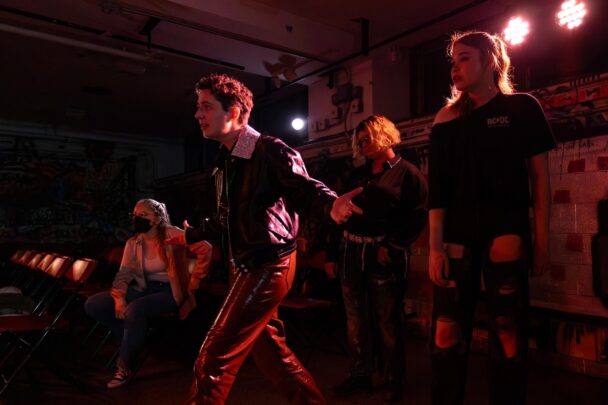
Like last semester’s “Pericles,” William Shakespeare’s “Richard III” is not one of his more performed plays. Nonetheless, Spike Tape continued its tradition of bringing underappreciated works to light in its premier production of “Richard III” from Friday, April 17 to Sunday, April 19 in WestCo Café.
Director Sophie Brusini ’26 decided to take on the material from an ingenious angle and reimagine this bombastic anti-hero as a 1980s glam-rock superstar. What that entailed, from a technical and creative standpoint, was no small feat. To understand her motivations and the extent of the work that went into this ambitious show, The Argus interviewed Brusini to talk about her artistic process, inspirations, and goals for this production.
The Argus: How long have you been involved in theater at the University, and have you always been focused on directing? How did you come to that role?
Sophie Brusini: I have a very long history of theater, like little-kid-in-Wizard-of-Oz-when-they’re-six type of vibe. And I’m actually a transfer student, so I’ve only had three years here at Wes. My first year was at Emerson College, which is a great school for theater. So, you know, I cared about it a lot. And as soon as I got to Wesleyan, I started trying to find tech roles. I think my first thing was doing lighting design on, actually, a Shakespeare production of “Much Ado About Nothing.” It was a lot of tech from there on out; lighting and sound were my main focuses, and I also did stage management. Some of the shows I’ve stage managed here were “Irving and Callahan” a couple years ago, and then I was the stage manager of the “Macbeth” production that happened last spring, and most recently “What Horizon” last semester.
A: Oh, I saw that! That was a fantastic show.
SB: Oh, yeah, Percy [Liftin-Harris ’28, Director of “What Horizon”] is amazing. I loved that show so much.
A: I’m going to ask a little bit about “Richard III” now. “Richard III” is maybe not one of the more well-known Shakespeare plays, so what made you decide that this was the one you wanted to adapt, and, more broadly, what was your way into Shakespeare?
SB: My first main introduction to Shakespeare was through “Much Ado About Nothing.” I saw this production of the show on YouTube that had David Tennant as Benedick and Catherine Tate as Beatrice. It was so good. It’s a very famous production, just because the comedy is excellent, and of course, they’re very talented actors. It was the first time that I realized how funny and engaging Shakespeare could be, both in the actual words themselves and also in what you do outside of the words. Like, there’s so much comedy that you can create in terms of movement and character decisions that aren’t necessarily inherent to the text. And “Richard III,” like, you’re totally right—it’s not one that a lot of people do. But I saw a production of “Richard III” two summers ago at the Globe Theater. It was an incredible production. It wasn’t an adaptation; they did it like straight historical with a little bit of gender bending, but it was so engaging in a way that I didn’t realize it would be. I remember sitting in the third gallery, and by the end of the play, I was twirling my hair on my finger, feeling like a girl at a One Direction concert, being like, “Wow, it’s so engaging, I hope that they notice how good of an audience member I’m being.” You just get so caught up in how magnetic Richard is that you kind of don’t even realize how horrible a person he is and how much murder he does.
A: That segues perfectly into my next question, which is what lent glam rock aesthetics to this show?
SB: I think that just that power dynamic in Richard of him being a guy who is so charismatic and magnetic and performative and is really horrible, but you kind of don’t care about the horrible things he does, because he’s still so beautiful on the outside and like, wonderful and powerful. I think that that perfectly mirrored the music scene in the ’80s. I’m super into that era of music. My dad played it a lot as I was growing up—I mean, whose dad didn’t? It’s very nostalgic to me, and I think that the way that those guys behaved was, I mean, horrible. We’ve all heard the stories about, like, Mötley Crüe.
A: Steven Tyler.
SB: Yeah, exactly. They were horrible. And yet they were so popular, it was such a huge era of music, and the Sunset Strip was this big destination, like a mecca for music. And so I find it so interesting that the world was able to—is still able to—look past their awful actions because of how sparkly and beautiful and sexy and magnetic they are, which is the same story that we see happening in “Richard.”
A: That’s an incredible insight. What does your approach with actors look like? Do you think of that as the most important part of the job, or is there something else that takes precedence?
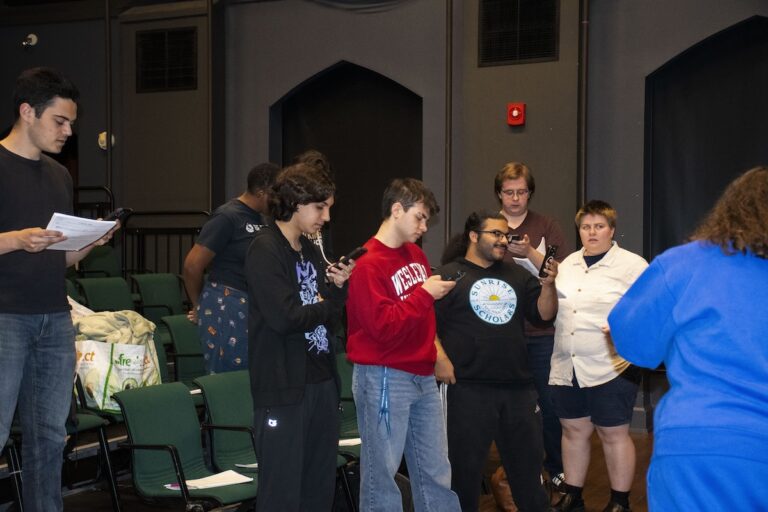
SB: This was my first time directing, so a lot of it was trial and error of figuring out how I wanted to run a rehearsal room and engage with performers. As a stage manager, I’ve been in a lot of rehearsal rooms and I’ve seen a lot of different techniques of organizing and of leading, and I was trying to figure out my own way through it. I think that we always tried to make rehearsal feel very concrete, like a very distinct time block where we would always start with check-ins and warm-ups, and we would always end with a clap, a single clap, that would end rehearsal so that people could feel like, “Okay, now it’s time to be in rehearsal,” versus, “Okay, now I can relax.” We tried to balance analysis of the text and talking and asking questions versus, you know, it’s a long play, and we had a lot of blocking to get done. We tried to get a good amount of both in there. But also, a lot of people think that a director’s job is to work only with the actors, and something that I found very valuable in this role was actually my tech knowledge, because having that background and the literal language of these different tech departments in my head meant that I could communicate a lot better with all of the different designers working on the show. I think that was a huge help. I think that I was able to understand everything that everyone was saying all the time, and I hope that they also felt secure knowing that I could understand them, too.
A: Definitely. And so what did the actors or specific tech departments bring to the piece and to your vision that you weren’t expecting?
SB: Oh gosh, I mean so much. Frankly, this project wouldn’t have been what it is without all of the wonderful people who worked on it. There were so many times that an actor came up to me and said, “Oh, hey, can I do this funny thing?” In fact, Ethan Diamondstein [’29], who played Grey and Brackenbury in the show, came up to me during one rehearsal and said, “Hey, Sophie, can I have an apple in this scene?” My job is just to say, “Yes, let’s work with that.” And that’s how so many funny, engaging pieces of the show came to be. People had an idea, and then we said, “Okay, how do we make that part of the show?” Alex White [’26], our lighting designer, came in with this idea of creating these fake blinders, which is a type of lighting fixture that is really popular in concert lighting. And he literally built these fake blinders out of old metal lighting exteriors that he found in the [Patricelli] ’92 Theater. There was just so much creativity that I genuinely was blown away by, from everyone.
A: Going off that, what were some of the most technically challenging parts of the show to pull off?
SB: There were a lot of technically challenging parts. This was frankly a crazy show to do for my first time directing, because it’s so big on so many levels. It’s a long ass show. There’s just so many words. My assistant director [Samara Brown ’28] and I cut down the script from what it was originally, and still, we couldn’t get it shorter than three hours. So it was a lot of “let’s go, go, go” in rehearsal time to try to get everything done so that we have time to run before tech week. And then we had so many technical elements. We also had live music, which was super important too. If we’re doing a play about glam rock, you have to have glam rock. And so, figuring out how to have the musicians come on stage in a way that feels natural? How do we get their equipment set up properly? How do we have all of these people have time to practice together? So many little tech things to keep in mind, too; we had these platforms that needed to be adjusted like, five times during load-in, which ate up a chunk of our time. And in WestCo [Café], you have to set up and tear down all of the equipment every day. There were so many hours that went into literally just setting up the lights and speakers every day.
A: It’s like being an actual roadie.
SB: Yeah, honestly. It’s great training.
A: I’ll just ask one last question. Are there any just funny or nice anecdotes you’d like to share about the production process?
SB: Honestly, something that I think is very representative of the environment that we were trying to create with this show was my wonderful Deputy Stage Management (DSM) team: my assistant director Samara Brown and stage manager Ember Mahnke [’29]. We spent so much time together throughout the show: coming in early to rehearsal, leaving late, just sitting and talking. It is a taxing thing to try to pull off, especially when we’re all busy college students. Something that we introduced very early on in the process, that I think kept all of us sane, were dance parties—slash lying-on-the-floor parties—where, after a really long rehearsal, we would put on the craziest music that we could find and we would just dance around the room in the most stupid way, just to try to get that energy into our bodies. I think that the fun that we were able to have together wasn’t something that was unique to the DSM team. We had so much fun throughout the entire process with our actors and with our tech team, that’s honestly going to be the lasting impression for me: just all of the laughter that we shared with each other. It was so special to me.
This interview has been edited for length and clarity.
Louis Chiasson can be reached at lchiassion@wesleyan.edu.
Leave a Reply