
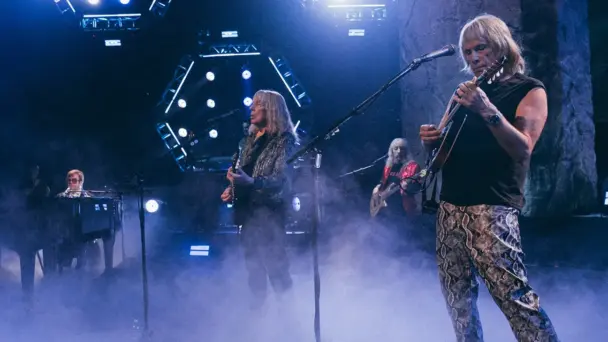
Movie Review: In “Spinal Tap II,” Rob Reiner Turns It Down To Seven in a Leisurely End to a Legendary Career
In an era of sequels no one asked for, “Spinal Tap II: The End Continues” arrived in September of last year—arrived like your aging uncle banging on your door at 3 a.m., insisting he can still party like he did in ’84. And, much like that uncle, the film is both endearing and mildly alarming. You’re glad it showed up, but you keep wondering whether what you’re watching is medically advisable.
“This Is Spinal Tap” (1984), which played this semester at the Wesleyan Film Series, is a mockumentary following the fictional British heavy metal band Spinal Tap, a bunch of middle-aged, spectacularly delusional musicians, as they embark on a disastrously mismanaged American tour. Filmmaker Marty DiBergi (portrayed by the late director Rob Reiner himself) documents every misstep, from shrinking audiences to exploding drummers to the infamous 18-inch Stonehenge stage-prop fiasco, while capturing the band’s hilariously inflated egos, questionable songwriting skills, and total obliviousness to their own steady decline. The film mocked rock-star pretensions and the absurdity of the music industry, all while showcasing the unmistakable deadpan dynamic of its main trio: David St. Hubbins (Michael McKean), Nigel Tufnel (Christopher Guest), and Derek Smalls (Harry Shearer), men whose amplifiers might go to eleven but whose self-awareness rarely rises above one.
From the opening moments of “Spinal Tap II: The End Continues,” it’s evident the band members haven’t matured since the first movie over the past forty years. While they have aged significantly, it is unclear whether the members of Spinal Tap have acknowledged this. For the sequel, the filmmakers have doubled down on what made the band iconic: sheer, unstoppable incompetence. These men are not just out of touch with modern music; they are out of touch with the modern world. Derek Smalls still seems confused by doorknobs. David St. Hubbins approaches technology as if it might bite him. Nigel Tufnel seems to have achieved a Buddhist level of enlightenment by simply forgetting things as soon as he learns them.
If the point of a sequel is to spend a little more time with characters you love, to see what they’ve become, and to watch them stumble through a world they’re no longer built for (or is no longer built for them), then “Spinal Tap II: The End Continues” hits the mark. It’s a final encore: wobbly, imperfect, and delivered by men who may collapse backstage afterward, but charming all the same. And that, oddly enough, works. Up to a point. As David St. Hubbins says in the first film, “There’s such a fine line between stupid and clever.” This becomes self-evident in the sequel.
The first film’s mockumentary style returns, and with it returns the uncomfortable intimacy of watching a band implode in slow motion. The sole reason for this reunion is that the band has one final show written in their contract. They’re not here because they want to be, and you can tell. Nigel and David can’t get along, and they won’t attempt to mend their relationship until the end of the movie because both of them have the stubbornness of toddlers. Derek kind of just sits there with his array of neon bass guitars. The venue they snagged had an opening because “An Evening with Stormy Daniels” was conveniently cancelled. They are not being set up to succeed, but that’s where the humor comes from.
The comedy in the film shines brightest when the band half-heartedly attempts to reinvent themselves for Gen Z. Watching these men try to understand anything invented after 1993 is gold. Their new manager, who tellingly doesn’t care about music at all, tries to get them to adopt Gen Z aesthetics, sounds, and digital habits, but the band remains proudly stuck in their ways. This stubbornness becomes the joke: they’re trying to survive in a musical world that’s changed far more than they have. But the film’s approach is less about truly transforming Spinal Tap into a band that Gen Z can relate to and more about poking fun at the idea of trying. The satire of contemporary music culture is one of the movie’s clearest attempts to connect with younger audiences. It’s hard to say if it succeeds; the film seems more interested in using generational differences as comedic contrast than in actually closing that gap.
The sequel often retreats into nostalgia, leaning heavily on callbacks, recycled punchlines, and self-referential winks meant for longtime fans. A few of these moments feel so painfully deliberate you can practically hear the movie going, “Remember this?” That strategy may delight older viewers, but it undermines the film’s attempt to reach younger ones, who may lack emotional investment in the original jokes. Yet this tension ultimately reinforces the movie’s underlying point: Spinal Tap cannot evolve because their inability to evolve is the joke. The result is a film that uses Gen Z references not as a bridge to a new audience, but as another backdrop against which the band’s eternal cluelessness can play out, proving that some things, for better or worse, never change. Indeed, this movie could not stand alone. If you didn’t know these characters previously, you would think that a bunch of old men got together to make a mediocre film just because they could. And in some ways, that is exactly what happens.
The first movie was such a groundbreaking hit that they managed to get away with a weak plot and even weaker jokes. The sequel offers very little of the sharpness or cultural bite the first film held. It comes across as more of “old friends having fun again” rather than “mockumentary deconstructing rock culture.” This sequel is really a nostalgia trip, and while there’s nothing wrong with that, you have to wonder who the nostalgia trip is actually for. Is it for the actors themselves, or for the people who saw the original movie back in the ’80s? Or is it for people like me, teenage old souls who were brought up on this movie and quote it on a regular basis? Of the three possible audiences, it is probably least effective in connecting with mine.
The biggest question surrounding this film is: Is it necessary? The short answer is no. Why mess with perfection, right? But was the sequel to the 2003 hit “Freaky Friday,” “Freakier Friday,” necessary? Not particularly. Many sequels are made purely because the filmmakers and studios know they can make a pretty penny off of them. Most often, it isn’t nearly as good as the original, but that doesn’t stop fans from watching it with the naive hope that it will be. Here’s where “Spinal Tap II” is different. The film’s tone is basically: We know we can’t top the original, but we can at least trip over it in an entertaining way.
The film isn’t all slapstick and malfunctioning equipment, however. Where “Spinal Tap II” genuinely succeeds—and occasionally surprises—is in its moments of accidental poignancy. Beneath the chaos lies something resembling heart. These men may be ridiculous, but their loyalty to one another (and their refusal to acknowledge medical advice) is oddly touching. There’s something beautiful about a group so committed to their delusions that you start rooting for them to pull it off, at least once more, before gravity finally wins.
Of course, not everything lands. Some jokes arrive slower than the band members walk. The pacing of the film is bumpy to say the least, which is considerably more noticeable due to the avalanche of iconic scenes the original film gave us. The sequel has sequences that you wish the editor had made the executive decision to cut. We don’t need to see Nigel on FaceTime with his girlfriend more than once. But even the weaker moments maintain a charm because, ultimately, we care about these characters.
The film tries to make up for its lack of originality through cameos. Big-name musicians appear to praise the band with such intensity you begin to wonder if they’re being blackmailed off-camera (or, more likely, they’re just big fans of the original). Sir Paul McCartney deems their lyrics in “Big Bottom” to be “literature” and even “educational.” If educational in this sense means they taught future bands what not to do when writing lyrics, then Paul is absolutely correct. Elton John shows up and gushes about playing with Tap: “It was an honor. It was like having your first hit record.” He may have changed his mind after Tap’s tone deaf manager told him he thought there was “too much piano.”
By the final concert, everything has gone wrong in ways both expected and delightfully unexpected. Instruments fail. Stage props misfire. David accuses Nigel of sleeping with his wife back in the ’80s. Nigel’s pedal board is making sounds that are offensive to both music itself and to David, who orders him to kill whatever noise he’s making. But the band soldiers on, and the crowd, swept up in a combination of nostalgia, concern, and genuine bafflement, cheers them to the end.
And isn’t that, ultimately, the magic? “Spinal Tap II” doesn’t recapture the lightning of the original, but it does capture something equally special: the joy of watching three aging rockers refuse to accept reality with such enthusiasm that reality just shrugs and lets them proceed. The film may or may not end with all of them in the hospital, but at least they went down doing what they do best.
The release of “Spinal Tap II” in 2025 now carries an even deeper, more somber context, because it stands as the final completed work from the legendary filmmaker Rob Reiner, who was tragically killed—alongside his wife, Michele—later that same year in what authorities have described as a fatal stabbing at their Brentwood home. Reiner’s influence on comedy and cinema was vast: He helped pioneer the mockumentary format with “This Is Spinal Tap,” directed beloved classics like “Stand by Me,” “The Princess Bride,” and “When Harry Met Sally,” and demonstrated a rare blend of humor, heart, and human insight throughout his career. In light of his death, returning to Tap feels almost like saying goodbye not just to these fictional characters, but to one of the creative forces who made their world feel alive. Reiner’s legacy—one where absurdity and affection coexist—reminds us why artists like him matter: Because they help us laugh with life even when it doesn’t make sense.
Edie Anderson can be reached at emanderson@wesleyan.edu.

Leave a Reply