
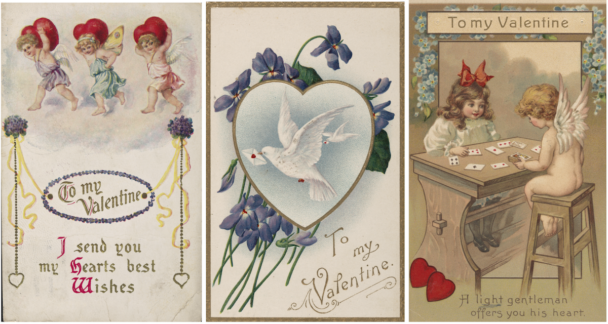
From The Argives: Cute, Concerning, and Creepy Student Love Poems From the 1800s
Love, longing, and lament lend themselves well to poetry, as the Argives know well. Valentine’s Day is approaching, and there is no better time to revive the most passionate verses of The Argus’ bygone poetry column, a cornerstone of the paper’s earliest days.
Week by week, students’ sonnets recalled their reeling love plots; successful, sorrowful, and scandalous alike. The unfamiliar, arguably stilted style of these poems certainly reveals their age, and their content makes the absence of women from Wesleyan University’s student body (save 1872–1909) abundantly apparent. Even so, these colloquial, jocular pieces provide a unique look into the earliest days of Wesleyan’s campus culture, and the Valentine’s Day conversations that may have been taking place.
If Cupid is making this February a lonely one, you can always air out your woes in the pages of The Argus. This seems to be a long-standing tradition among students at the University, especially popular around Valentine’s Day. On Feb. 18, 1888, The Argus printed a number of uncredited poems lamenting unrequited love.
One poem titled “A Bill(e)t Due” reads as follows,
“The day of good Saint Valentine,
As ancient tales relate,
Was once the time when every bird
Chose for itself a mate.
So I that day, in ardent mood, By way of Valentine,
Sent to my girl a billet-doux, Asking her to be mine.”
All seems well so far.
“Next day, the postman brought to me
A dainty envelope,
Enclosing, as I doubted not,
Assurance of my hope.
With eager hands I opened it
To feast my eyes upon
The precious words—to my disgust
It was a tailor’s dun.”
A tailor’s dun, whatever its meaning, was certainly a disappointment.
“Alas! alas! that cruel fate
Should thus possess the power
To change a hoped-for billet-doux
Into a billet-sour.”
Still, the brave poet stuck the landing with an apt summary of his situation.
“Sum folks gits valentines
And sum gits nun;
Last year I cent a norful thing;
This year I don’t send Ⅰ.”
“A Billet Doux,” dreadful as it may be, was not enough trouble for The Argus’ 1888 Valentine’s Day issue. Another uncredited poem ran in the neighbouring column:
“There was a young girl at De Pauw
Got mashed on a student of Lauw;
She always cried ‘Cæsar’
When he tried to sqæsar,
And smashed him right under the jauw.”
The Argus published a similar languishing “love” poem on Dec. 19, 1887, which described another unsavory interaction.
“‘Give me a kiss, my darling, do,’” the poet wrote,
“He said as he gazed in her eyes so blue,
‘I won’t,’ she said; ‘you lazy elf,
Screw up your lips and help yourself.’”
The Argus also included another student’s work titled “Understood” in this issue, which spoke from a woman’s perspective on these fraught romantic relationships. The Argus did not name the poem’s author in the paper, so it is unclear whether the writer was indeed a woman.
“He was surprised at my nay, but I’m sure I looked yea:
How provoking men are when they’re going away.
I know I was pretty—why did he delay?
He was surprised at my nay, but I’m sure I looked yea.
Some men are so dense—but ’twas different next day,
When I shyly said yes as he was going away.
The horrid wretch! What did he say?
‘Last night you declined; now it’s my turn for nay.’”
Wesleyan was one of several universities publishing this genre of pining poetry. The Argus reprinted one such piece from an unnamed author at Yale University in the same Dec. 19, 1887 issue:
“Eyes half reproachful on me bend,
And in those true eyes tear drops glister;
But when she said I might enlist her
As my adviser, champion, friend,
I couldn’t help it,—I just kissed her,
You think ’twas wrong? Well, she’s my sister.”
However, The Argus focused on poems from Wesleyan students and showcased their writing in practically every issue from the 19th century. During this time, women made up an exceedingly small proportion of the Wesleyan student body, which is more than apparent in “The Bell(e)s,” the poem featured on the front page of The Argus’ June 11, 1868 issue, written by F. D. H. (whose full name is not given).
“See the ladies so-called belles!
Pretty belles!
What a storm of merriment their prettiness impels!
How they te-he, te-he, te-he,
At a silly little sight,
While they sit and chat so freely
On a subject e’er so silly
With a wonderful delight.”
The poet warned, however, of a kind of belle far less delightful.
“See another kind of belles,
Spinster belles!” the author wrote.
“What a world of happiness this cross old class dispels!
Never bear the horrid sight
That’s the pretty belles’ delight […]
What a rush of gossip most slanderously wells!
How it swells!
How it dwells
On their neighbors! How it sells
Them to the De’il who impels
To the sinning and the ringing
Of such belles, belles, belles.”
Despite what this trove of tragic works suggests, The Argus featured cheerful love poems just as often as these sorrowful sonnets. “An Autumn Leaf,” for instance, published in the Dec. 19, 1887 issue, includes some swoon-worthy lines sure to woo anyone’s Valentine.
“‘You are the autumn leaf,’ said he,” wrote Williams Weekly.
“‘And my arms are the book, you know,
So I’ll put the leaf in the book, you see,
And tenderly press it, so.’
The maiden looked up with a glance demure
And blushes her fair cheeks wore,
As she softly whispered, ‘The leaf I’m sure
Needs pressing a little more.’”
Clearly, the Argives boast a wealth of wisdom in the art of wooing. On Oct. 24, 1876, The Argus praised a poem written by an anonymous undergraduate student, which was packed with advice for Wesleyan singles.
“We would like to introduce our pet poet,” The Argus wrote to preface the poem, “in a few verses containing some very sage advice—advice which we are bound to believe is both sounder and more likely to be eagerly followed…[than any poems] running the rounds of the comic and tragic press alike.”
“Kiss, boys, kiss; kiss with care,” the author wrote,
“Kiss every lass that is debonnaire;
Kiss all the cheeks that are plump and fair,
And give the rosy lips their share.
Let prudent mammies fume and flare[…]
Let doting daddies curse and swear,
But kiss, boys, kiss, what need you care?
Then kiss, boys, kiss, if kiss you dare[…]
And give the rosy cheeks their share!”
The Argus’ editors were thoroughly impressed.
“Are not our praises just?” The Argus wrote in an appendix to the poem. “Boys, take the advice, and follow it to the full!”
The Argus’ earliest editors were, in a way, Wesleyan’s top wingmen, and were willing to leverage students’ love lives to boost readership of The Argus. The editors published a note on Nov. 25, 1884, promoting The Argus student body.
“The Argus is pained to see the strange lack of interest in literature manifested by ’[18]88,” the editors wrote. “Is it a fact that the class is to be known as muscular instead of intellectual? We fear so.”
The editors cited statistics indicating The Argus’ dwindling popularity.
“Only about 50 per cent of the freshmen have yet subscribed to The Argus,” the editors wrote, “[…]and in the case of the seniors (oh, men of brain!) more than 91.5 per cent are subscribers.”
A solution was clearly needed.
“Perhaps ’88 has not realized that The Argus is a most powerful agent for mental and moral improvement, the promotion of good health, and the consummation of love plots,” the editors wrote. “Let us explain: The mental benefits of reading The Argus are obvious. Again, our subscribers learn patience as they wait for delayed issues[….] From laughing at the jokes, a good digestion is promoted, ensuring health.”
But what does good health matter without someone to share it with? Fear not, Wesleyan: The Argus is at hand.
“Send The Argus to your girl,” the editors wrote. “We can write up the incidents of college life in better style than you can; our print is easier for her to read than your flowing hand; the time you have been spending in writing these things can be put on the ‘sweet nothings’ which every girl loves to read. Do this, and be happy.”
If The Argus (somehow) fails to ignite your Valentine’s affections, the paper still makes for a handy bouquet wrap.
Hope Cognata can be reached at hcognata@wesleyan.edu.



Leave a Reply